AdBlue Freezing: Cold-Morning Warnings and Heater Faults
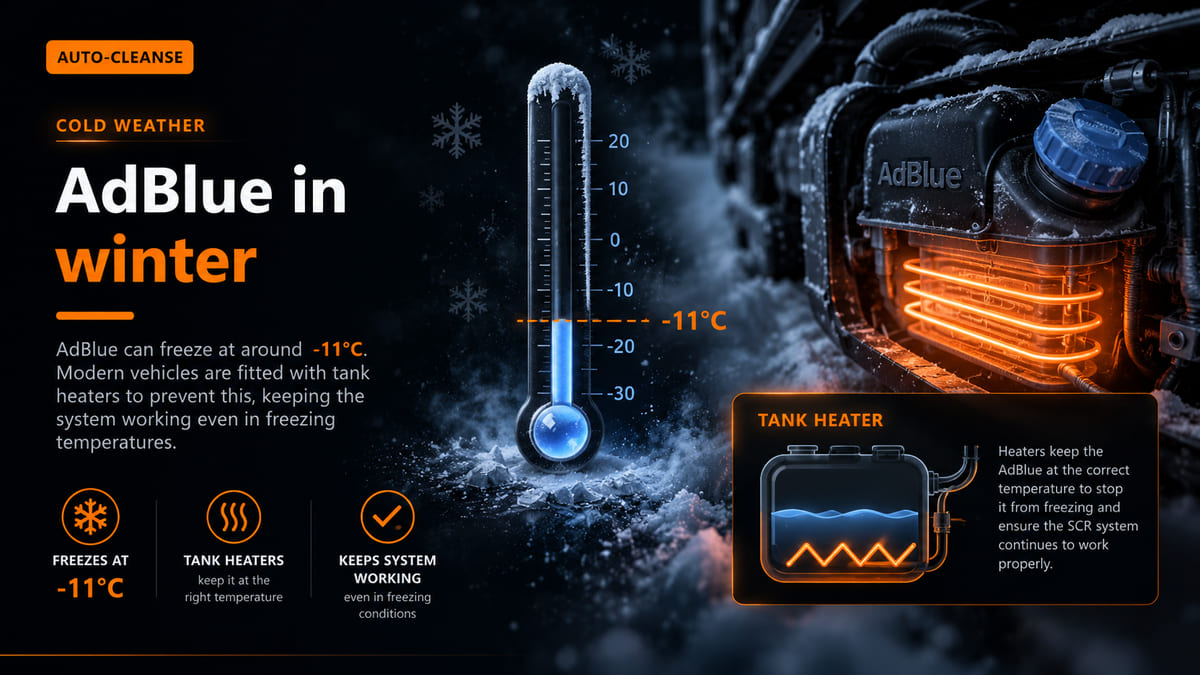
AdBlue freezing is normal in winter. It starts to freeze at about minus 11°C, and SCR systems are built for it: the tank, pump and lines are typically heated, so on many vehicles you can start and drive as normal while the heaters thaw it.
What does go wrong in winter is the equipment that deals with the cold: heater circuits, sensors trying to read part-frozen fluid, and pumps that can't prime. Those faults tend to appear on a frosty morning and vanish by lunchtime, which is exactly why they get ignored.
Frozen AdBlue is normal. A cold-morning warning that keeps coming back is not, so get the heating side tested.
AdBlue freezing: what temperature does it freeze at?
AdBlue is a 32.5 per cent urea solution in demineralised water, and it freezes at about minus 11°C. Mazda's handbook and Mercedes-Benz service information both give that figure. That strength is the urea-water mix with the lowest freezing point, so diluted or off-specification fluid starts to freeze at a higher temperature, one more reason never to dilute it.
It expands as it freezes, which is one reason not to overfill the tank.
Freezing doesn't harm the fluid. Mercedes-Benz notes that freeze-thaw does not degrade uncontaminated AdBlue, and Yara says frozen AdBlue can be used once it has thawed because it returns to its original state.
So a warning on a morning only just below freezing is unlikely to be frozen fluid. Look at the heater circuit, a sensor or the fluid quality instead.
Can I drive with frozen AdBlue?
On many vehicles, yes. You start and drive as normal while the heaters thaw enough fluid for the system to prime and begin dosing, and your handbook will say if your vehicle shows a message while that happens. If a warning stays on after the vehicle has had a proper run and warmed through, that is a fault to get checked.
Don't leave it there. On cars and light vans, if AdBlue dosing is interrupted and not restored within 50 km of the warning, the type-approval rules bring in driver inducement, such as a countdown to no restart or a speed limit. A heater fault that stops dosing can escalate that way, so get it tested while the vehicle still starts. Our AdBlue countdown and no-start guide explains each stage.
How the system copes with AdBlue freezing
SCR systems deal with freezing in three main ways:
- Heaters. On many systems the tank, the pump or supply module and the lines are heated, and Volkswagen describes an automatic heating system that keeps AdBlue at its operating temperature.
- Purging the lines. Some systems, such as Bosch's Denoxtronic 2.2 (common on heavy-duty, farm and construction machinery), draw AdBlue out of the line and back into the tank after the engine is switched off, so fluid can't freeze in place. Pico Technology also describes heater elements on that system's pipework, tank and supply module.
- Type-approval targets. For cars and light vans, manufacturers must take measures to stop AdBlue freezing completely during up to seven days parked at minus 15°C with a half-full tank. If it does freeze, it must be liquid and ready for use within 20 minutes of starting. Heavy-duty vehicles follow separate rules.
Why does my AdBlue warning come on in cold weather?
The giveaway is timing: the fault appears in a cold snap and clears once the vehicle warms through.
Heater element and heater circuit faults
If a heater element fails, or its circuit is broken by an open circuit, a corroded connector, a failed relay or a blown fuse, the fluid stays frozen and the pump can't prime. The generic code P20B9 means Reductant Heater "A" Control Circuit/Open, and the codes that follow it, P20BA to P20BC, cover the same heater's performance and low or high circuit faults. Makes log their own heater codes too. It needs testing with the heater commanded on, not a code clear.
On many Peugeot, Citroen, DS and Vauxhall diesels the heater is built into the AdBlue tank assembly with the pump and sensors, so a heater fault in a cold snap can end in a "Starting impossible" countdown. Some of these vehicles can still get a Stellantis contribution towards the tank, so ask a franchised dealer first. Our Peugeot, Citroen and Vauxhall AdBlue tank guide explains the cover.
Pump and pressure faults that only show when cold
A pump that can't draw from a frozen or part-frozen tank, or a weak pump that copes in summer, can set a low-pressure fault on cold mornings. Our guide to fault code P20E8 explains how pressure and dosing are tested.
Level and quality readings that go wrong when frozen
Mercedes-Benz service information for the Sprinter notes that frozen or partly frozen AdBlue can make the level reading inaccurate. The steps are to check for newer SCR software, let the vehicle thaw somewhere warm, then recheck before replacing anything.
A quality reading taken from part-frozen fluid can mislead too, which is why our guide to fault code P204F tests the fluid only once the tank has thawed and been mixed by driving.
Crystallisation from short, cold runs
Short trips in cold weather keep the exhaust cool, which is when urea deposits build up faster than exhaust heat can clear them. Our post on AdBlue crystallisation and dosing faults explains why.
Common misdiagnosis: "It came on in the frost, so the pump has failed." Cold-only faults can be a heater circuit, a connector or a sensor reading frozen fluid, so test the heating side before buying a pump or a tank.
What not to do in cold weather
- Never add antifreeze, alcohol, water or any additive to AdBlue. Volkswagen's guidance is not to put antifreeze or any other fluid in the AdBlue tank, and Mazda's handbook says not to add any fluid other than AdBlue or dilute it with water.
- Don't pour hot water over the tank, lines or connectors. Water around wiring and plugs is the last thing a heater circuit needs, and Mercedes-Benz's thaw step for the Sprinter is simply to let the vehicle stand somewhere warm.
- Don't top up in a hard frost. Mazda advises moving the vehicle somewhere warm to add AdBlue at minus 11°C or below, because part-frozen fluid may not flow and the right amount may not go in.
AdBlue in winter: checks for drivers and fleets
- Don't go into a cold spell on the last warning. Top up beforehand, and follow the handbook on how full to fill it.
- Keep spare AdBlue frost-free. Yara recommends 0 to 30°C, sealed and out of direct sunlight, and says it keeps for up to a year that way. A garage or van below minus 11°C will freeze it, which does no harm once it thaws but means you can't pour it until then. Heat, not cold, is what shortens its shelf life.
- Report cold-morning warnings the same day, with a photo of the dash, the outside temperature and whether the warning clears once the vehicle warms up. Don't keep clearing the code: the pattern is the clue.
- Get the heater circuits tested on any vehicle with a history of winter warnings, before the coldest weeks.
- On a fleet, compare vehicles. One van with cold-morning faults is a heater question. Several at once after topping up from the same supply is a fluid question.
How Auto-Cleanse can help
If an AdBlue warning keeps coming back in the cold, we diagnose and repair AdBlue systems nationally: our own technicians in Devon and, elsewhere, an independent mobile technician from our national network, booked through us. If we can't cover your area, we say so. Call or WhatsApp 07823 649190 with your reg, the dash message, the outside temperature and whether it cleared once warm. We triage by phone, tell you who will attend and agree the price before any repair.
In Devon we offer AdBlue repair from Totnes or mobile anywhere in the county.
Frequently asked questions
Should I fill my AdBlue tank right up in winter?
Not to the brim. AdBlue expands as it freezes, so avoid overfilling and follow your handbook on how full to fill it. Don't go into a cold spell on the last warning.
How long does frozen AdBlue take to thaw?
On cars and light vans the type-approval rules require it to be liquid and ready for use within 20 minutes of starting at minus 15°C. Heavy-duty vehicles follow separate rules.
Does frozen AdBlue go off?
No. Mercedes-Benz and Yara both say uncontaminated AdBlue returns to normal once thawed. Recheck any quality reading taken while it was part-frozen.
Can I add antifreeze to AdBlue?
No. Manufacturers say to put nothing but AdBlue in the tank. Antifreeze, alcohol or water changes the fluid the system is calibrated for and can set quality faults or damage parts.
The takeaway
AdBlue freezes at about minus 11°C and the system is designed to cope, so frozen fluid alone isn't a fault. Warnings that keep returning in the cold are worth testing: heaters, wiring and sensors come first, and left alone they can escalate. Add nothing to the tank, and get cold-only faults tested before you buy parts.
Sources
- UK legislation - Commission Regulation (EU) 2017/1151, Annex XVI: reagent system operating conditions, including freezing and driver inducement
- Mercedes-Benz AG - service information LI49.20-N-078838 and LI49.20-N-080376, AdBlue level and concentration readings in cold weather
- Volkswagen UK and Mazda - owner guidance on AdBlue heating, refilling and fluids
- Yara - AdBlue technical information on freezing, thawing and storage
- Pico Technology - Bosch Denoxtronic 2.2 guided test (AGT 903) and technical support notes
- SAE International - J2012 diagnostic trouble code definitions
General technical guidance only. Manufacturer-specific handbook information, workshop procedures and specifications always take precedence.
Need help with this on your vehicle?
Auto-Cleanse can sort it. See our Adblue Repair service, or get in touch.
Related: Adblue Fault Codes/P20e8 · Adblue Warning Light