AdBlue Crystallisation and Dosing Faults
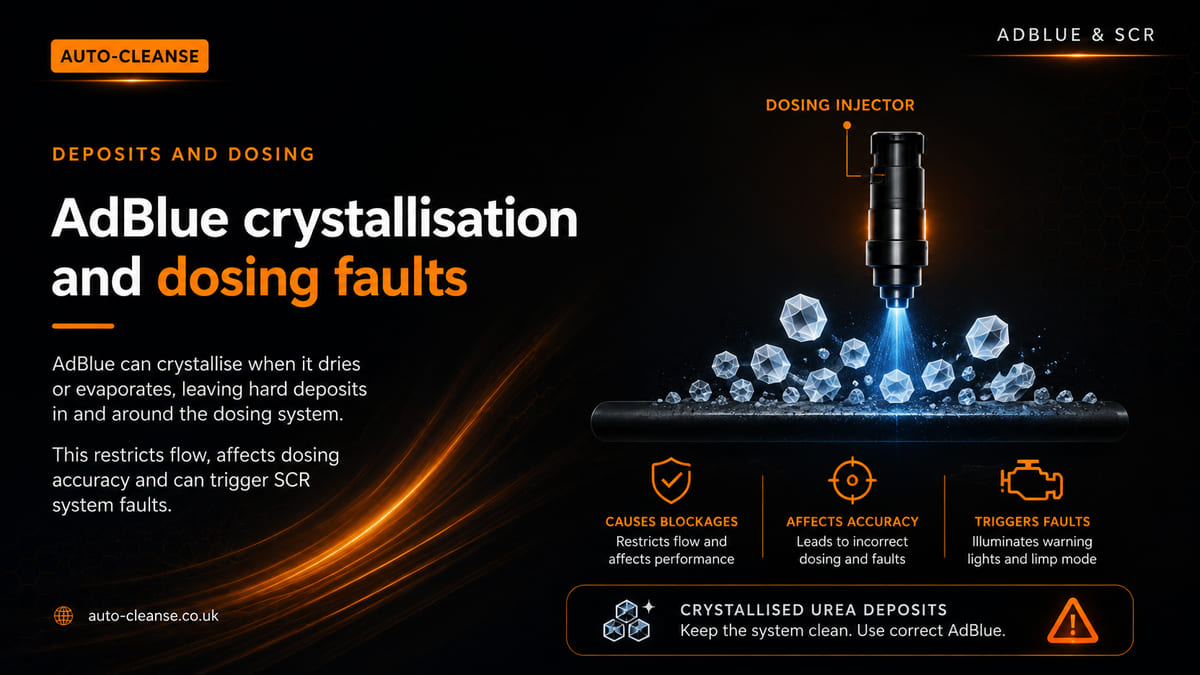
AdBlue systems fail in fairly predictable ways. The fluid is simple, but it is metered into a hot exhaust in small, precisely controlled quantities, and almost anything upsetting that balance leaves a white or pale-yellow crystalline deposit behind. Deposits then restrict the injector, spoil the spray pattern and push the system further out of specification, producing more deposit.
That makes crystallisation a symptom far more often than a cause. Cleaning it away without establishing why it formed buys a short reprieve and nothing more.
Crystallised urea is the evidence, not the fault - something allowed it to form.
Why urea crystallises
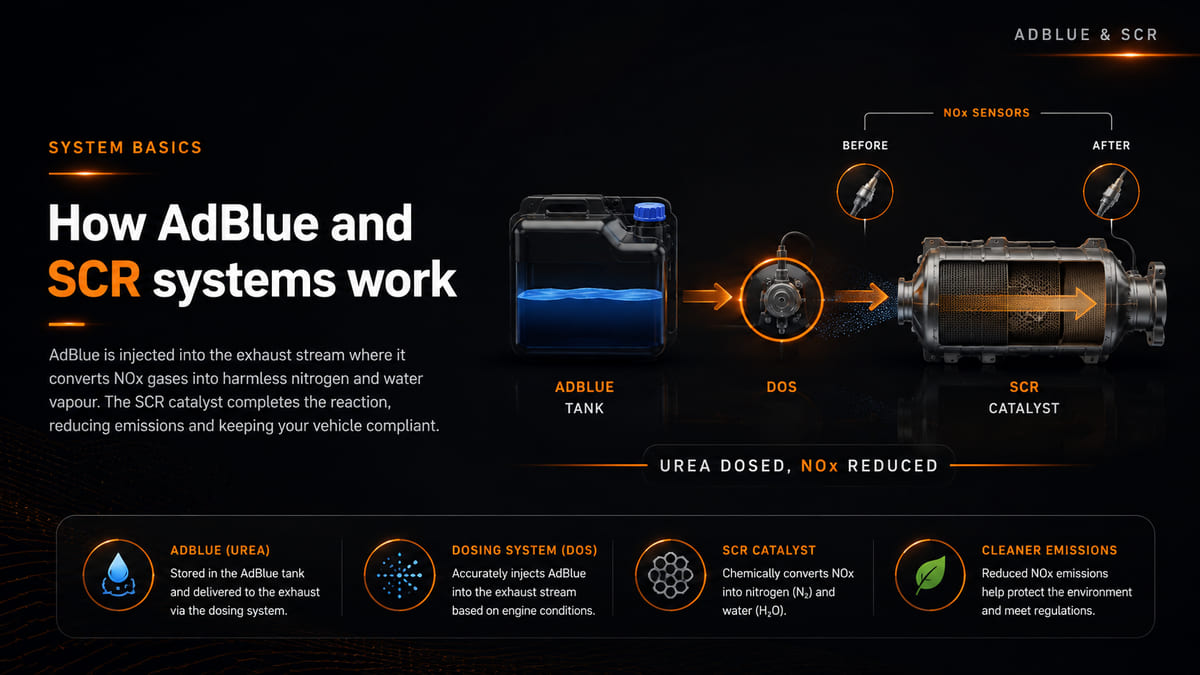
AdBlue is a urea solution in demineralised water, made to the AUS 32 specification. It is injected upstream of the SCR catalyst, where the water evaporates and the urea decomposes to ammonia, which then reacts with oxides of nitrogen.
That decomposition needs three things: enough heat, good atomisation, and a dose the exhaust can actually evaporate. Remove any one of them and the water leaves while solid urea and its by-products stay behind. Repeated heat cycles bake those solids into a hard, chalky crust.
Deposits collect in predictable places: the injector tip and mounting boss, the exhaust wall or mixer opposite the spray, line unions and the pump or filter area, and the tank, fill neck and level or quality sensor.
What causes it
Leaks and weeping joints
Any seepage at a union, seal, line or injector mounting dries into crystal almost immediately in a warm engine bay. A visible white trail is a useful clue, because it points at the leak path rather than at the SCR catalyst.
Poor-quality or contaminated fluid
AdBlue is easily spoiled. Diesel, oil, dust, screenwash, tap water or a dirty funnel will put the fluid out of specification and leave residues the exhaust cannot deal with. Contamination also damages the pump, filter and injector long before the driver notices a warning.
Incorrect dosing
If the system meters too much fluid, or delivers it at the wrong moment, the excess cannot be evaporated. Injector wear, a failing pump, incorrect pressure build-up, or implausible temperature or NOx sensor data can all shift dosing away from what the calibration intended.
Low exhaust temperature and short journeys
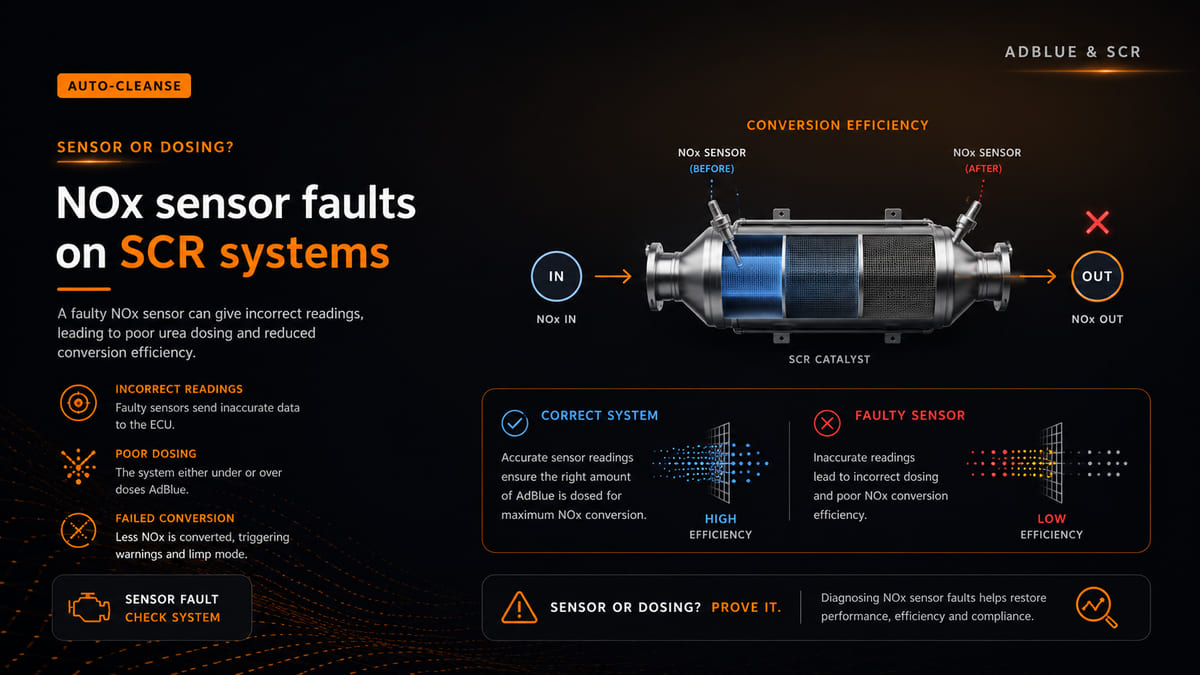
Urea decomposition only works properly above a reasonable exhaust temperature. A vehicle used mainly for short, cold, low-load journeys spends much of its life below that point, so deposits build up faster than exhaust heat can clear them. The duty cycle that causes repeat DPF loading tends to cause AdBlue deposits too, which is why the two often turn up together during DPF and emissions diagnostics.
Symptoms and codes
Typical symptoms are a countdown or no-restart warning, an SCR or emissions light, white deposits around the injector or unions, a strong ammonia smell, unusually high or low fluid consumption, and derate or limp behaviour.
On the diagnostic side, expect generic reductant-system and SCR-efficiency codes alongside manufacturer-specific codes for the pump, heater, injector, quality sensor or NOx sensors, with coverage varying between applications. Read stored codes, freeze-frame data and live values before clearing anything, because the order in which faults appeared usually tells you more than the final code.
Common misdiagnosis: "The efficiency code points at the SCR catalyst, so the catalyst is finished." An efficiency fault only says the system is not achieving its target. A leaking union, a crystallised injector, out-of-specification fluid or a failing NOx sensor produces the same complaint at a fraction of the cost.
Why the wrong fluid is damaging
AdBlue is not a general-purpose additive and there is no acceptable substitute. Topping up with water, screenwash, a diluted mixture or a fluid of unknown specification changes the urea concentration the calibration assumes, so the ammonia reaching the catalyst no longer matches what the system believes it has delivered. The wrong fluid can also carry contaminants that attack the pump and injector, and residues that will not decompose cleanly.
Many systems monitor fluid quality directly, others infer it from downstream NOx feedback. Once poor fluid is detected the vehicle typically flags a fault and begins its restriction strategy, and the affected components often need cleaning or replacement rather than a drain and refill.
Heater and pump circuits in cold weather
AdBlue freezes well below zero, and a hard British winter can reach that point. Manufacturers therefore heat the tank, the suction line and often the pump module so the system can thaw and prime after a cold start. Freezing is anticipated in the design and does not in itself damage the vehicle; a failed heater circuit is a different matter.
If a heater element, relay, wiring loom or coolant-valve circuit fails, the fluid stays frozen or only partly thawed and the pump cannot prime and hold pressure. The resulting faults appear only in cold weather and clear once the vehicle warms through, which makes them easy to dismiss. Check heater and pump circuit operation, feed and earth quality and the tank sensors before condemning the dosing module during an AdBlue system repair.
Storage and shelf life
AdBlue has a limited shelf life, and that life shortens if it is stored in direct sunlight or at high temperature. Keep containers sealed and in a cool, shaded place within the manufacturer's stated temperature range, and use dedicated funnels so nothing else finds its way into the tank. Old stock that has spent a summer in a hot workshop or on a van floor is not a safe top-up.
The takeaway
Treat crystallisation as a pointer rather than a diagnosis. Find the leak, the contamination, the dosing error or the temperature problem that allowed the deposit to form, and correct that alongside the clean.
Sources
- Bosch Mobility - urea dosing and SCR exhaust aftertreatment technical information
- HELLA TechWorld - SCR catalytic converters and AdBlue system diagnostics
- Motorservice - exhaust gas aftertreatment and emission control technical information
- DVSA - diesel vehicle emissions and roadworthiness guidance
General technical guidance only. Manufacturer-specific workshop information, test conditions and specifications always take precedence.
Need help with this on your vehicle?
Auto-Cleanse can sort it. See our AdBlue Repair & Diagnostics service, or get in touch.
Related: DPF Diagnostics