How Much AdBlue Should a Vehicle Use?
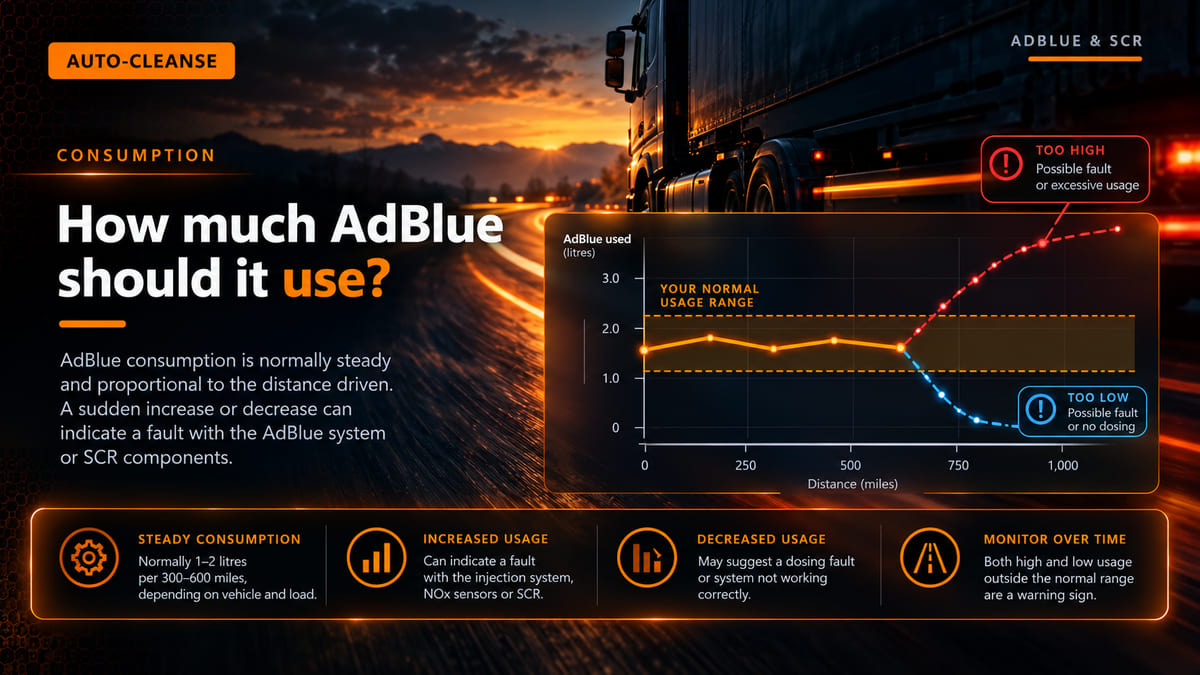
How much AdBlue a vehicle should use depends on its engine, its load and how it is driven: a typical diesel car uses roughly a litre to a litre and a half every 600 miles. Volkswagen quotes about 1.5 litres per 620 miles for a passenger car, and the AA says around a litre every 600 miles, rising to a litre every 350 depending on the car and how it is driven. How long AdBlue lasts depends on the tank: the AA says refills can fall anywhere between 3,000 and 12,000 miles.
Commercial vehicles are usually measured as a share of the diesel they burn, from about 3 per cent for lighter vehicles to about 6 per cent for the heaviest trucks. The figure that matters most is your own vehicle's normal, because AdBlue use is one of the few things an owner can track that can point to a fault in the SCR system.
A sudden change in AdBlue use, up or down, tells you more than any rule of thumb. It can be an early sign of a fault.
How much AdBlue should a vehicle use, and how long should it last?
Treat these published figures as a sense of scale, not a target, because every vehicle differs.
- Per tank (Ford UK): a tank can usually last between 2,330 and 6,835 miles, on AdBlue use of 1 to 6 per cent of diesel use. Ford's short end is a Focus 1.5 diesel and its long end a Transit 2.0 diesel.
- Lighter commercial vehicles: about 3 per cent of diesel use for those under 18 tonnes, on TotalEnergies UK's figures.
- Medium and heavy trucks, and buses: about 5 per cent for medium commercial vehicles and buses, and about 6 per cent for heavy-duty vehicles over 35 tonnes.
How much AdBlue per 1,000 miles?
Converting the car figures above gives roughly 1.7 to 2.9 litres per 1,000 miles. For a van, work from your fuel receipts instead: 3 per cent is 3 litres of AdBlue per 100 litres of diesel, but Ford's Transit sits at the low end of its 1 to 6 per cent range, so your own records will be closer.
What makes AdBlue consumption vary
The system doses AdBlue to match the NOx the engine produces, not the distance travelled. Anything that makes the engine work harder, or produce more NOx, raises consumption.
- Load and towing. A loaded van or a car pulling a trailer makes more NOx per mile, so it doses more.
- Driving style. Volkswagen notes that consumption depends largely on how you drive, and that people who drive particularly fast have to refill more often.
- Journey type and conditions. Volkswagen also lists journey type and environmental conditions. Dosing only starts once the exhaust is warm enough, so town and motorway driving can give different figures.
- The engine and its calibration. Engine size and the manufacturer's software decide how much NOx the SCR system has to clean up, so two models can use very different amounts over the same miles. A remap may give it more NOx to treat, and a working system may then dose more - our post on whether a remap causes DPF or AdBlue problems explains why.
How to find your vehicle's normal
- Read the handbook. It gives the tank capacity, the refill procedure and what each warning means. On many Volkswagen cars the first refill message appears at about 1,500 miles of remaining range.
- Watch the range display. Where the vehicle shows remaining AdBlue range, note it at each refill. It is an estimate, but the trend is useful.
- Keep a log. Write down the date, mileage, litres added and where the AdBlue came from at every refill. After two or three refills, divide each refill's litres by the miles since the previous refill, then multiply by 1,000. For example, 10 litres over 4,000 miles is 2.5 litres per 1,000 miles.
Fill the same way each time so the numbers compare. The vehicle keeps its own figures: the type-approval rules for cars and light vans require AdBlue consumption data for the previous 2,400 km to be available through the diagnostic socket.
Why your log can mislead you
The range display is an estimate, and some vehicles need time, a short drive or a minimum quantity before they register a refill. Our AdBlue warning light guide covers what to check. Level sensing isn't precise either: Mercedes-Benz service information for some recent Sprinter vans notes that one level sensor reads accurately only near the bottom of the tank, and that readings above that can fluctuate, which it calls normal.
The fluid matters too. Buy AdBlue that meets ISO 22241, from a sealed container or a pump. The standard sets the urea content at 32.5 per cent, within 31.8 to 33.2 per cent, and the dosing calculation assumes that concentration, so weak or contaminated fluid can make a healthy system look faulty.
Using too much AdBlue: what it can mean
First check that nothing obvious has changed, such as more towing, heavier loads or a different job. If the work is the same, look at these:
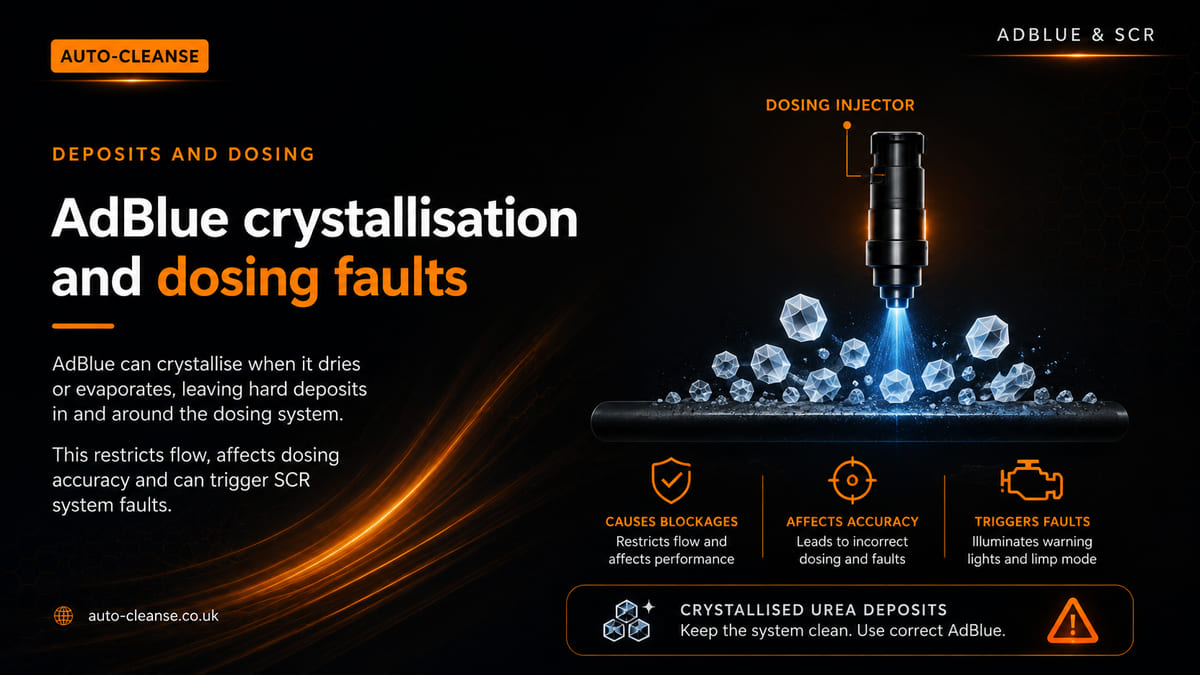
- Leaks. A weeping union, line, pump or injector seal loses fluid that never reaches the exhaust, and often leaves white crystals behind. Our post on AdBlue crystallisation and dosing faults shows where to look.
- A NOx reading fault. On many systems an upstream NOx sensor, or a calculated engine-out figure, feeds the dosing calculation, and a downstream sensor checks the result. A sensor reading high can drive extra dosing. Our guide to NOx sensor diagnosis and replacement explains how that is proved.
- The engine making more NOx. EGR and other engine-side faults change how much NOx the SCR system has to deal with, and dosing rises to match.
The system watches for this itself. Under the type-approval rules for cars and light vans, a difference of more than 50 per cent between the AdBlue actually used and the amount the engine demanded, over 30 minutes of running, has to bring up a warning. If it isn't put right within 50 km (about 30 miles), restrictions such as a no-start countdown follow.
AdBlue barely going down? Why low use can be serious
If the level hardly seems to move and the vehicle's work hasn't changed, don't count it as good economy. It can mean the system has stopped dosing properly, so the NOx is leaving the tailpipe untreated. Common causes:
- A blocked or sticking dosing injector. A dosing quantity test shows it: the injector sprays into a measuring container for a set time and the amount is checked against the manufacturer's figure.
- A pump or pressure fault, where the pump can't build or hold the pressure needed to dose. Our guide to fault code P20E8 covers how that is tested.
- A frozen tank or failed heater, which can stop the system priming in cold weather.
- A level sender stuck on one reading, so fluid is being used but the gauge doesn't show it.
When dosing stops, the NOx after the catalyst rises and the engine computer may log P20EE, SCR efficiency below threshold. The rules also require a warning when dosing is interrupted, with the same 50 km limit before restrictions follow.
Common misdiagnosis: "It hardly uses any AdBlue, so it must be running well." Low use with no change in driving points to less being dosed, or a gauge that isn't reading, not to less being needed.
How Auto-Cleanse can help
If your AdBlue use has changed and you can't see why, call or WhatsApp 07823 649190 with your reg, the dash message and your refill log if you keep one. Our AdBlue repair service covers the UK, with our own technicians in Devon and an independent mobile technician from our national network elsewhere. We triage by phone, tell you who will attend and agree the price before any repair.
Frequently asked questions
How long should AdBlue last in a car?
It depends on the tank size and how the car is driven. The AA says refills can be needed anywhere between 3,000 and 12,000 miles, and that most drivers top up at least once between services.
How many miles will 10 litres of AdBlue last?
On the AA's figures of a litre every 350 to 600 miles, 10 litres covers roughly 3,500 to 6,000 miles, and about 4,100 miles at Volkswagen's 1.5 litres per 620 miles. Fast driving, towing and heavy loads shorten that, so your own log is the real answer.
Why is my AdBlue running out quickly?
Check whether the vehicle's work has changed first. If not, look for leaks and white crystals around the lines, pump and injector, and have the NOx sensor readings checked.
My AdBlue never seems to go down. Is that a problem?
It can be. A level that barely moves can mean the system has stopped dosing or the level sender is stuck. Get the codes read, especially if there is any warning on the dash.
The takeaway
Published figures put a car at about a litre or so of AdBlue every 600 miles and commercial vehicles at about 3 to 6 per cent of their diesel, but your own log is the number that matters. A rise can point to leaks or over-dosing. A fall can mean it has stopped dosing, which is easy to mistake for good economy.
Sources
- Volkswagen UK and Ford UK - AdBlue consumption, tank range, refill warnings and price and specification guides
- The AA - AdBlue consumption and refill intervals
- TotalEnergies UK - AdBlue consumption guide for commercial vehicles and buses
- UK legislation - Commission Regulation (EU) 2017/1151, Annex XVI: reagent consumption and dosing monitoring
- Mercedes-Benz AG - service information LI49.20-N-078838, Sprinter AdBlue level and concentration readings
- ISO - ISO 22241-1, AUS 32 (AdBlue) quality requirements
General technical guidance only. Manufacturer-specific handbook information, workshop procedures and specifications always take precedence.
Need help with this on your vehicle?
Auto-Cleanse can sort it. See our Adblue Repair service, or get in touch.
Related: Adblue Fault Codes/P20ee · Adblue Warning Light