Does My Diesel Use AdBlue? How to Check Your Car
Does my diesel use AdBlue? Yes, if it has a second filler, usually with a blue cap, next to the diesel filler, in the boot or under the bonnet, or if the dashboard can show an AdBlue level or range. "SCR" in the model name is another giveaway. If you still can't tell, the handbook settles it.
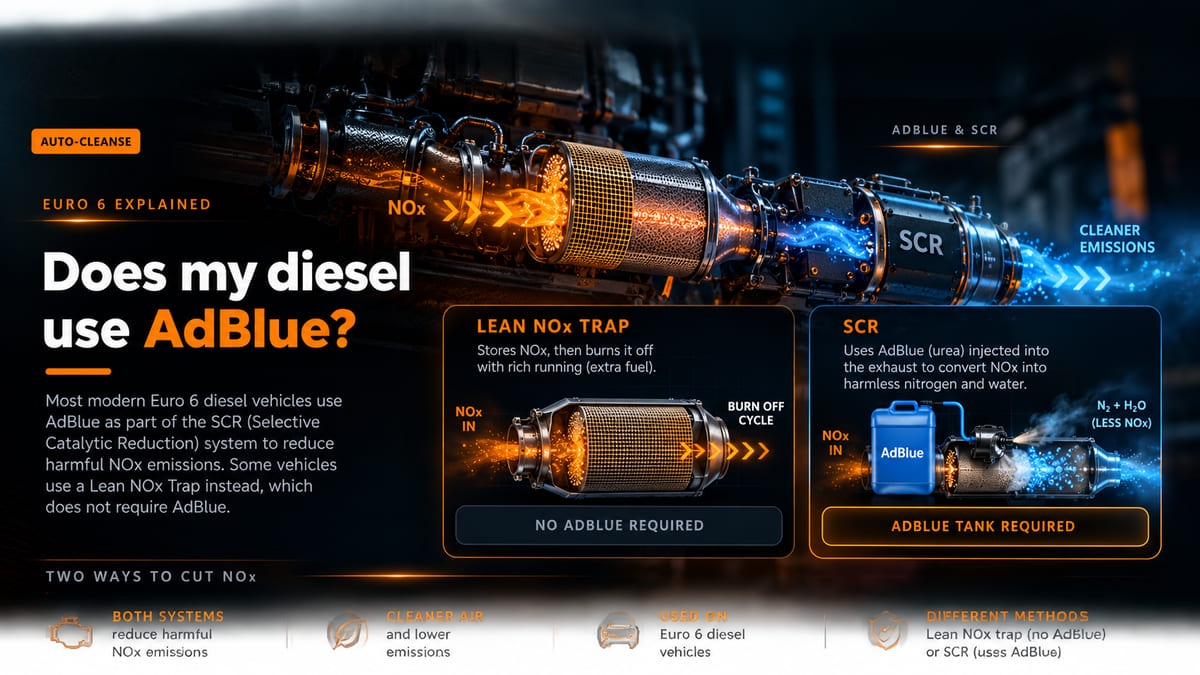
Petrol cars don't use it. Diesels built before Euro 6 mostly don't, many early Euro 6 diesels don't, and it is the usual system on diesels built to the later Euro 6d-TEMP and Euro 6d standards, which applied to all new cars from September 2019 and January 2021. Euro 6 can be met in more than one way, mainly SCR or a lean NOx trap, and only SCR needs a tank of fluid.
A Euro 6 status does not mean AdBlue. Plenty of Euro 6 diesels control their NOx without it.
Does my diesel use AdBlue? Check these in order
- Look for the filler. The AA describes a usually blue cap next to the main diesel filler. If it isn't there, check the boot and under the bonnet. The tank itself often sits under the boot floor.
- Check the badge or engine name. The AA suggests looking for "Blue" or "SCR" in the model name. SCR is the AdBlue system, so that one is a strong sign. "Blue" is only a hint: carwow notes that some newer Volkswagen BlueMotion cars use AdBlue, but the name doesn't imply it.
- Check the display. Vehicles with AdBlue can show its level or remaining range, and warn you when it is getting low. If your trip computer or vehicle menu has an AdBlue entry, you have the system.
- Read the handbook. Look for a section on AdBlue, SCR, urea or diesel exhaust fluid (DEF). No section on AdBlue or refilling usually means no AdBlue tank.
- Check the Euro standard. The DVLA's online vehicle enquiry service can show a vehicle's European emissions status where DVLA holds one, and HMRC's guidance says the V5C shows Euro 6d information for cars registered from 1 September 2018. A status of 6AJ to 6AR means the car meets Euro 6d, where SCR is the usual system. If your car or van is Euro 5, it probably has no AdBlue system, though SCR did appear on certain Euro 5 models. Euro 6 alone doesn't settle it, for the reasons below.
- Ask a franchised dealer. If you are still unsure, they can check from the VIN.
What to do once you know
If it has AdBlue (SCR):
- You will need to top up between services. The AA says most drivers will need to top up at least once between normal service visits.
- Use AdBlue made to ISO 22241, and nothing else.
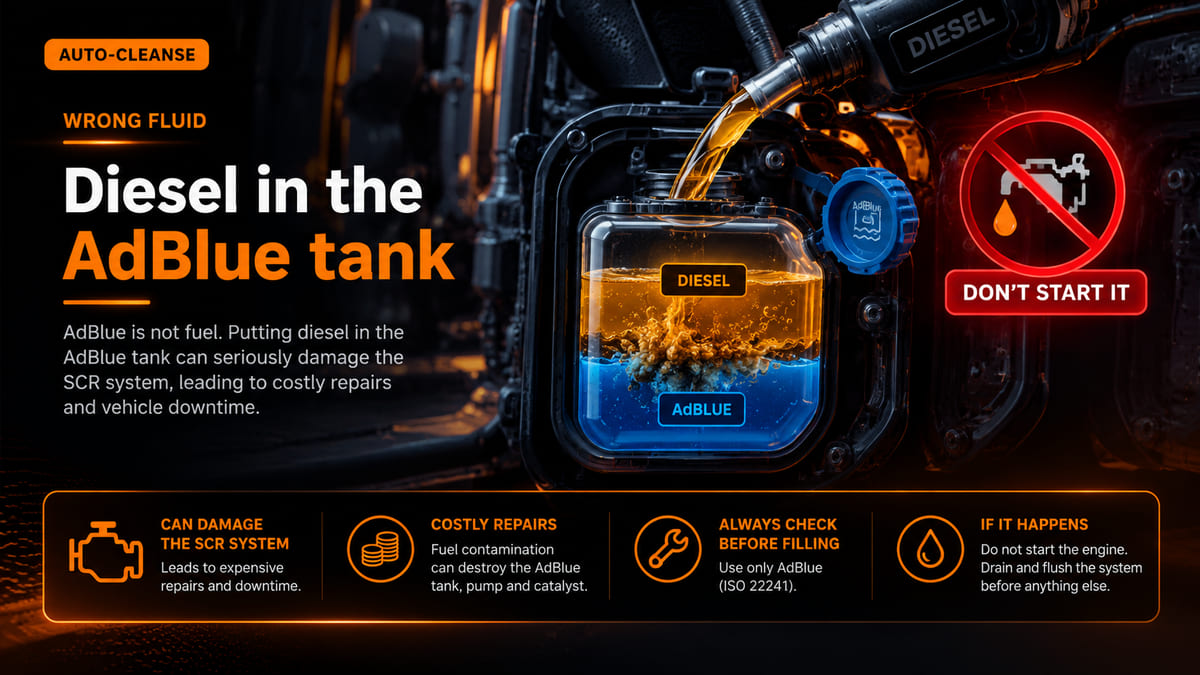
- Only pour it into the AdBlue filler. If it goes into the diesel tank, don't switch on the ignition: the AA says the tank has to be drained and the contents disposed of safely.
- Learn the warnings. Low level, poor fluid and system faults look similar on the dash, and our AdBlue warning light guide explains how to tell them apart.
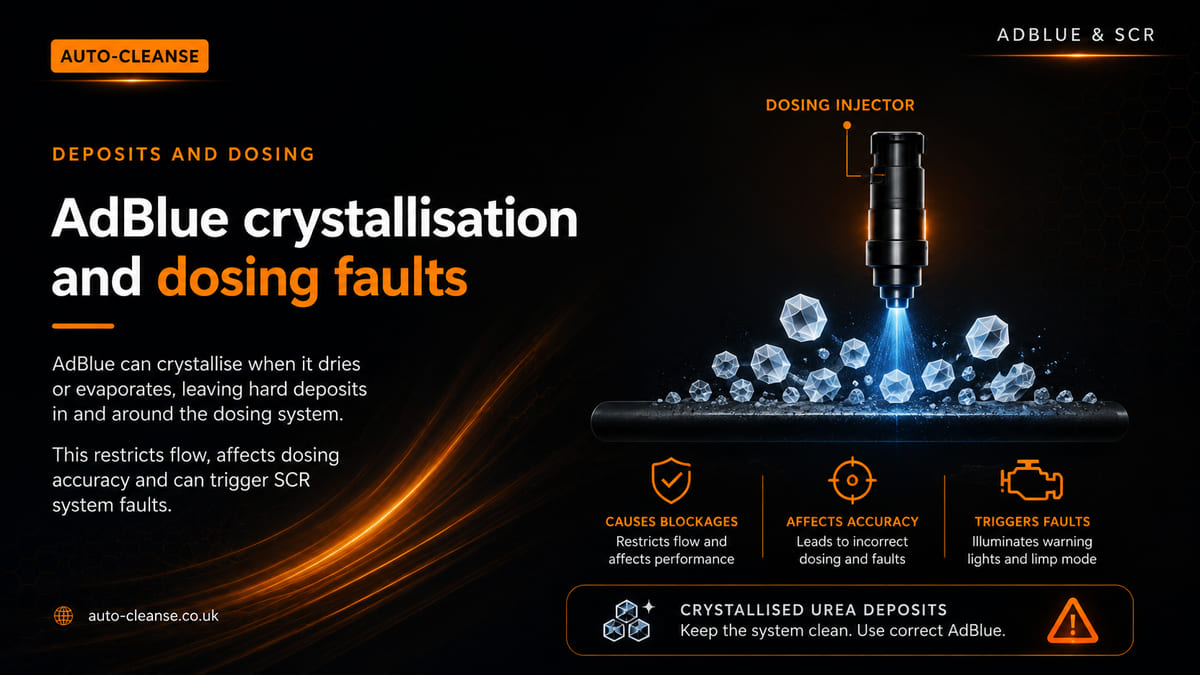
- The system has parts that can fail and need diagnosing: the heaters, pump, dosing injector and NOx sensors.
If it has no AdBlue filler: it doesn't use AdBlue, so there is nothing to top up. Many Euro 6 diesels use a lean NOx trap instead, explained below. Its purges and desulphation cycles run automatically, and the cost shows up as a little extra fuel rather than fluid to buy.
If it has both a trap and SCR, with an AdBlue filler: treat it as an AdBlue vehicle.
Why some Euro 6 diesels have AdBlue and some don't
Euro 6 cut the NOx limit for diesel cars to 80 mg/km, down from 180 mg/km under Euro 5. It applied to new car types from September 2014 and to all new cars from September 2015. For most engines that meant adding dedicated NOx after-treatment, and manufacturers chose between two main technologies.
SCR with AdBlue
Selective catalytic reduction doses AdBlue into the exhaust, where it releases ammonia that converts NOx into nitrogen and water inside a catalyst. In tests of Euro 6 diesels by the International Council on Clean Transportation (ICCT), most SCR cars did better on NOx than trap cars. The ICCT also says a small trap is only the more economical choice on engines below 2 litres, so SCR suits bigger ones. The owner pays differently: AdBlue to buy, a heated tank and lines, and a dosing system to maintain. Our guide to how AdBlue and SCR systems work covers the parts and the warnings.
Lean NOx trap (LNT or NSC)
A lean NOx trap, also called a NOx storage catalyst or NOx adsorber, uses no fluid. During normal running it stores NOx on its catalyst coating. When it is full, the engine management briefly runs the engine rich, with more fuel than the air can burn, and that purge converts the stored NOx to nitrogen. A trap has limits:
- Limited capacity. It can only hold so much NOx before it must purge, and its NOx reduction performance declines at higher exhaust temperatures, which hard, sustained driving produces.
- A fuel penalty. Every purge uses extra fuel.
- Sulphur poisoning. The trap also collects sulphur, which poisons it over time, so it needs a periodic desulphation cycle.
Both together
Some vehicles combine a trap with SCR. Whether one needs AdBlue depends on its design, so the filler is still the real test.
Early Euro 6 cars leaned heavily on traps. The ICCT found that about 55 per cent of Euro 6 diesel cars sold in the EU in 2014 used a trap, a share that had grown fast in only a few years. About 40 per cent used SCR, and about 5 per cent relied on engine design and exhaust gas recirculation instead.
Euro 6 and AdBlue: why SCR became the norm
Early Euro 6 cars were approved on a laboratory test. Real-driving emissions (RDE) testing added an on-road test with portable measuring equipment. It arrived in two steps:
- Euro 6d-TEMP: new car types from 1 September 2017, all new cars from 1 September 2019.
- Euro 6d: new car types from 1 January 2020, all new cars from 1 January 2021.
An on-road test takes in motorway driving as well as urban and rural roads, and a trap loses performance at higher exhaust temperatures. Research on Euro 6d-TEMP cars by the European Commission's Joint Research Centre concluded that meeting the RDE limits pushed manufacturers towards SCR. The later the diesel, the more likely it is to have the blue cap.
Does my van need AdBlue?
Check a van the same way as a car: filler, display, handbook. Vans went through the same Euro 6 stages, but larger vans reached Euro 6 itself about a year after cars, so don't read a van's age against the car dates above. Larger engines tend to favour SCR over a trap, but check rather than assume.
How Auto-Cleanse can help
If your diesel has AdBlue and is showing a warning, we repair AdBlue systems UK-wide through our own technicians in Devon and, elsewhere, an independent mobile technician from our national network, booked through us. Call, WhatsApp or text 07823 649190 and we triage by phone, tell you who will attend, and agree the price before any repair. If we can't cover your area, we say so. In Devon, our AdBlue repair service works from the Totnes workshop or mobile anywhere in the county.
Frequently asked questions
Do all diesel cars use AdBlue?
No. Diesels built before Euro 6 mostly don't, and many early Euro 6 diesels use a lean NOx trap instead. AdBlue became far more common once on-road emissions testing arrived with Euro 6d-TEMP.
What year did diesel cars start using AdBlue?
There isn't one cut-off year. SCR appeared on certain Euro 5 models and became much more common with Euro 6, which was compulsory for all new cars from September 2015, though many early Euro 6 diesels used a trap instead. SCR became the usual system with Euro 6d-TEMP (all new cars from September 2019) and Euro 6d (January 2021), so check the car rather than the year.
Can I tell from the registration whether my car uses AdBlue?
Only partly. The DVLA's vehicle enquiry service can show the Euro status, but Euro 6 alone can go either way. The filler cap, the dashboard or the handbook gives the real answer.
What happens if an AdBlue car runs out?
It warns you well in advance, then counts down towards a restriction. On many vehicles the engine won't restart once the count reaches zero, so top up early. Our guide to the AdBlue countdown and no-start covers what to do if it gets that far.
The takeaway
Look for the blue cap, check the display or read the handbook. Euro 6 diesels can use SCR with AdBlue, a lean NOx trap, or a combination, and SCR has become the usual choice since on-road testing arrived. If yours has an AdBlue filler, buy the right fluid and act on the first warning.
Sources
- ICCT - NOx control technologies for Euro 6 diesel passenger cars (white paper, 2015), and its briefing on heavy-duty and light-duty diesel NOx in the EU (2016)
- European Commission Joint Research Centre - on-road emissions of Euro 6d-TEMP vehicles (SAE technical paper 2020-01-2219)
- The AA - AdBlue guide
- AECC and DieselNet - Euro 6 light-duty implementation dates and limits, and SCR and NOx adsorber technology
- GOV.UK - HMRC guidance on Euro 6d status and the V5C, and the DVLA vehicle enquiry service
- carwow - Volkswagen BlueMotion explainer (2022)
General technical guidance only. Manufacturer-specific handbook information, workshop procedures and specifications always take precedence.
Need help with this on your vehicle?
Auto-Cleanse can sort it. See our Adblue Repair service, or get in touch.
Related: Adblue Warning Light · AdBlue Repair & Diagnostics