NOx Sensor Faults on SCR Systems
Most AdBlue problems reach the driver as a dashboard message and, if they are left unresolved, an inducement countdown. Behind that message is usually a comparison the engine management system is making between two NOx sensors, and the conclusion it has drawn about how well the SCR catalyst is converting.
The awkward part is that those sensors are both the measuring instrument and one of the more common failure items in the system. Once the instrument is in doubt, so is everything it reports.
A NOx reading is evidence, not a diagnosis - it only means something once the sensor itself is known to be sound.
What the NOx sensors actually do
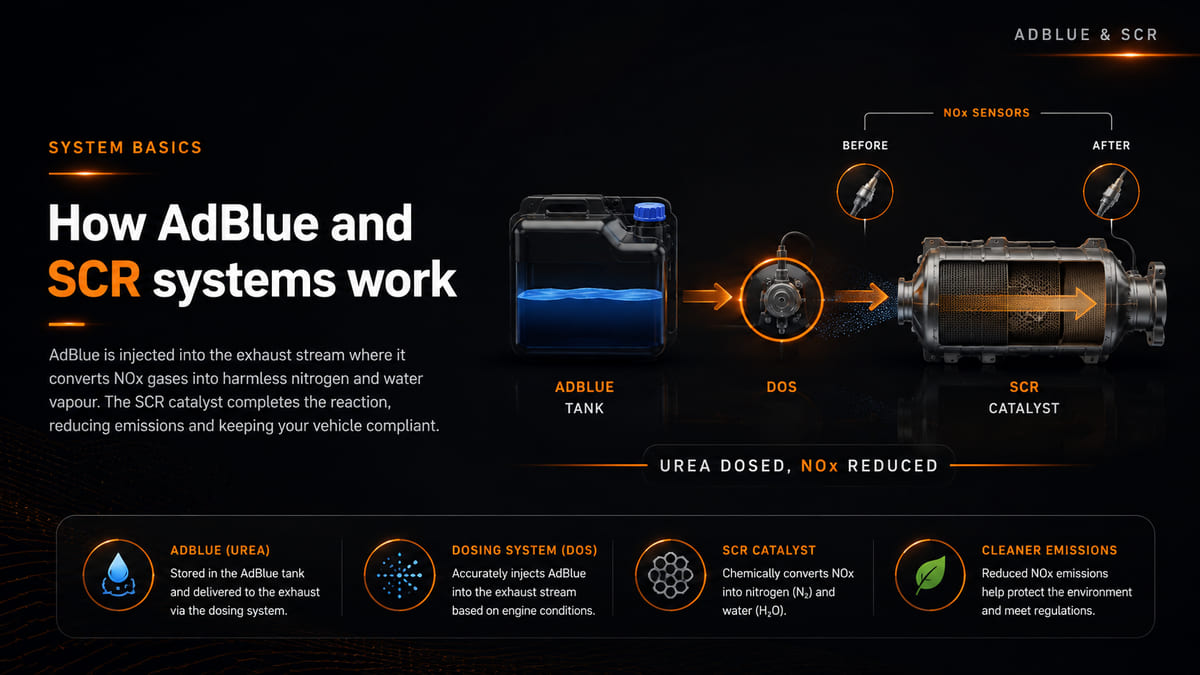
A selective catalytic reduction (SCR) system injects a urea-based reductant ahead of the catalyst, where oxides of nitrogen are converted into nitrogen and water vapour. To know whether that is working, it measures the gas either side of the catalyst.
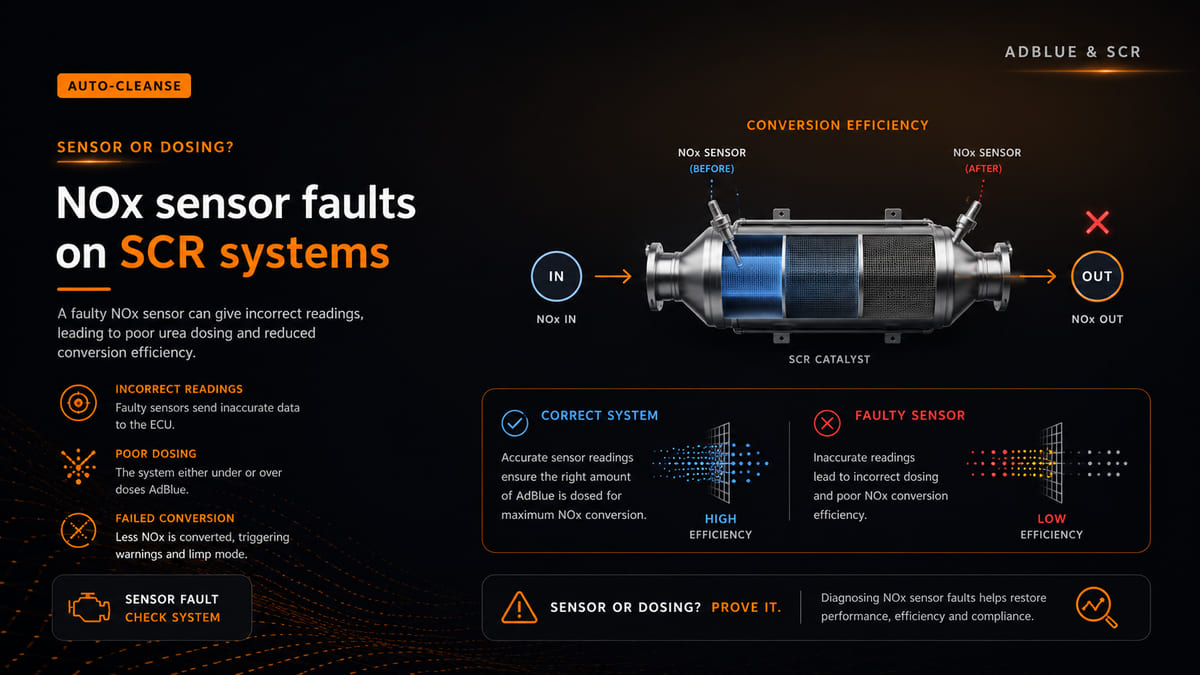
The upstream sensor reports the NOx entering the system; the downstream sensor reports what is left. The upstream value feeds the calculation of how much reductant to inject, while the comparison between the two gives the ECU a conversion efficiency used to correct that dosing and to judge whether the system is working. If efficiency stays below the threshold set for that application, the warning and inducement sequence follows.
Both are heated ceramic sensors with their own small control module, communicating over a data bus rather than as a simple analogue signal. So a sensor can be electrically alive and physically intact yet report nothing usable, because its module has dropped off the bus or its heater has failed.
Why NOx sensors are a common failure item
Heater circuit and thermal stress
The element only works at operating temperature, so each sensor carries a heater, brought up in a controlled way because warming a cold ceramic element while condensation remains in the exhaust risks thermal shock. Heater circuits fail with age and cycle count, and the result is often logged as a sensor performance fault rather than anything obviously heater-related.
Contamination and deposits
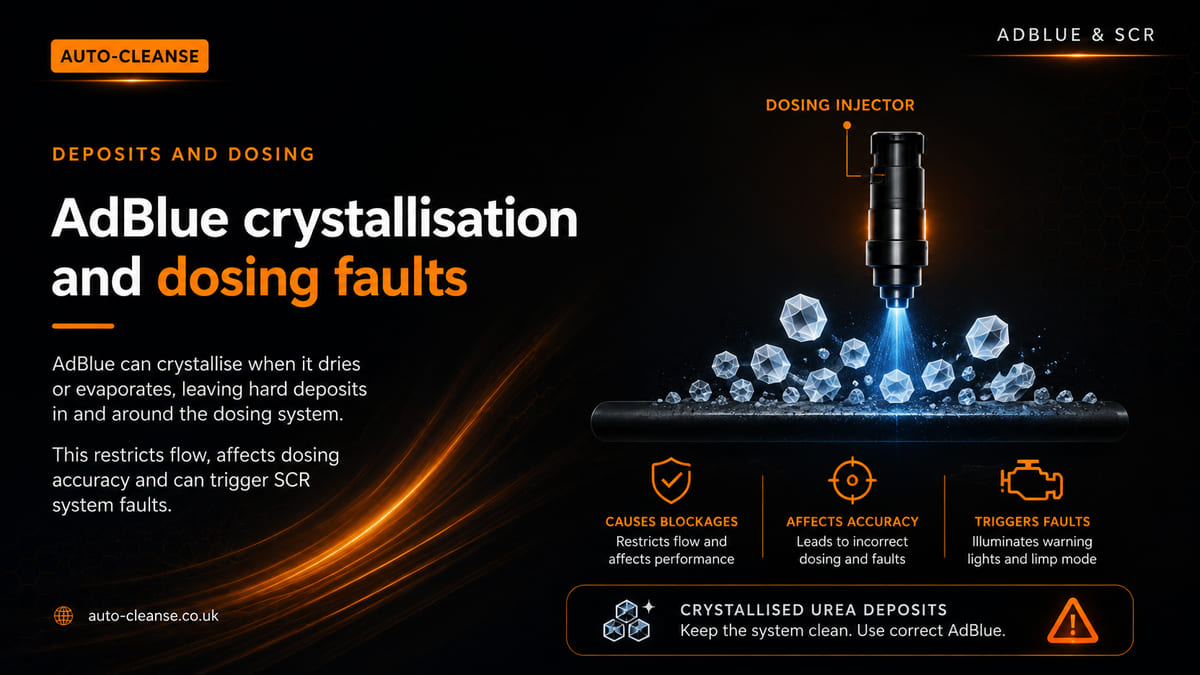
The downstream sensor lives in a harsh environment of hot gas, reductant spray, urea deposits and soot. Deposits on or around the element can slow response, shift readings or block the protective tube. A slow but not dead sensor is the hardest version to catch, because the values still look plausible at idle.
Wiring, connectors and earths
These sensors sit on a long, exposed loom that runs past heat sources and gets disturbed whenever exhaust work is carried out. Chafed insulation, corroded pins, a poor earth or a connector left part-seated after an earlier repair all produce sensor faults without the sensor being faulty.
Cross-sensitivity
Downstream NOx sensors also respond to ammonia. If dosing over-supplies, ammonia slipping past the catalyst raises the downstream reading and makes conversion look worse than it really is. A distortion can run the other way as well, with a slow or drifted sensor flattering a system that is genuinely underperforming.
The symptoms that get reported
- Efficiency codes. SCR conversion-efficiency-below-threshold codes, alongside manufacturer-specific equivalents.
- Sensor circuit and communication codes. Circuit, range, performance or bus faults on either sensor.
- Warning messages and reduced power. An emissions or AdBlue warning, sometimes with a torque limit applied.
- An inducement countdown. Distance or restart-based, ending in a speed limit or a no-start depending on the manufacturer's strategy.
- No obvious driveability change. Many vehicles drive normally until the inducement bites.
Sensor fault or dosing fault?
These are the two most commonly confused SCR diagnoses, and the mix-up runs both ways.
A dosing fault - a blocked or leaking injector, a pressure problem, degraded fluid - genuinely lowers conversion. The sensors correctly report poor efficiency. Replace a sensor here and nothing changes.
A sensor fault produces the same headline symptom from the opposite direction. Dosing may be working as intended, but if a sensor is slow, contaminated, out of range or not communicating, the calculated efficiency is wrong and the system reacts to a measurement problem it cannot tell apart from a real one.
Common misdiagnosis: "The code names the NOx sensor, so the NOx sensor is faulty." The code names the monitor that failed and the circuit it relates to. It does not confirm the sensor is the cause, and says nothing about dosing quantity, reductant quality, exhaust leaks, wiring or catalyst condition.
Assessing the system rather than swapping the sensor
- Record the full picture first. Codes, freeze-frame data and live values from both sensors before anything is cleared.
- Compare the two sensors under known conditions. From cold, and again once both are up to operating temperature and reporting, the two should behave sensibly relative to each other and to engine load.
- Test the electrical side. Supply, earth, bus communication and heater operation, with the loom inspected along its full run, not just at the plug.
- Confirm dosing independently. Reductant quality, dosing quantity and pressure checked against the manufacturer specification - not inferred from the sensors already under suspicion.
- Check the exhaust as a whole. Leaks, a restricted filter or poor temperature control all change what these sensors see, which is why AdBlue and SCR diagnostics and exhaust and DPF diagnostics belong together. Where the filter is restricted, an off-vehicle clean is a separate job, not a substitute for an SCR repair.
- Verify after repair. Run the correct drive cycle or manufacturer routine and confirm the monitor completes and efficiency recovers, rather than clearing the code and hoping.
The takeaway
A NOx sensor fault and an AdBlue dosing fault present almost identically, so the sensor should be judged rather than assumed. Test the measurement chain and the dosing side before any part is replaced - it is the only way to know whether a new sensor is the repair or just an expensive way of ruling one thing out.
Sources
- Bosch Mobility - diesel engine management and exhaust gas sensor technical information
- HELLA TechWorld - selective catalytic reduction systems and NOx sensor diagnostics
- Denso - exhaust and emissions sensor technical information
- Motorservice - SCR and reductant dosing system technical information
General technical guidance only. Manufacturer-specific workshop information, test conditions and specifications always take precedence.
Need help with this on your vehicle?
Auto-Cleanse can sort it. See our AdBlue Repair & Diagnostics service, or get in touch.
Related: DPF Diagnostics