Diesel in the AdBlue Tank? What Happens and What to Do
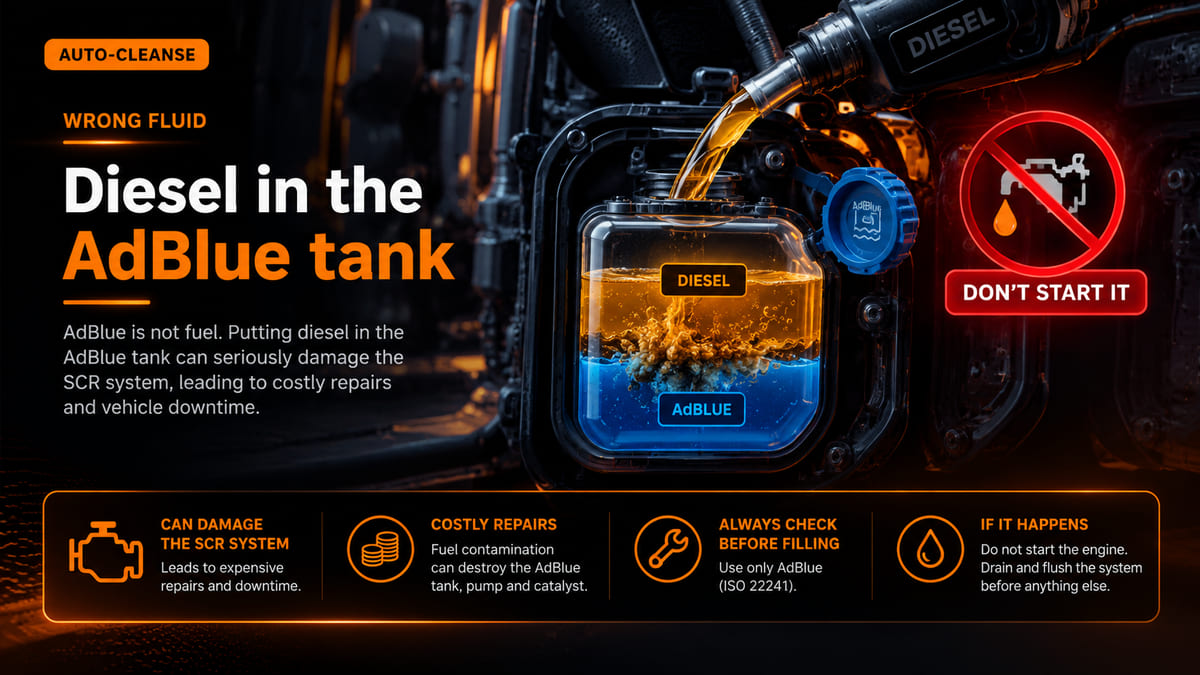
If you've put diesel in the AdBlue tank, don't start the engine, don't switch on the ignition, and don't pour in AdBlue to dilute it. Get the vehicle recovered or a technician to it, so the tank can be drained before the system pumps any of it through. The diesel won't go to the engine, because the AdBlue tank is separate and feeds the exhaust, but it can damage the rubber parts in the AdBlue pump and heater and, once pumped, can reach the dosing injector and SCR catalyst.
Diesel in the AdBlue tank: what to do right now
- Leave the engine off. The AA says not to switch on the ignition or start the engine.
- Get it somewhere safe. If you are on a forecourt, tell the staff. The AA's misfuel advice is to put the vehicle in neutral and get help to move it to a quiet spot. Some automatics and electronic parking brakes may not release with the ignition off, so if that applies, leave it for the recovery operator.
- Don't top up with AdBlue. More AdBlue doesn't dilute the problem. It just means more contaminated fluid to drain.
- Record what happened. What went in, roughly how much, the container it came from, and whether the ignition was on or the engine ran. A photo helps.
- Check your cover. Which? found that misfuel cover is standard on some insurance and breakdown policies, an optional extra on others and not available at all on some. Ask whether yours covers the AdBlue tank as well as the fuel tank.
- Arrange recovery or a technician. Call us on 07823 649190 before anyone starts it: we triage by phone and tell you who will attend. The tank has to be drained, either where the vehicle stands or after it is moved without being started.
Why diesel damages an AdBlue system
AdBlue is urea dissolved in demineralised water, and every part of the AdBlue and SCR system is made for that fluid. Diesel and engine oil are hydrocarbons, and they can damage parts that AdBlue doesn't.
- Seals and rubber parts. A 2016 FCA US (now Stellantis) bulletin for Ram heavy-duty trucks in North America says the rubber in the AdBlue pump module is designed to withstand AdBlue only, and that hydrocarbons such as diesel damage the unit beyond repair. In that failure the rubber heater unit crinkles, and in some cases the metal heater pushes through the rubber.
- The dosing injector and SCR catalyst. If contaminated fluid is pumped through, it can reach the injector and the catalyst. The AA warns that if the engine is started with diesel in the AdBlue tank, the entire SCR and AdBlue injection system might have to be replaced.
Misfuel damage may not be covered by a manufacturer warranty, so check your warranty terms. In North America, for example, that Ram bulletin treats the damage as misuse and says warranty claims for it will be rejected.
Water, coolant or screenwash in the AdBlue tank
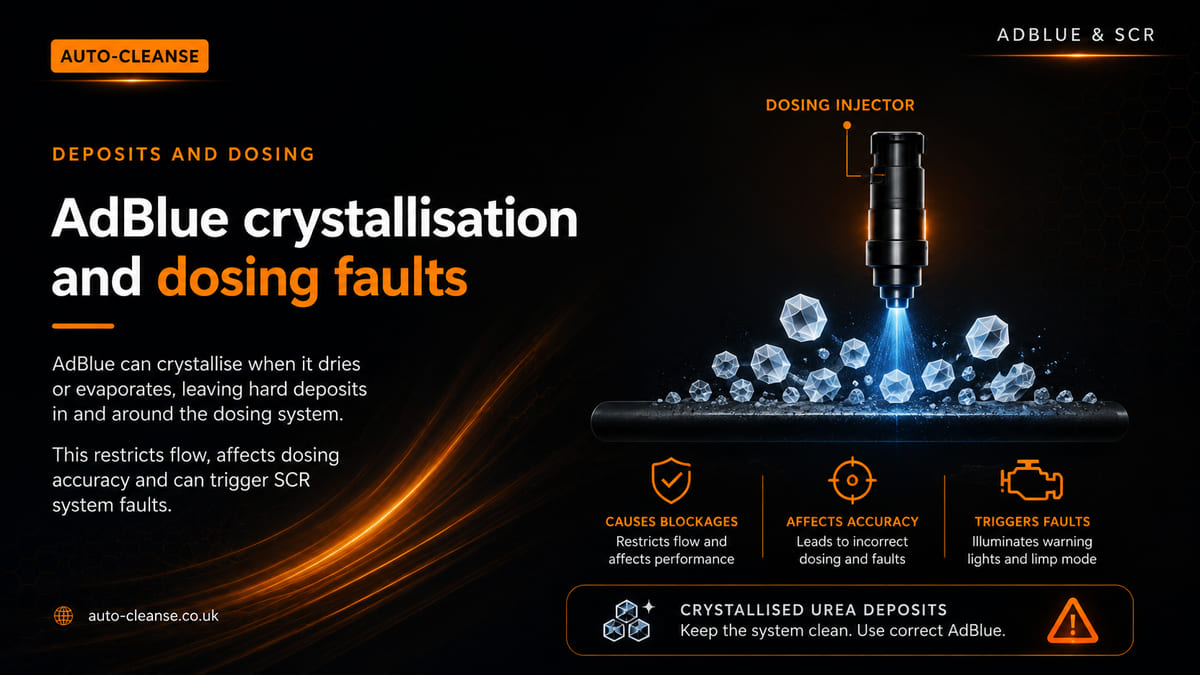
Water dilutes the urea, which ISO 22241 sets at 31.8 to 33.2 per cent by mass, so the system delivers less ammonia than it thinks, as our post on AdBlue crystallisation and dosing faults explains.
Coolant, screenwash and similar fluids bring chemicals the system was never designed for. ISO 22241 limits impurities such as metals and phosphate to tiny traces, so anything else in the tank is contamination.
If you aren't sure what went in, the fluid can be tested, and our guide to fault code P204F explains the refractometer check.
A clean fluid test may not clear a diesel misfill. Stellantis's US service information says its test paper and refractometer may miss small amounts of hydrocarbon that are still enough to cause damage, so the pump module and heater may need inspecting too.
What a proper fix involves
There is no single repair: it depends on what went in and how far it got. The manufacturer's procedure decides, but a sound repair follows the same shape:
- Confirm the contaminant. The fluid is tested and, if diesel or oil is suspected, the pump module and heater are inspected for damage.
- Drain and flush the tank. The contaminated fluid is removed and disposed of properly, and the tank cleaned out.
- Work out what else it reached. If nothing ran, the lines, injector and catalyst may be untouched, though anything sitting in the tank has still been exposed. If the system primed or the engine ran, they come into question too.
- Replace what the procedure says to replace. Where the pump, heater and sensors are built into the tank, the tank assembly is the part. Where hydrocarbon contamination is confirmed, the same Stellantis US service information lists the pump and level module, tank, supply line, filler and vent hoses, cap and dosing injector for replacement.
- Refill, initialise and prove it. Fresh AdBlue, any priming or initialisation routine, clearing codes and any countdown, then a check that the system doses and passes its own tests.
How much does it cost to fix? It depends on whether the engine ran
We don't publish prices, because the cost depends on what happened:
- Whether the ignition was on or the engine started, and for how long.
- What went in, and how much. A splash and a full refill are different jobs.
- How the parts are supplied. A pump sold on its own is a different bill from a complete tank assembly.
- Whether the injector and catalyst were reached.
- Initialisation and software the manufacturer requires afterwards.
To get a price, tell us what went in, roughly how much, whether the ignition was on or the engine ran, and any warnings showing. How we quote explains what happens next, and the price is agreed before any repair.
How to stop it happening
The AA points out that the AdBlue filler cap is smaller than the diesel one, which makes filling it from a diesel pump nozzle less likely. Cans, funnels and containers are where a mix-up can still happen.
- Keep AdBlue in its own labelled container. Never decant it into old diesel or oil cans.
- Use a dedicated spout or bottle. A funnel that has ever held diesel or oil shouldn't go near the AdBlue filler. Check your handbook before using a forecourt pump: Mazda's CX-5 handbook, for one, asks for a bottle with an anti-spill nozzle and warns that a petrol-station dispenser can cause leakage.
- Check the cap before you pour. The AdBlue cap is usually blue. Where both fillers sit under one flap, open one at a time.
- Brief everyone who fills the vehicle, including occasional drivers.
AdBlue in the diesel tank
The opposite mistake needs the same first response: don't start it. The AA warns that starting the engine is likely to mean a big repair bill and advises not to turn on the ignition. General Motors' service guidance explains why on its US diesel models: as soon as the ignition is on, the fuel pump runs and sends the contaminated fuel into the system.
The tank has to be drained and the contents disposed of safely before it is refilled. The AA says its patrols can't remove AdBlue at the roadside because it is corrosive, so a tow to a garage may be needed. This is a fuel-system job for your breakdown provider or a garage.
How Auto-Cleanse can help
We repair AdBlue systems nationally: our own technicians in Devon and, elsewhere, an independent mobile technician from our national network, booked through us, and if we can't cover your area we say so. In Devon our AdBlue repair service works from the Totnes workshop or comes to you anywhere in the county. Either way, the price is agreed before any repair.
Frequently asked questions
Can I drive with diesel in the AdBlue tank?
No. Driving can pump the contaminated fluid through the pump, lines and injector, which can turn a tank clean-out into a much bigger repair. Leave it switched off and arrange recovery or a technician.
I've already started it or driven it. What now?
Stop and switch off as soon as it is safe, which is the AA's general misfuel advice, and don't restart it. Note how long it ran or how far you drove and tell whoever repairs it, because that decides how much of the system needs checking. Don't add AdBlue to try to clear a warning.
Will diesel in the AdBlue tank damage the engine?
Not directly. The AdBlue tank only feeds the exhaust, so pumped diesel goes through the AdBlue pump, lines and injector, not into the engine. The catch is that a damaged AdBlue system can bring on warnings and, left unrepaired, a no-start countdown.
How do I know if diesel has got into the AdBlue?
If you didn't see it go in, you may only find out from a warning. Stellantis's US service information lists the engine warning light, sometimes with an AdBlue service message, and fault codes covering AdBlue pressure, level, tank temperature, heater and pump control. If someone else filled it, or the can or funnel might have held fuel, leave it switched off and get it checked.
The takeaway
Diesel in the AdBlue tank is damage limitation, and the biggest saving comes from what you do first: don't start it, don't dilute it, get it drained. After that, how far the contaminant got decides the repair.
Sources
- The AA - AdBlue advice and wrong fuel guidance
- FCA US and Stellantis US - service bulletin 25-001-16 and STAR case S1425000019, hydrocarbon contamination of the AdBlue system
- General Motors - TechLink, diesel exhaust fluid contamination in the fuel system
- ISO - ISO 22241-1 diesel engines NOx reduction agent AUS 32, quality requirements
- Mazda - owner's manual, AdBlue replenishment
- Which? - misfuelling cover in car insurance and breakdown policies
General technical guidance only. Manufacturer-specific handbook information, workshop procedures and specifications always take precedence.
Need help with this on your vehicle?
Auto-Cleanse can sort it. See our Adblue Repair service, or get in touch.
Related: Adblue Fault Codes/P204f · AdBlue Repair & Diagnostics