

 AdBlue
13 Jul 2026 5 min read
AdBlue Crystallisation and Dosing Faults
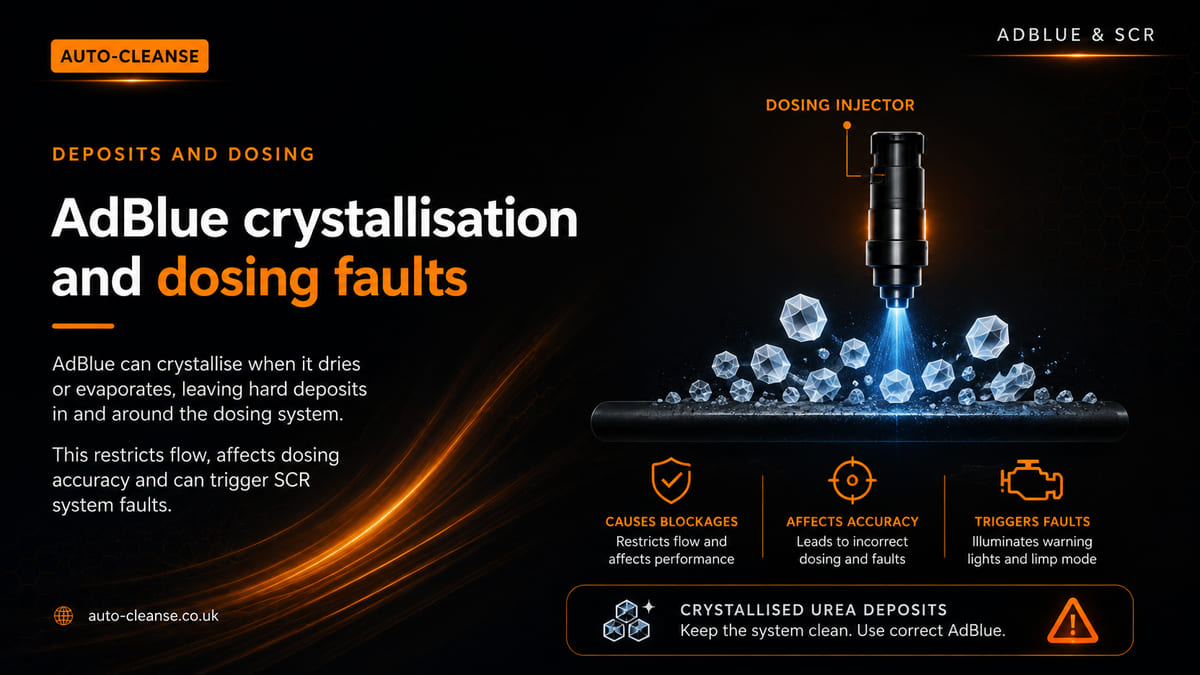
White crystalline deposits around an AdBlue injector are evidence, not the fault. Here is why urea crystallises, what causes it, and what to check.
Read more →A message such as "Starting impossible in X miles" means the AdBlue system is low, has poor fluid or has found a fault, and the vehicle is counting down to the point where it will not restart. Until it reaches zero you can normally still drive, so use those miles to get somewhere safe and book the repair. A top-up only helps if the tank is genuinely low.
Have your reg, the exact dash message and any fault codes to hand. We'll tell you on the call what it's likely to be and what happens next.
Cars and vans that use AdBlue are built to type-approval rules, still part of UK law, which say the vehicle must not keep running without working NOx control. The rules call this a driver inducement system. The countdown is deliberate.
There are two ways in. The first is level: after an earlier low AdBlue warning, the countdown starts once the AdBlue left would only last around a tank of fuel's driving, or less, depending on the make.
The second is a fault. If the system sees fluid that is not to specification, dosing that has stopped, AdBlue use well off what the engine asks for, or too much NOx at the sensors, it warns you first. If it is not put right within 50 km (about 30 miles) of that warning, the countdown starts, set at roughly the distance the vehicle covers on a full tank of fuel.
Some vehicles count down engine starts rather than miles. Others also restrict speed, to no more than 50 km/h (about 30 mph) shortly before restarts are blocked. Heavier vans approved to the heavy-duty standard follow separate rules.
Wording varies by make, model and year. You might see "Starting impossible in X miles", "No start in X miles", "No engine start in X km" or "Engine start not possible". Volkswagen pairs its AdBlue level lamp with "No engine start in XXX km". Mercedes-Benz uses "No start in" with a distance, sometimes alongside "Check AdBlue".
The rules expect the warning to give the reason, such as a low level, incorrect AdBlue or a dosing fault, so read the whole message, not just the number. If it says top up or refill, fluid is the first step. If it mentions a fault or the emissions system, more AdBlue will not clear it. Our AdBlue warning light guide covers the message types in more detail.
The miles left are your window to sort it on your terms.
Record it
Photograph the dash. Note whether it counts miles, kilometres or starts, and how fast it drops.
Top up only if it is low
Add AdBlue if the gauge is low or the message asks for it. Use fluid made to ISO 22241 from a sealed container, never water or additives.
Leave the codes alone
Clearing them fixes nothing, and the countdown comes back if the fault is still there.
Book the repair before zero
A vehicle that still drives gives you far more options than one stuck where it stopped.
If the countdown started soon after a top-up, tell us where that fluid came from. Wrong or contaminated fluid changes the repair.
If the count is in its last few miles, or the van has dropped into a speed-limited mode, treat it as a breakdown. Leave the motorway or fast road at the next exit or service area, and only switch off somewhere you can safely leave the vehicle.
Do not stop on a hard shoulder or verge just to check something. It may not restart, and the Highway Code warns that hard shoulders give less protection than other places to stop.
If it has already stopped somewhere unsafe, follow Highway Code rules 275 to 277: hazard lights on, get out on the side away from traffic if it is safe to, and wait well away from the vehicle, behind a barrier where there is one. If you are stuck in a live lane and cannot get out safely, stay in with your seat belt on and call 999.
Call us once you and any passengers are safe, not before.
Where the system blocks restarts, it does not stop an engine that is already running. The block applies the next time you switch off.
If the tank ran dry, add at least the quantity your handbook gives. The rules let the system stay locked until a set minimum has gone in, and that minimum differs between makes. Park level if you can and follow the handbook's restart steps, as some vehicles need the ignition on for a short time before they read the new level.
If a fault caused it, fluid will not help, and repeated attempts to start can flatten the battery. The fault has to be repaired where the vehicle is, or the vehicle moved to a workshop. In Devon, our own technicians attend. Outside Devon, we book a vetted independent technician near you where we have one, and we'll tell you on the call whether we can get someone to you.
The rules say the restriction must not switch itself off until its cause has been put right. A reset is allowed after a repair, so the vehicle can run up to 50 km (about 30 miles) to confirm it. If the fault is still there, the full restriction comes back.
The vehicle also keeps a record. The reason for each countdown and the distance driven with it active are stored where a code reader cannot erase them, for at least 800 days or 30,000 km. You may also see a code from the P2BA7 to P2BAD group. SAE J2012 titles these "NOx Exceedence" codes by cause, such as "Empty Reagent Tank" or "Insufficient Reagent Quality". They tell you why, not which part failed.
Clearing codes also wipes freeze-frame data, one of the best clues to the real fault. So we do not reset a countdown without repairing the fault. The reset is the last step of the repair, followed by a check that the system is working.
Emulators and deletes are no way round it. Emission control equipment that is missing, obviously modified or obviously defective is a major MOT defect, and DVSA checks lorries at the roadside for emissions cheat devices.
These let us give you a straight answer first time.
We don't put AdBlue repair prices online because the same warning can mean very different repairs. Call with your reg and the warning message and we'll quote for your vehicle. How we quote
In Devon, our own technicians from the Totnes workshop. Outside Devon, we book a vetted independent technician near you where we have one.
Either way you deal with us: we quote, take payment and look after anything afterwards. Call and we'll tell you straight away whether we can get someone to you.
We find the actual fault and fix it, so the vehicle stays road-legal and passes its MOT. We don't remove, disable or emulate AdBlue systems.
Genuine Google feedback on our AdBlue, SCR and diagnostic work.
Very impressed with the professional service offered. They diagnosed and sorted the adblue issues on my car, explained the process well and I believe the price was very reasonable. I would highly recommend them.
I took my VW Golf diesel to AutoClean after it went into limp mode with a flashing glow-plug light and suspected DPF blockage. Tom carried out proper diagnostics and confirmed the DPF itself was healthy. Instead of replacing parts unnecessarily, they identified a faulty DPF differential pressure sensor as the root cause. The issue was explained clearly, the costs were transparent, and the repair was completed promptly. Limp mode resolved immediately and no further work was pushed. I appreciated that they didn't default to a costly DPF removal when it wasn't needed. Good diagnostics, straightforward communication, and a proportionate fix. Would recommend if you're dealing with DPF or emissions-related issues.
Very professional and incredibly helpful services from Tom at Auto-Cleanse, walked me through the findings on the diagnostic tool and thankfully didn't need a DPF clean! Excellent piece of mind and whilst I hope I don't need their services again (!) I will be recommending them to everyone!
It depends on the make, the model and the cause. For a fault, the rules for cars and vans set it at roughly a full tank of fuel's driving, but go by the number on your dash and book the repair early.
Where the system blocks restarts, it stops the next start, not a running engine. Some makes restrict speed near the end, so get off fast roads before the count runs out.
Some vehicles need a minimum quantity, or the ignition left on for a while, before they read the new level. If it still will not clear, a fault is the likely cause and it needs diagnosing.
A code reader may clear the codes, but if the fault is still there the countdown returns, and the vehicle keeps a record you cannot erase.
No. We find and repair the fault first, then reset the system and check the repair has worked.
No. Diluted or wrong fluid can set a quality fault and start a countdown of its own. Only add AdBlue made to ISO 22241.
Get everyone out on the side away from traffic if it is safe, and wait well away from the vehicle, behind the barrier where there is one. Use the emergency phone or a breakdown service to get the vehicle moved, then call us about the repair.
AdBlueWhite crystalline deposits around an AdBlue injector are evidence, not the fault. Here is why urea crystallises, what causes it, and what to check.
Read more →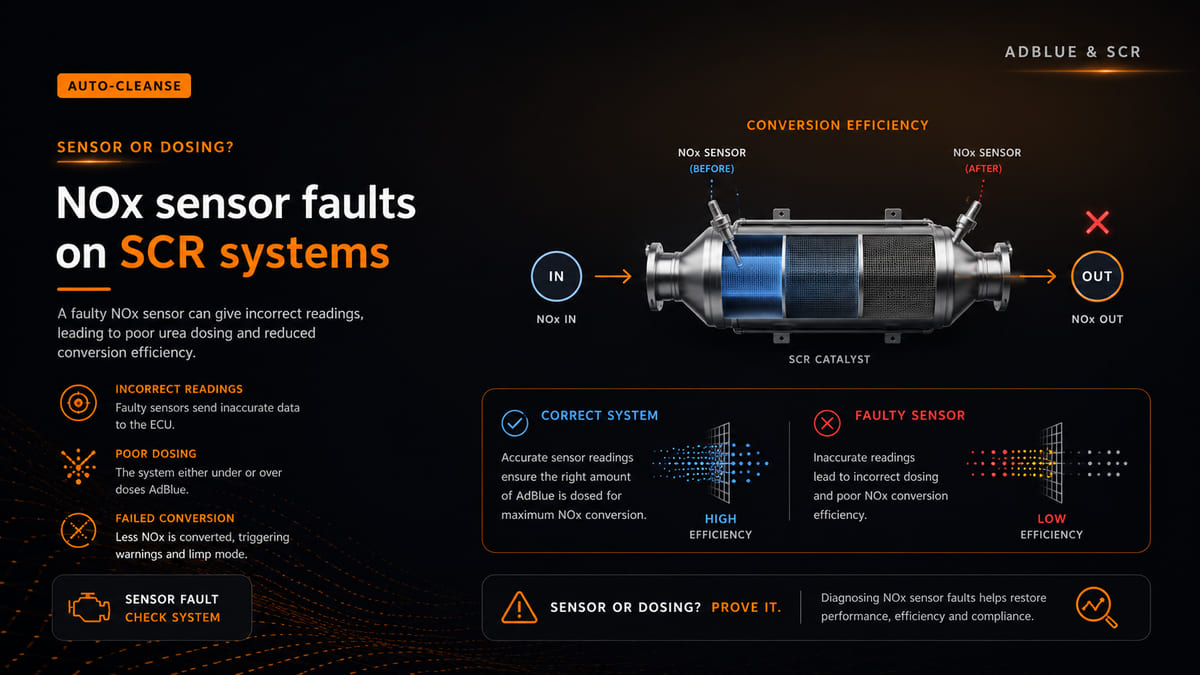 AdBlue
NOx sensors decide whether the SCR system passes or fails its own efficiency check. Here is why they fail, and why swapping one first is rarely the fix.
Read more →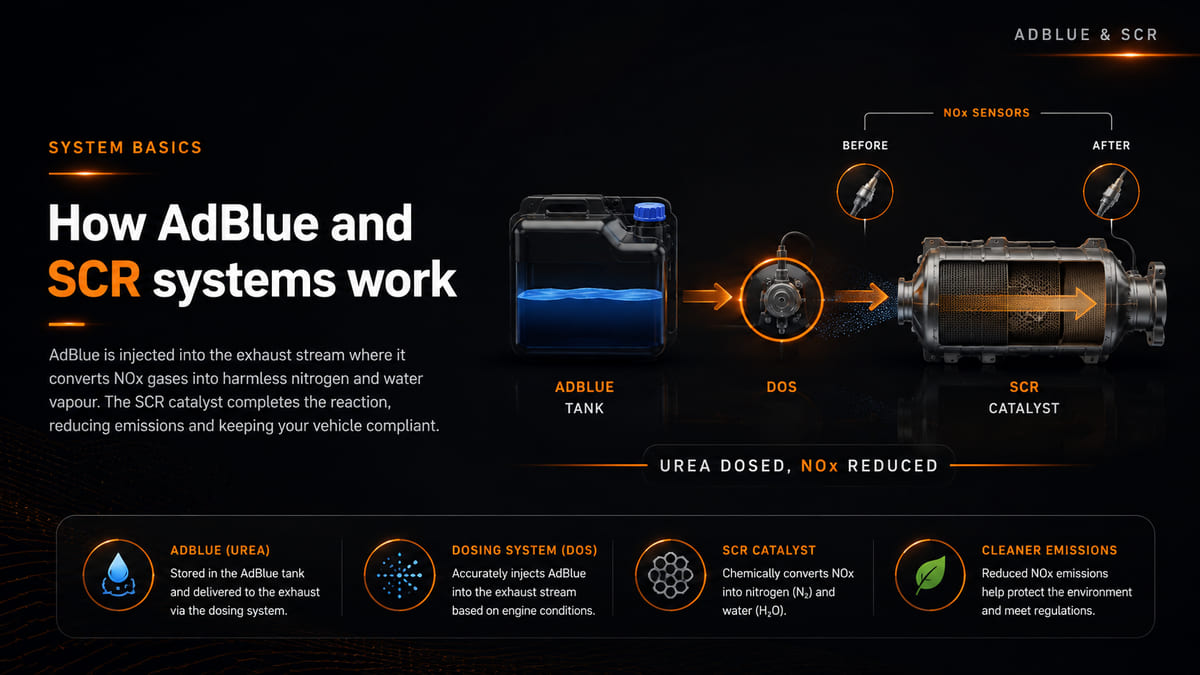 AdBlue
AdBlue is not a fuel additive. Here is how selective catalytic reduction actually works, and why the warnings escalate towards reduced power and no-start.
Read more →Ring with your reg and the warning message. We'll tell you what it's likely to be, who'd come out and what happens next.
Sources
Last reviewed 13 October 2026.