

 AdBlue
13 Jul 2026 5 min read
AdBlue Crystallisation and Dosing Faults
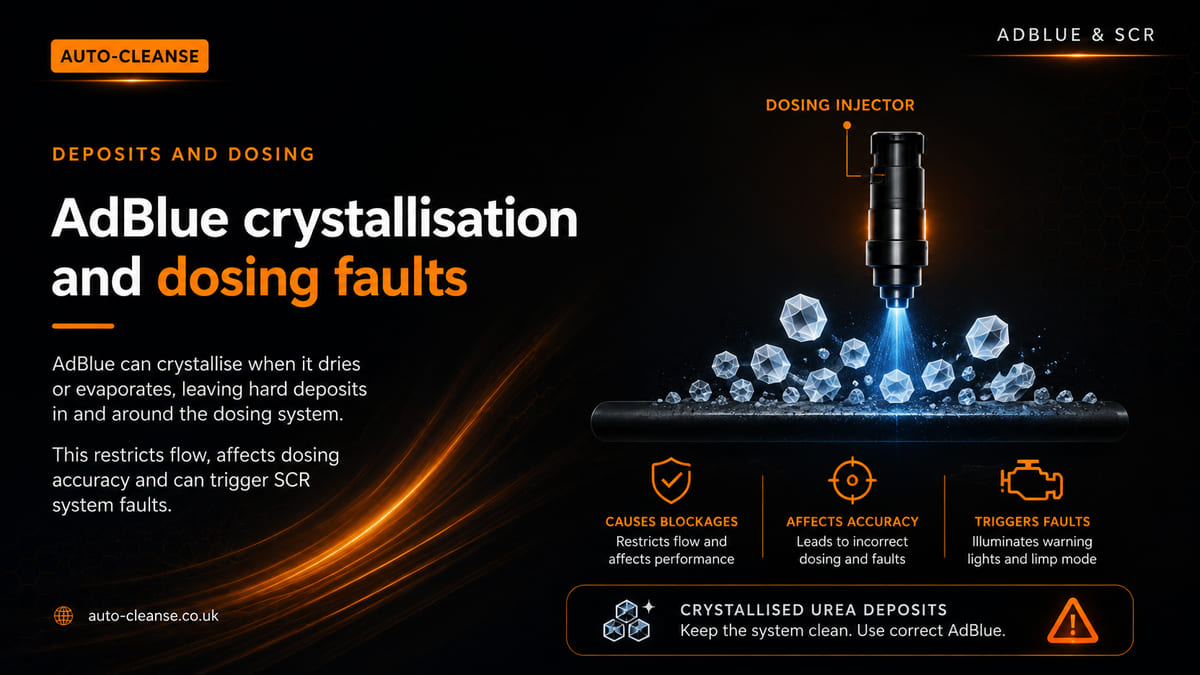
White crystalline deposits around an AdBlue injector are evidence, not the fault. Here is why urea crystallises, what causes it, and what to check.
Read more →An AdBlue delete or emulator is not a legal fix for a road vehicle. It fails the MOT when found, can already be an offence depending on the vehicle, puts your insurance at risk, and the law is expected to tighten in 2027. The legal fix is to repair the fault behind the warning.
Have your reg, the exact dash message and any fault codes to hand. We'll tell you on the call what it's likely to be and what happens next.
Regulation 61A of the Road Vehicles (Construction and Use) Regulations 1986 covers vehicles first used from 1 January 2001. It bans using one on the road if it fails its emissions standard because the engine or exhaust has been altered, or an emission control device is not in good and efficient working order.
Breaking that rule is an offence under section 42 of the Road Traffic Act 1988, for the driver and anyone who causes or permits the use, such as a fleet operator. Sections 75 and 76 cover the work: altering a vehicle, or fitting a part, so that road use would break these rules. In England and Wales both carry an unlimited fine.
There is a gap, and the government admits it. Regulation 61A stops at Euro 4 cars and vans and Euro V lorries. The Department for Transport says there is currently no requirement to keep the emissions control system working on Euro 5 or 6 light vehicles or Euro VI heavy vehicles, which includes Euro 6 AdBlue vans. That is a gap in one regulation, not permission: the MOT, DVSA and insurance points below still apply.
This is general information about the law in Great Britain, not legal advice. Northern Ireland has similar but separate rules. Facing a prosecution or an insurance dispute? Speak to a solicitor.
Vans up to 3,500 kg are tested against the same MOT manual as cars. Emission control equipment fitted by the manufacturer that is missing, obviously modified or obviously defective is a major defect. On diesels first used from 1 July 2008, so is an engine warning light that does not work or shows a malfunction. Either one is a fail.
A pass is not proof that a vehicle is legal. The test only checks what the tester can see and what the vehicle reports on the day.
DVSA added emissions cheat devices to its roadside lorry checks in August 2017, and across Great Britain from September 2018. They include devices that stop the emissions control system working, which is what an AdBlue emulator does. From August to November 2017 examiners found cheat devices on 293 of the 3,735 lorries they searched (DVSA figures).
The driver and operator get 10 days to remove the device and repair the system, or face a fine and a prohibition taking the vehicle off the road. DVSA can refer the operator to the Traffic Commissioners, who can remove an operator's licence.
In February 2025 DVSA said its enforcement teams continue to crack down on garages that offer removal or manipulation of emissions control devices, and that its work on garage services that make a vehicle illegal has led to prosecutions.
Insurers ask about modifications, and a delete or emulator is one. The Financial Ombudsman has backed an insurer that voided a policy over an undisclosed ECU remap and exhaust changes, and says owners should declare modifications even if they were made before they bought the vehicle. If your cover is voided, you can be left paying for a claim yourself, so ask your insurer if you are unsure.
The DfT consultation In-use emissions of road vehicles ran from 6 July to 6 September 2026. It proposes that all road vehicles in use in Great Britain from 1 January 2001 keep their emissions control system working to the standard they were built to, with offences for using such a vehicle, allowing its use, and modifying it or allowing it to be modified.
It lists modifications it would always consider illegal, including SCR manipulation, "often referred to as 'AdBlue Delete'", and EGR manipulation, whether by hardware or software. DVSA would enforce, with the focus likely to be upstream, on where illegal modifications are done. The DfT expects new legislation in summer 2027 and has proposed a six-month lead-in. Its response is not yet published, so treat the detail as proposed.
Some sellers label delete or emulator work "for off-road, export or competition use only". On a van that arrives by road, is taxed and insured, and drives away afterwards, that line does very little.
We repair AdBlue systems. We never delete, emulate or bypass them, and we do not reset a countdown without fixing the cause.
Bought a vehicle that has already been deleted or emulated? Call and tell us what you know, and we will tell you straight away whether we can help put it back to standard.
Read the faults and live data
Codes, NOx readings, dosing, tank and heater data show what the system is really doing.
Find the cause
We test the suspect part and its wiring before anything is ordered.
Repair it
The right part for the vehicle, plus any coding or adaptation it needs.
Confirm, then reset
We check the system works before any countdown is reset. A reset without a repair just brings the warning back.
We don't put AdBlue repair prices online because the same warning can mean very different repairs. Call with your reg and the warning message and we'll quote for your vehicle. How we quote
In Devon, our own technicians from the Totnes workshop. Outside Devon, we book a vetted independent technician near you where we have one.
Either way you deal with us: we quote, take payment and look after anything afterwards. Call and we'll tell you straight away whether we can get someone to you.
Genuine Google feedback on our AdBlue, SCR and diagnostic work.
Very impressed with the professional service offered. They diagnosed and sorted the adblue issues on my car, explained the process well and I believe the price was very reasonable. I would highly recommend them.
I took my VW Golf diesel to AutoClean after it went into limp mode with a flashing glow-plug light and suspected DPF blockage. Tom carried out proper diagnostics and confirmed the DPF itself was healthy. Instead of replacing parts unnecessarily, they identified a faulty DPF differential pressure sensor as the root cause. The issue was explained clearly, the costs were transparent, and the repair was completed promptly. Limp mode resolved immediately and no further work was pushed. I appreciated that they didn't default to a costly DPF removal when it wasn't needed. Good diagnostics, straightforward communication, and a proportionate fix. Would recommend if you're dealing with DPF or emissions-related issues.
Very professional and incredibly helpful services from Tom at Auto-Cleanse, walked me through the findings on the diagnostic tool and thankfully didn't need a DPF clean! Excellent piece of mind and whilst I hope I don't need their services again (!) I will be recommending them to everyone!
Not as a fix for a road vehicle. It is a major MOT failure when found, can be an offence depending on the vehicle, and proposed rules, expected to become law in 2027, would cover road vehicles from 2001 onwards.
No. It makes the engine computer think the system works when it does not, which leaves the vehicle in the same position as a delete.
Not if the tester finds the emissions equipment missing, obviously modified or obviously defective, or the engine warning light shows a fault. Getting through an MOT does not make a delete legal.
No. Once the vehicle is used on the road, the MOT, the construction and use rules and your insurer all still apply.
Insurers ask about modifications, and an undisclosed one can give them grounds to refuse a claim or void the policy. If you are unsure, ask your insurer.
The DfT has proposed that road vehicles from 2001 onwards must keep their emissions system working, with 'AdBlue Delete' on its list of modifications it would always consider illegal. It expects new legislation in summer 2027, but its response is not out yet.
AdBlueWhite crystalline deposits around an AdBlue injector are evidence, not the fault. Here is why urea crystallises, what causes it, and what to check.
Read more →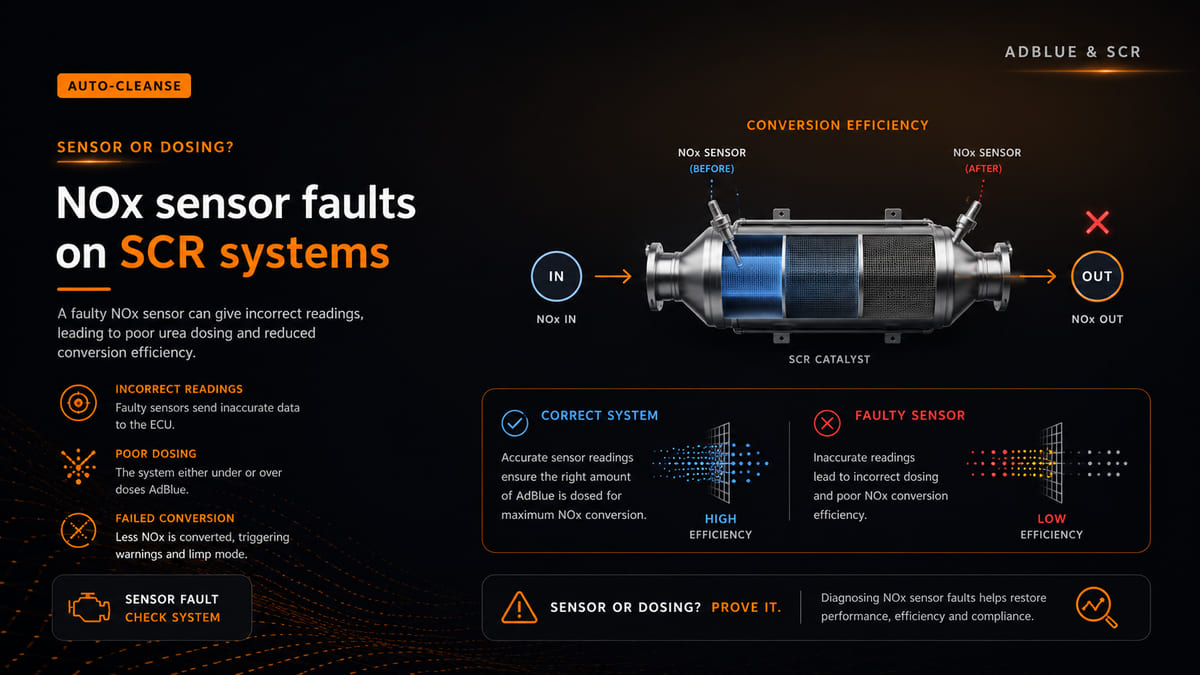 AdBlue
NOx sensors decide whether the SCR system passes or fails its own efficiency check. Here is why they fail, and why swapping one first is rarely the fix.
Read more →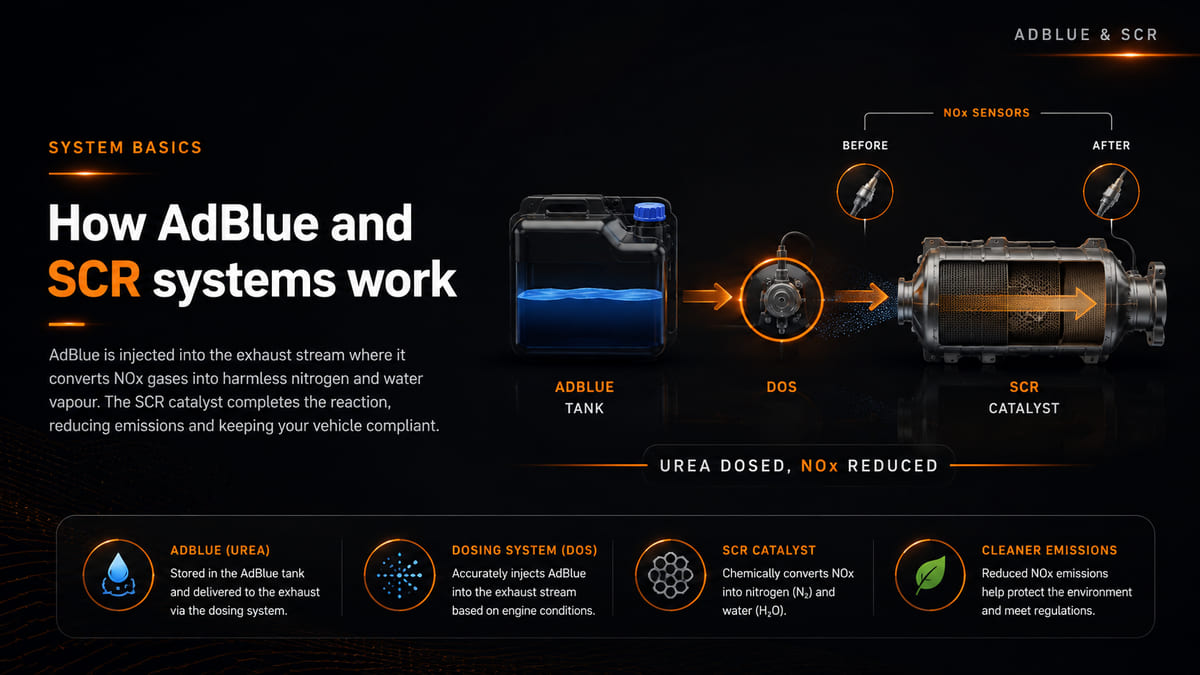 AdBlue
AdBlue is not a fuel additive. Here is how selective catalytic reduction actually works, and why the warnings escalate towards reduced power and no-start.
Read more →Ring with your reg and the warning message. We'll tell you what it's likely to be, who'd come out and what happens next.
Sources
Last reviewed 13 October 2026.