

 AdBlue
13 Jul 2026 5 min read
AdBlue Crystallisation and Dosing Faults
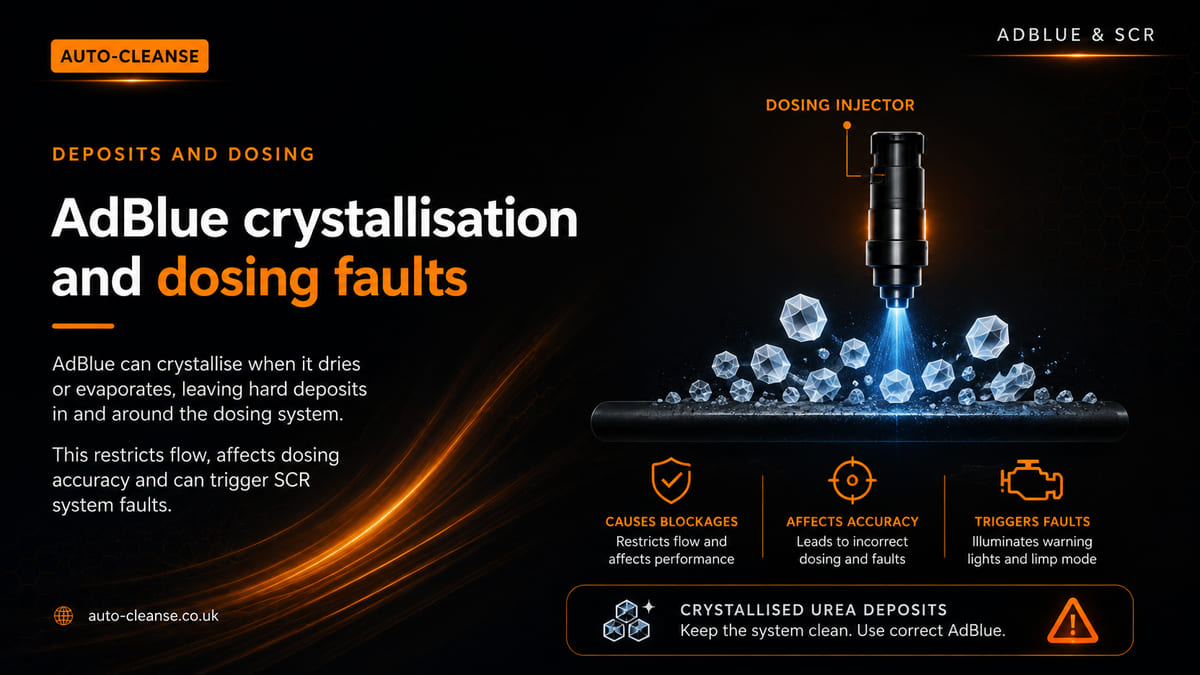
White crystalline deposits around an AdBlue injector are evidence, not the fault. Here is why urea crystallises, what causes it, and what to check.
Read more →An AdBlue warning means one of three things: the tank is low, the fluid in it is wrong, or part of the SCR system has a fault. Only a low level is fixed by topping up. The other two need diagnosing, and if they are left they can lead to a countdown and a no-start.
Have your reg, the exact dash message and any fault codes to hand. We'll tell you on the call what it's likely to be and what happens next.
The wording on the dash is your best clue, so read the whole message or photograph it before you switch off. Makes word it differently, but nearly every AdBlue warning is one of these.
A code reader confirms which it is. Generic codes include P203F (reductant level too low) and P207F (reductant quality performance), though manufacturer software can word them differently.
Dashboard lights follow a broad international colour code: amber or yellow means caution or a system malfunction, red means act now. AdBlue warnings mostly follow it, but makes differ in symbols, colours and wording, so check your handbook.
The rules for cars and vans also require the warning to escalate as the tank nears empty and restrictions get closer. Depending on the make, that can mean a light that starts flashing, a repeating chime, a colour change or a count of miles or starts left. Some heavier vans are approved under the heavy-duty rules, which work differently.
If you have topped up and the warning is still there, check these before assuming the worst.
A quality or system fault, or a low-level warning that keeps coming back, means the SCR system needs diagnosing. Different faults bring up the same message, so the codes and live data matter more than the wording. Typical causes:
Clearing the codes fixes nothing. The engine computer re-runs its checks as you drive, and the light returns as soon as the fault is seen again. That can take more than one journey, so a clear can look like a fix at first. The system also keeps a record of why restrictions were triggered that a code reader can't erase.
A cheap part can do the same. A NOx sensor or tank sender that isn't right for the vehicle, or isn't built to the original specification, can give readings the engine computer rejects. Some new parts also need coding or an adaptation reset before the system accepts them.
And sometimes the replaced part was never the cause. A NOx sensor can report a problem that started with dosing, bad fluid or the engine itself.
We diagnose before fitting parts, then confirm the repair on a drive with live data, so the fault is fixed rather than just cleared.
We don't put AdBlue repair prices online because the same warning can mean very different repairs. Call with your reg and the warning message and we'll quote for your vehicle. How we quote
In Devon, our own technicians from the Totnes workshop. Outside Devon, we book a vetted independent technician near you where we have one.
Either way you deal with us: we quote, take payment and look after anything afterwards. Call and we'll tell you straight away whether we can get someone to you.
We find the actual fault and fix it, so the vehicle stays road-legal and passes its MOT. We don't remove, disable or emulate AdBlue systems.
Genuine Google feedback on our AdBlue, SCR and diagnostic work.
Very impressed with the professional service offered. They diagnosed and sorted the adblue issues on my car, explained the process well and I believe the price was very reasonable. I would highly recommend them.
I took my VW Golf diesel to AutoClean after it went into limp mode with a flashing glow-plug light and suspected DPF blockage. Tom carried out proper diagnostics and confirmed the DPF itself was healthy. Instead of replacing parts unnecessarily, they identified a faulty DPF differential pressure sensor as the root cause. The issue was explained clearly, the costs were transparent, and the repair was completed promptly. Limp mode resolved immediately and no further work was pushed. I appreciated that they didn't default to a costly DPF removal when it wasn't needed. Good diagnostics, straightforward communication, and a proportionate fix. Would recommend if you're dealing with DPF or emissions-related issues.
Very professional and incredibly helpful services from Tom at Auto-Cleanse, walked me through the findings on the diagnostic tool and thankfully didn't need a DPF clean! Excellent piece of mind and whilst I hope I don't need their services again (!) I will be recommending them to everyone!
With a low-level warning, yes for now, as the first warning comes well before the tank is empty, but top up soon. With a quality or fault warning, get it checked quickly, because restrictions such as a no-start countdown can begin within about 30 miles.
It may not have registered the new level yet, you may not have added enough, or the warning was a fault rather than a low level. If it is still on after a drive, have the codes read.
Broadly, amber means sort it soon and red means act now, but makes use different colours and symbols. Flashing, chimes or a countdown mean the warning has escalated.
The MOT has no separate check for the AdBlue light. But an engine management light showing a fault is a major fail on diesels first used from 1 July 2008, and SCR faults can bring it on.
A reset after a genuine repair is normal. Without a repair the fault is detected again and the warning returns.
Don't start the engine, as running it draws the wrong fluid through the system. The tank and lines will need draining and cleaning, and parts that have had it through them may need replacing.
No. Coding out the warning or the system only hides the fault. A missing or obviously modified system is a major MOT fail and running without it can be an offence depending on the vehicle, so we repair the fault instead.
AdBlueWhite crystalline deposits around an AdBlue injector are evidence, not the fault. Here is why urea crystallises, what causes it, and what to check.
Read more →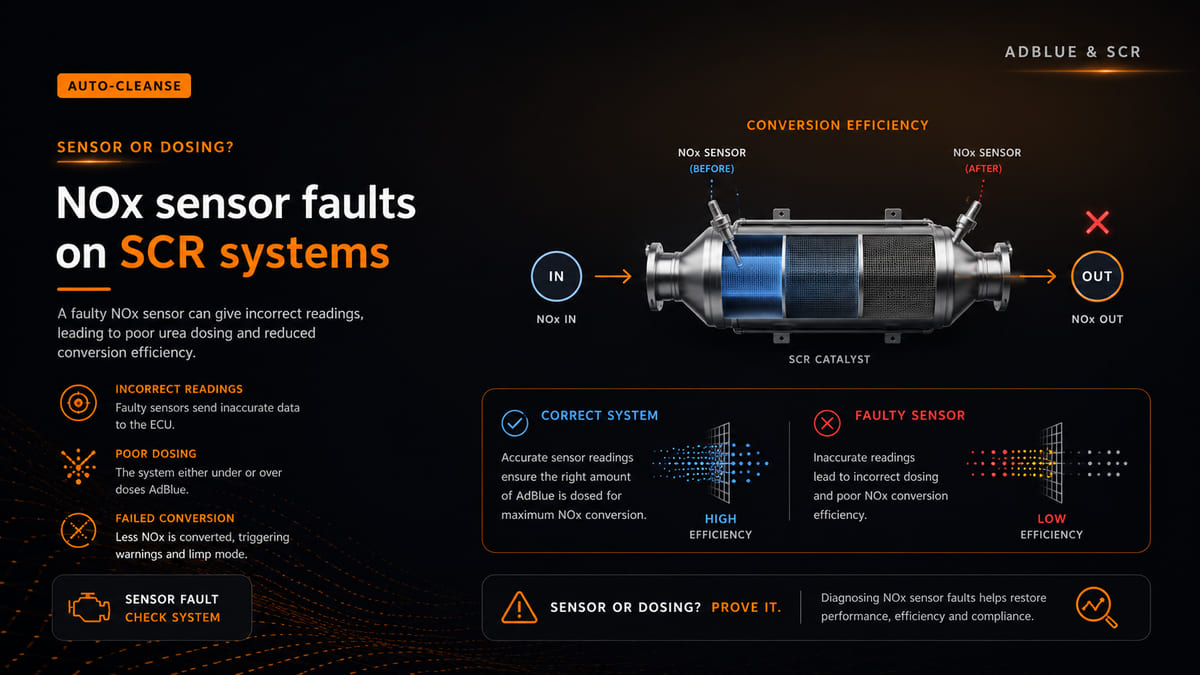 AdBlue
NOx sensors decide whether the SCR system passes or fails its own efficiency check. Here is why they fail, and why swapping one first is rarely the fix.
Read more →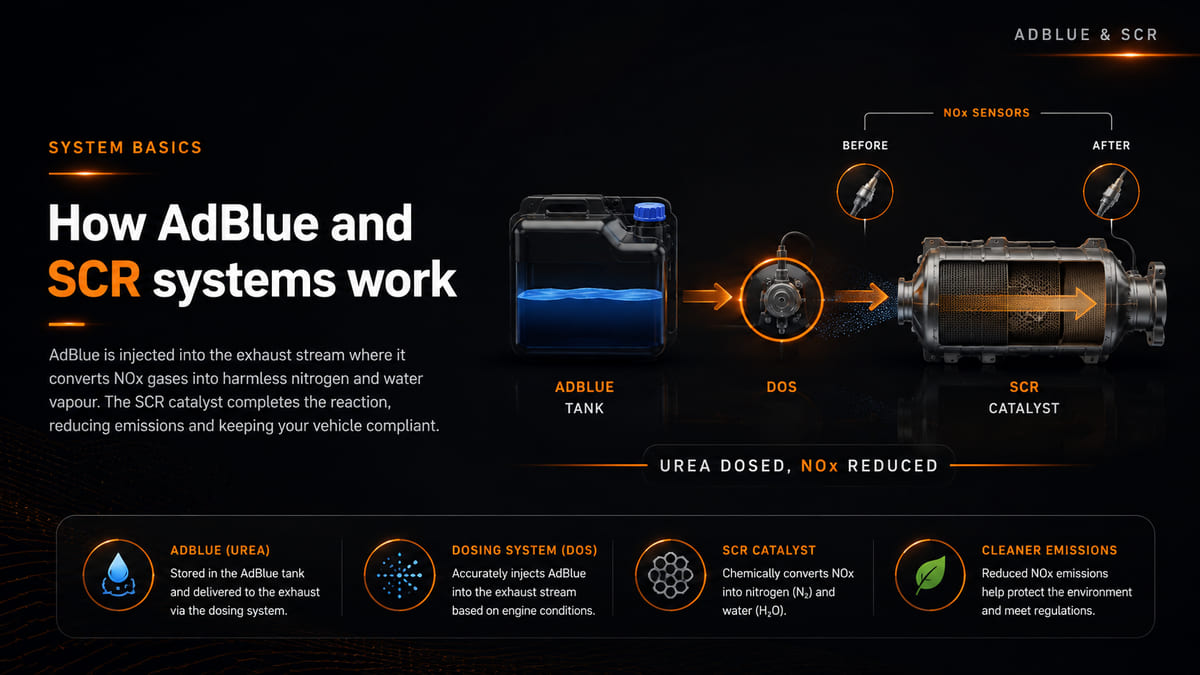 AdBlue
AdBlue is not a fuel additive. Here is how selective catalytic reduction actually works, and why the warnings escalate towards reduced power and no-start.
Read more →Ring with your reg and the warning message. We'll tell you what it's likely to be, who'd come out and what happens next.
Sources
Last reviewed 13 October 2026.