

 AdBlue
13 Jul 2026 5 min read
AdBlue Crystallisation and Dosing Faults
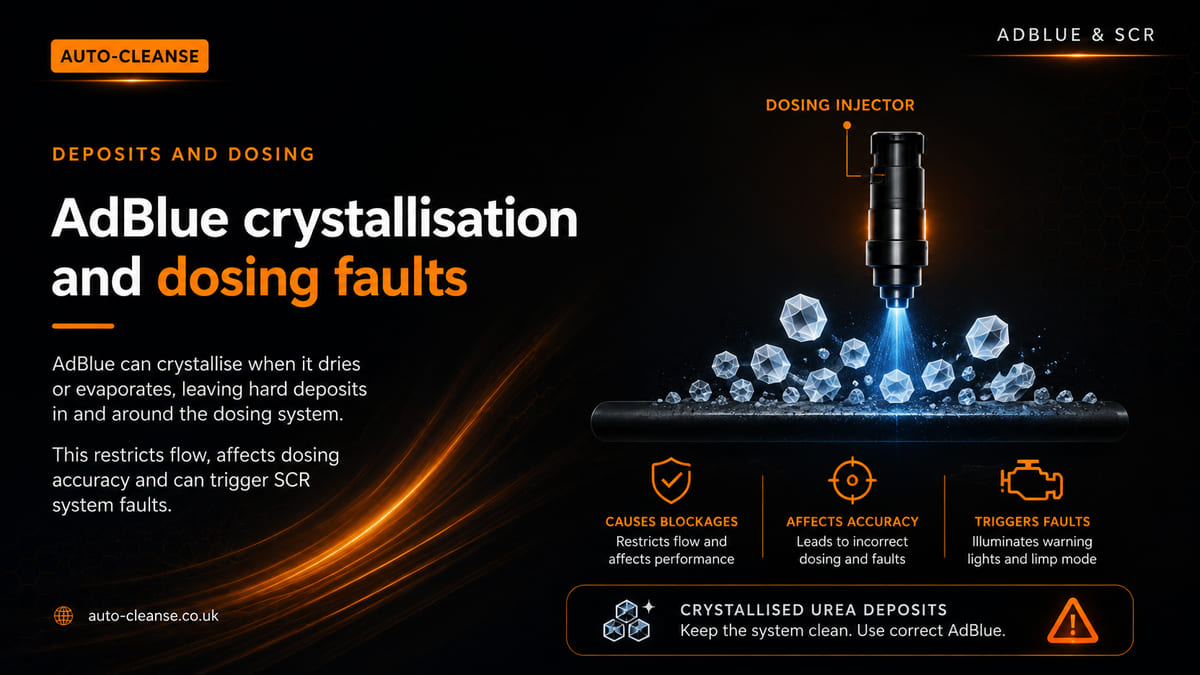
White crystalline deposits around an AdBlue injector are evidence, not the fault. Here is why urea crystallises, what causes it, and what to check.
Read more →A NOx sensor fault usually shows as an engine or AdBlue warning light with a code in the P2200 range, or a U-code for lost communication with the sensor. It may be the sensor, but wiring, exhaust leaks and dosing faults can make a good one look bad. We prove which it is before fitting anything, then do the reset and road test the repair needs.
Have your reg, the exact dash message and any fault codes to hand. We'll tell you on the call what it's likely to be and what happens next.
Many AdBlue (SCR) systems use two NOx sensors. The upstream one, before the SCR catalyst, measures NOx coming out of the engine so the engine computer can decide how much AdBlue to inject. The downstream one, after the catalyst, measures what is left, to check the exhaust is being cleaned.
In fault codes the upstream sensor is usually Bank 1 Sensor 1 and the downstream one Bank 1 Sensor 2. Layouts vary by make, so we confirm which sensors your vehicle has before quoting.
Each sensor is a heated ceramic probe with a small control box that sends readings over the vehicle's data network. It only reports once the exhaust is hot and dry, so a cold check at idle tells you little.
One quirk matters for diagnosis: NOx sensors also read ammonia. If too much AdBlue is injected, or a dosing injector leaks, ammonia slipping past the catalyst reads as high NOx downstream and can make a healthy sensor look faulty.
Expect a warning light rather than a change in how the vehicle drives. On many vans and cars an AdBlue warning follows and, if left, a no-start countdown, because the system can no longer check its own performance. Which faults trigger the countdown varies by make.
These are the generic SAE J2012 descriptions. Manufacturers sometimes word or use them differently.
Sensor A is often upstream and B downstream, but labels vary by make. Manufacturers also log their own codes, which a basic code reader may not show.
Industry warranty data puts NOx sensors at the top of the list. A 2026 analysis of more than 3,000 authorised UK van warranty claims found they were the single most common repair, just ahead of alternators. A matching analysis of almost 2,500 HGV claims put them top by a wide margin.
In the US, BMW extended the warranty on the NOx sensors before and after the SCR catalyst on some of its diesels to 10 years or 120,000 miles.
Much of it comes down to where the sensor lives:
A NOx sensor's accuracy depends on its sensing element and the calibration in its control box. A cheap one can talk to the engine computer yet read slightly wrong. That may not set a sensor code, but it makes the catalyst look inefficient and the warning comes back.
Volvo's truck service information says third-party NOx sensors have been found to cause false fault codes and system failures, and tells technicians to replace them with genuine sensors.
Upstream and downstream sensors can look alike but are often different part numbers and aren't usually interchangeable. We match the replacement to your vehicle's part number and position, and tell you what we're fitting.
A NOx code shows where the system noticed a problem, not always what caused it. Before recommending a sensor, we check:
Full scan and history
Every module, noting whether each code is active or stored from earlier, and the conditions when it set.
Check other causes
Software updates and manufacturer campaigns, related EGR, leak or dosing codes, and the quality of the AdBlue in the tank.
Test the wiring
Supply, earth and data lines at the sensor's control box, for circuit and lost-communication codes.
Live data on a warm road test
Upstream NOx should follow load, both sensors should drop close to zero when you lift off, and downstream should read well below upstream once dosing. A reading stuck on one value or slow to react points to the sensor.
Rule out leaks and overdosing
An exhaust leak near a sensor, or ammonia slipping past the catalyst, can make a good sensor read wrong.
If the evidence points somewhere other than the sensor, we tell you and quote for that instead.
The engine computer stores learned correction values for the sensors and the AdBlue dosing. Applied to a new sensor, old values can throw its readings off, and the light can come back days later.
What's needed depends on the make. Mercedes-Benz diagnostics, for example, include a routine to reset the learned values of the NOx sensors. Some makes also need the new part coded or a guided test, and on others clearing the codes and a drive is enough.
The self-test that set the code must then run and pass on a road test before the warning stays off, which can take more than one drive. If a no-start countdown had started, some makes also need it reset with diagnostic equipment once the repair is confirmed.
A NOx emulator, or software that switches the sensors off, hides the fault rather than fixing it. We don't fit them, and our guide to the law on AdBlue deletes explains why.
We don't put AdBlue repair prices online because the same warning can mean very different repairs. Call with your reg and the warning message and we'll quote for your vehicle. How we quote
In Devon, our own technicians from the Totnes workshop. Outside Devon, we book a vetted independent technician near you where we have one.
Either way you deal with us: we quote, take payment and look after anything afterwards. Call and we'll tell you straight away whether we can get someone to you.
We find the actual fault and fix it, so the vehicle stays road-legal and passes its MOT. We don't remove, disable or emulate AdBlue systems.
Genuine Google feedback on our AdBlue, SCR and diagnostic work.
Very impressed with the professional service offered. They diagnosed and sorted the adblue issues on my car, explained the process well and I believe the price was very reasonable. I would highly recommend them.
I took my VW Golf diesel to AutoClean after it went into limp mode with a flashing glow-plug light and suspected DPF blockage. Tom carried out proper diagnostics and confirmed the DPF itself was healthy. Instead of replacing parts unnecessarily, they identified a faulty DPF differential pressure sensor as the root cause. The issue was explained clearly, the costs were transparent, and the repair was completed promptly. Limp mode resolved immediately and no further work was pushed. I appreciated that they didn't default to a costly DPF removal when it wasn't needed. Good diagnostics, straightforward communication, and a proportionate fix. Would recommend if you're dealing with DPF or emissions-related issues.
Very professional and incredibly helpful services from Tom at Auto-Cleanse, walked me through the findings on the diagnostic tool and thankfully didn't need a DPF clean! Excellent piece of mind and whilst I hope I don't need their services again (!) I will be recommending them to everyone!
Usually for a short while, but get it booked in. Many vehicles start a no-start countdown, and once it reaches zero the engine may not restart until the fault is fixed.
Sensor 1 in the code is normally upstream and Sensor 2 downstream. A and B labels on U-codes vary by make, so we confirm with live data before ordering a part.
No. If the fault is still there the code returns when the self-test runs again, and clearing it wipes information that helps diagnosis.
On many vehicles, yes. Learned values often need resetting and some makes need the sensor coded, or the light can come back.
It can. A NOx sensor fault usually puts the engine warning light on, and on diesels first used from 1 July 2008 that light showing a fault is a major defect.
It depends on which sensor, your make and model, access, and the reset or coding needed. Call for a quote for your vehicle.
Usually because the learned values weren't reset, the replacement reads slightly wrong, or the sensor was never the cause. An exhaust leak or over-dosing can make a brand new sensor report the same problem.
AdBlueWhite crystalline deposits around an AdBlue injector are evidence, not the fault. Here is why urea crystallises, what causes it, and what to check.
Read more →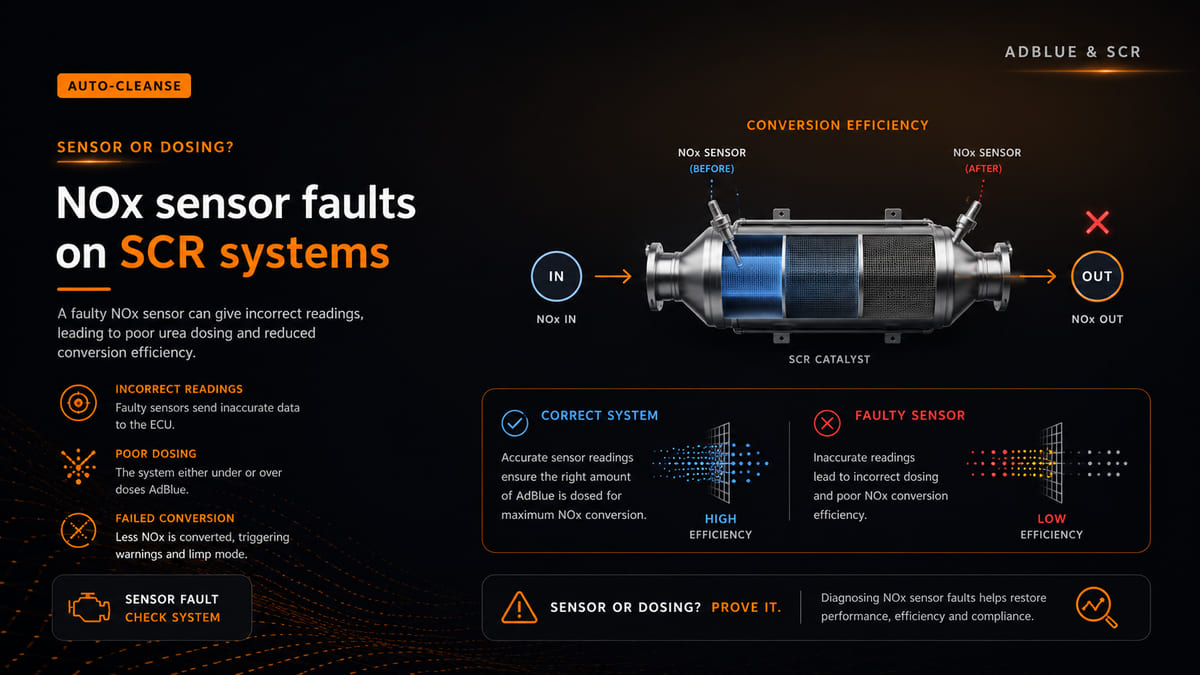 AdBlue
NOx sensors decide whether the SCR system passes or fails its own efficiency check. Here is why they fail, and why swapping one first is rarely the fix.
Read more →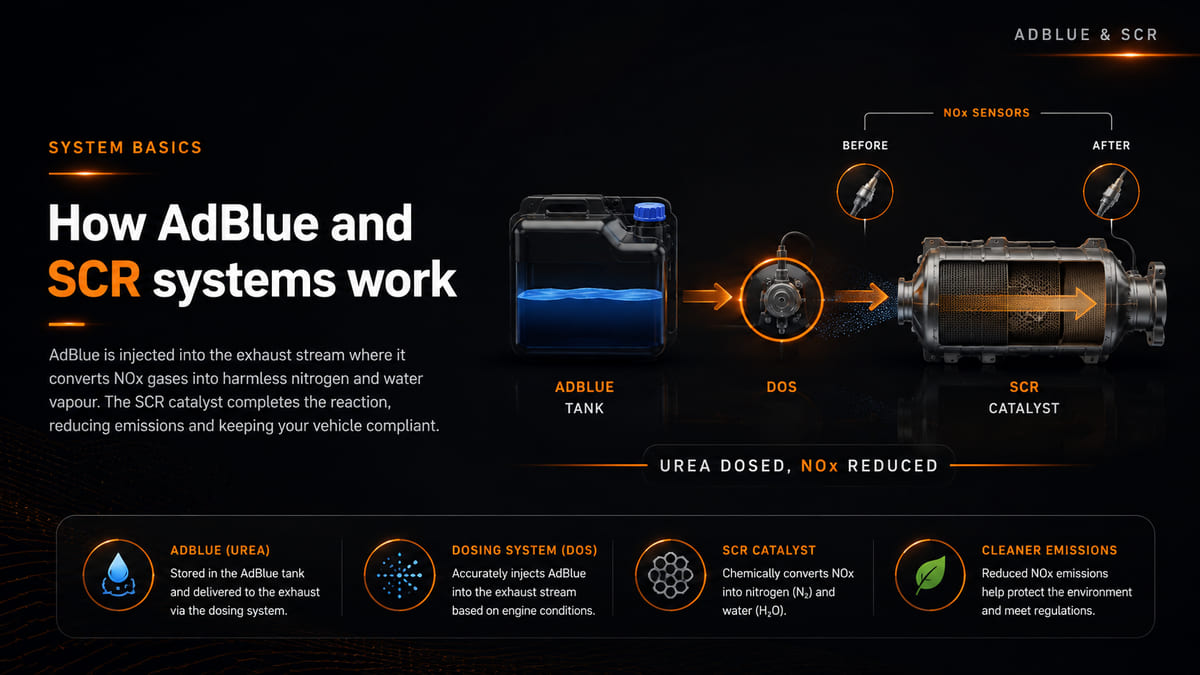 AdBlue
AdBlue is not a fuel additive. Here is how selective catalytic reduction actually works, and why the warnings escalate towards reduced power and no-start.
Read more →Ring with your reg and the warning message. We'll tell you what it's likely to be, who'd come out and what happens next.
Sources
Last reviewed 13 October 2026.