How AdBlue and SCR Systems Work
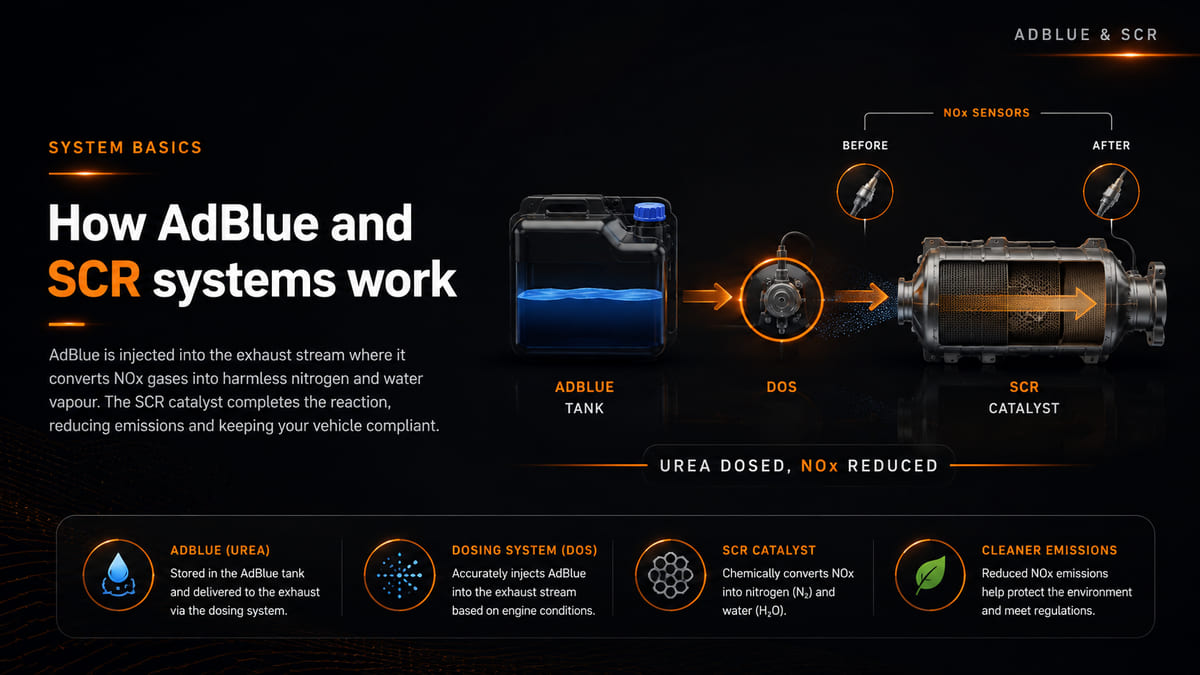
AdBlue is one of the most misunderstood parts of a modern diesel. It gets called an additive, a fuel treatment, or something invented to complicate ownership. It is none of those. It is the consumable in a chemical after-treatment system with one job: turning oxides of nitrogen in the exhaust into nitrogen and water vapour.
Understand the system and the warnings become easier to read - including the ones counting down towards a vehicle that will not restart. That behaviour is designed in, not a sign of unusual failure.
AdBlue is not put into the fuel. It is a reagent dosed into the exhaust, and the system that meters it is monitored as closely as the engine itself.
What AdBlue actually is
AdBlue is the trade name for an aqueous urea solution: high-purity urea dissolved in demineralised water at a defined concentration, made to a published quality standard. It is stored in its own tank, never mixed with diesel, and consumed at a rate set by engine load and NOx production rather than mileage alone.
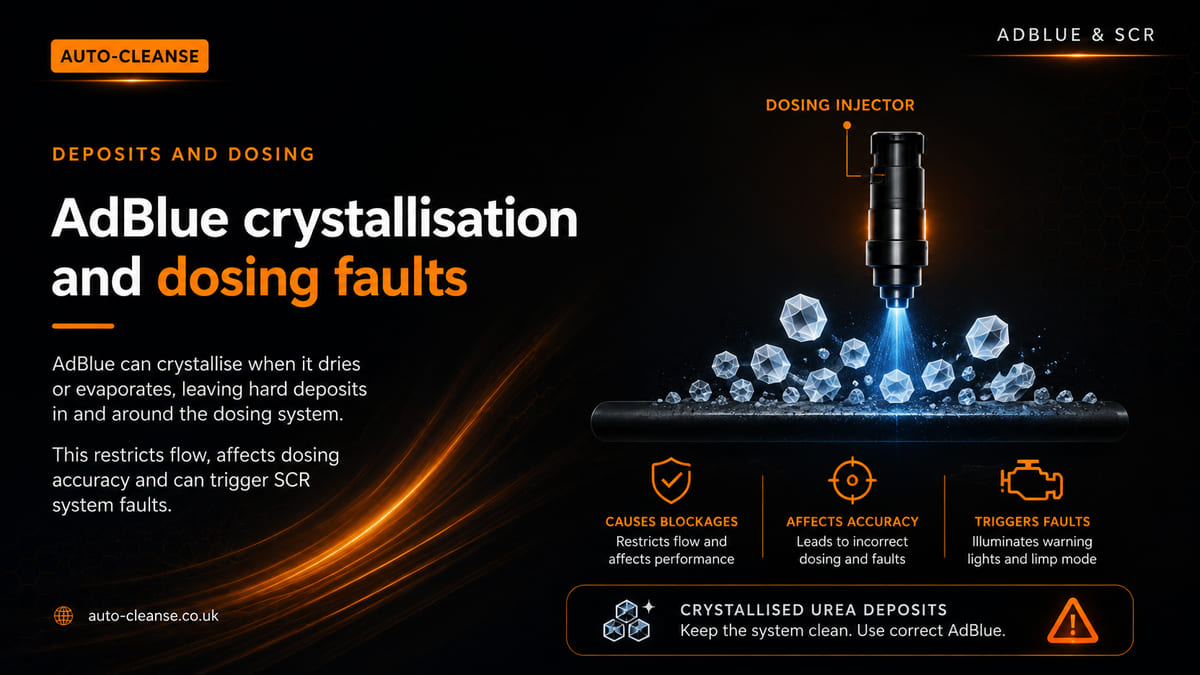
Two physical properties matter more than owners expect. It freezes at low ambient temperatures, which is why the tank and lines are heated. It also crystallises as water evaporates out of it, leaving hard white deposits. Between them they account for a good share of the faults these systems develop.
Particulates and NOx are two different problems
Diesel combustion produces two emissions groups that pull in opposite directions. Hotter, leaner combustion produces less soot but more NOx; cooler combustion suppresses NOx and tends to produce more particulate. Manufacturers cannot tune their way out of that trade-off, so the exhaust carries a system for each side.
- The DPF traps particulate matter - solid carbon soot, plus non-combustible ash - and oxidises the soot during regeneration.
- The SCR catalyst converts NOx, which is a gas, into nitrogen and water using ammonia released from the dosed AdBlue.
They share the same exhaust and are routinely confused, but a filter cannot trap a gas and a catalyst cannot filter soot. A restricted filter and a reductant fault therefore lead down different routes - one towards DPF diagnostics, the other towards AdBlue repair.
Selective catalytic reduction in plain terms
- The ECU works out how much NOx the engine is producing for the current conditions.
- A metered quantity of AdBlue is injected into the hot exhaust upstream of the SCR catalyst.
- Exhaust heat breaks the urea down, releasing ammonia.
- Inside the catalyst, that ammonia reacts with NOx across the coated substrate, producing nitrogen and water vapour.
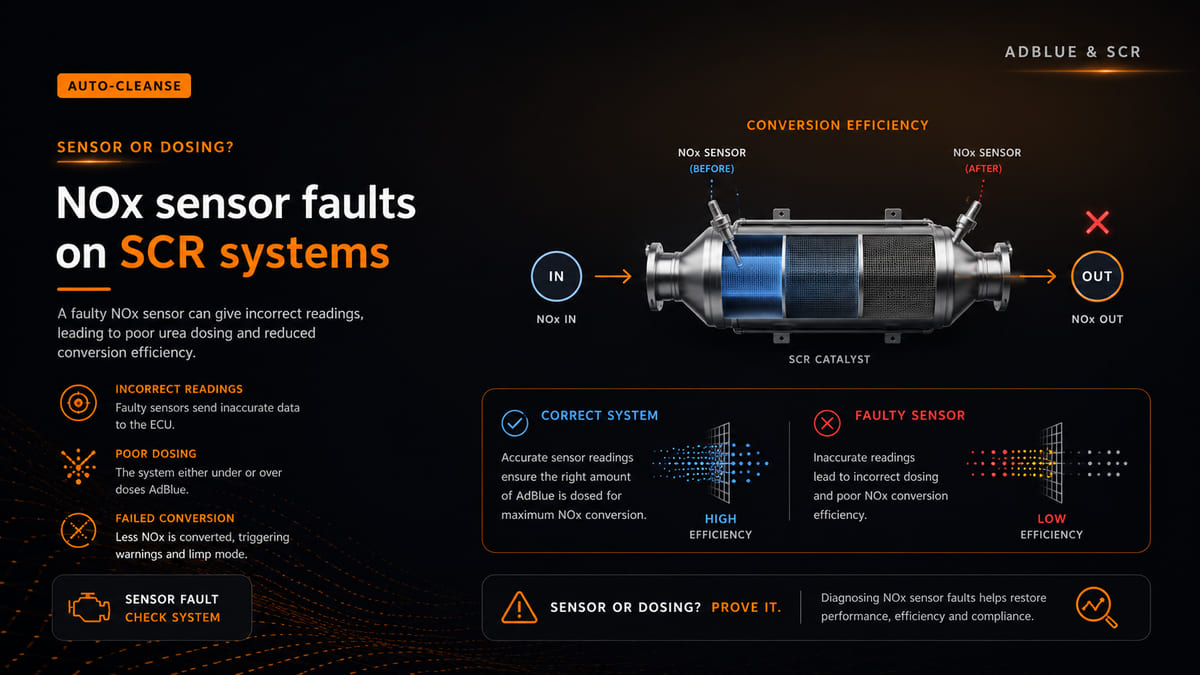
- Sensors report what actually left the catalyst, and the ECU compares it against what it expected.
It is called selective because the ammonia targets NOx rather than burning off in the oxygen a diesel exhaust always carries, and it only works within a temperature window. Dose into an exhaust that is too cold and the urea will not break down properly, which is one reason deposits form. Dose too little and NOx passes through untreated; dose too much and ammonia slips past unreacted.
The parts and what each one does
Tank and heater
Holds the reagent and keeps it usable in cold weather. A level sender, and often a quality sensor, report what is in there.
Pump and delivery module
Builds and holds the pressure the dosing side needs, and typically purges the line back to the tank at shutdown so fluid cannot freeze in place.
Dosing injector
Meters the commanded quantity into the exhaust and atomises it. Working hot while carrying a crystallising fluid, it is a well-known blockage point.
SCR catalyst
The coated substrate where the reaction happens. Conversion efficiency degrades with contamination, thermal damage or age.
NOx and temperature sensors
Comparing NOx before and after the catalyst lets the ECU work out conversion efficiency, though some systems calculate the engine-out figure rather than measure it. Exhaust temperature governs when dosing is permitted at all.
Why it is monitored so strictly
None of this is visible from the driving seat: a vehicle dosing no AdBlue drives much like one dosing correctly, so normal running tells an owner nothing. Emissions legislation therefore requires the vehicle to police itself: reagent level and quality, dosing activity, conversion efficiency and signs of tampering are monitored on board, with faults stored and reported. The system has to prove it is working.
Why the warnings escalate
The escalation is deliberate and staged, broadly in this order:
- An early advisory - low reagent level, or a stored fault.
- A more insistent warning, often with a distance countdown.
- Restricted engine performance once that countdown expires.
- A prevented restart, typically once the vehicle is next switched off.
The sequence gives plenty of notice while making it impractical to ignore an emissions fault indefinitely. Removing or disabling the system is not a repair: using a vehicle on the road with its emissions control equipment removed or defeated is an offence in the UK, and missing or obviously tampered equipment fails the MOT.
Common misdiagnosis: "The AdBlue light is on, so it needs a top-up." A genuine low-level warning does. A fault warning does not, and topping up will not clear a stored quality, dosing or efficiency fault - the countdown is driven by the fault, not the fluid.
What this means in practice
Treat an AdBlue warning like any other emissions fault: read the stored codes and live data, establish whether the complaint is level, quality, delivery or conversion, then repair the cause. Clearing the light without fixing the fault only buys time. The same discipline that applies to a blocked DPF applies here.
The takeaway
SCR is a dosing and chemistry system that neutralises NOx, separate from the DPF that traps particulates. The escalating warnings are the design working as intended, so the answer is to diagnose and repair the system rather than silence the message.
Sources
- Bosch Mobility - diesel exhaust after-treatment and reagent dosing technical information
- HELLA TechWorld - selective catalytic reduction and NOx sensor technical information
- Motorservice - exhaust gas after-treatment technical information
- Delphi Technologies - diesel after-treatment and SCR system information
- DVSA - emissions control equipment requirements for MOT testing
General technical guidance only. Manufacturer-specific system layouts, dosing strategies, warning sequences and diagnostic procedures always take precedence for the exact vehicle.
Need help with this on your vehicle?
Auto-Cleanse can sort it. See our AdBlue Repair & Diagnostics service, or get in touch.
Related: DPF Diagnostics