

 AdBlue
13 Jul 2026 5 min read
AdBlue Crystallisation and Dosing Faults
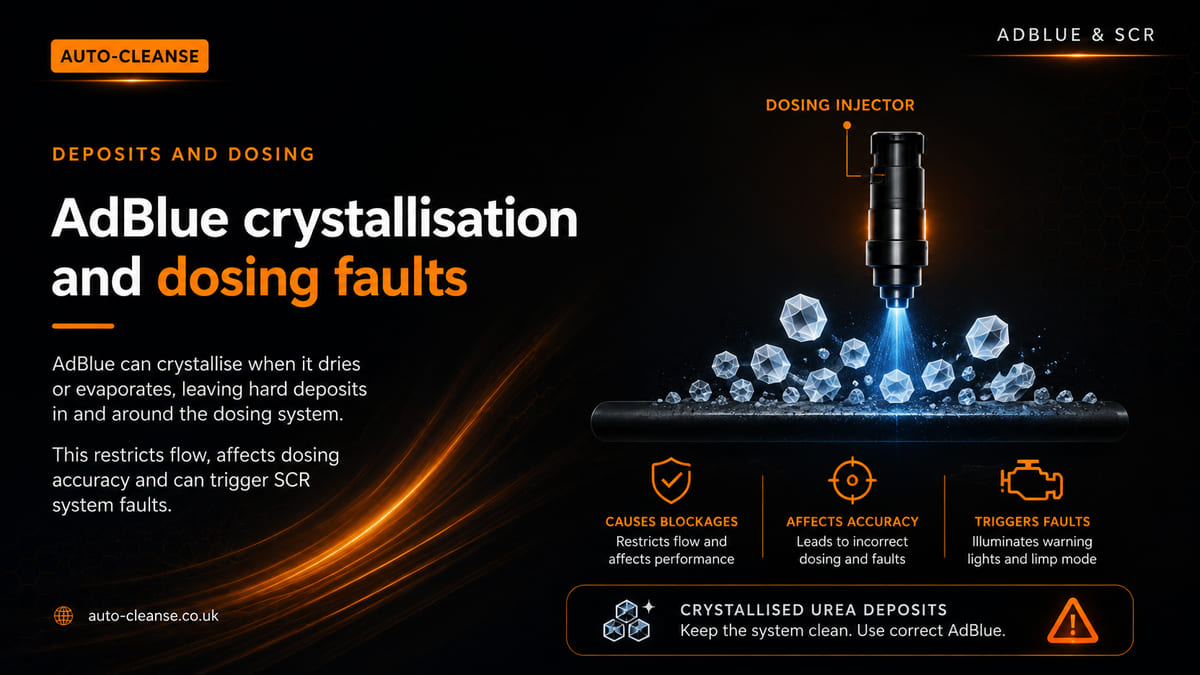
White crystalline deposits around an AdBlue injector are evidence, not the fault. Here is why urea crystallises, what causes it, and what to check.
Read more →P204F means the engine computer has decided the AdBlue side of your SCR system isn't doing its job properly. It points at the dosing system as a whole, not one named part, so the fix comes from testing rather than guessing. Depending on the make, it can start a no-start countdown, so get it looked at while the vehicle still drives.
Have your reg, the exact dash message and any fault codes to hand. We'll tell you on the call what it's likely to be and what happens next.
The generic description is "Reductant System Performance Bank 1". Reductant is the AdBlue. The code is stored when the engine computer's check of AdBlue delivery doesn't come out as expected.
Bank 1 is the side of the engine with cylinder number one. On a van with one exhaust and one SCR system, it simply means that system.
Makes differ in exactly which check sets P204F, so the manufacturer's test plan for your vehicle decides the order of tests. It can be stored with other AdBlue codes: a Volkswagen tech tip on poor AdBlue quality in the Touareg 3.0 TDI lists it alongside P20EE and P207F (Reductant Quality Performance).
These codes look alike on a scan tool, but each asks a different question.
If P20E8 is stored too, the pressure fault comes first. If P20EE is stored with P204F, the dosing side is tested before anyone condemns a catalyst or NOx sensor.
A proper diagnosis works through these. None should be assumed until it has been tested.
Volkswagen's 2014 bulletin for P204F on the US-market Passat 2.0 TDI put it down to an over-sensitive SCR self-check, and told technicians not to diagnose or replace parts before fitting the software update. That's why updates are checked early, before any parts.
This shows whether the injector delivers what the engine computer asks for. The injector comes out of the exhaust but stays connected to its line and wiring. A diagnostic tool commands it to spray into a measuring container for a set time, and the amount is compared with the manufacturer's figure.
That figure is specific to the vehicle. Volkswagen once had to correct a guided test that showed the figure for a different engine, so the result has to be judged against the figure for your exact model.
Ford's bulletin for its 6.7-litre US pickups links P204F to urea crystals forming on the injector nozzle. It uses this measurement to decide the repair, replacing the injector only if the amount is outside specification.
With the injector out, the nozzle is inspected too. Cleaning off crystals without finding why they formed, such as a dribbling injector or a leaking joint, risks P204F coming back.
Fluid is checked with a refractometer, which reads the urea concentration of a sample. Mercedes-Benz advises against judging AdBlue from a frozen, part-thawed or unmixed tank. AdBlue starts to freeze at about minus 11°C, so the sample is taken once the tank has fully thawed and been mixed by driving.
If anything other than AdBlue has gone into the tank, tell us before the vehicle is driven further. Manufacturers have their own clean-out procedures, and what is needed depends on what went in.
On the Mercedes-Benz Sprinter (906 from July 2013, 651 and 642 engines), Mercedes' service information for a different code, P203B (AdBlue fill level sensor), lists wrong fluid in the tank, poor contact at the sensor plug and resistance in the wiring connectors to the tank module as causes. If a Sprinter has P203B stored alongside P204F, those checks come first.
The order matters, because several causes look the same from the driver's seat.
Read everything
All stored codes, freeze-frame data and the countdown status, not just P204F.
Check the fluid
A refractometer test on a thawed, mixed sample, and where the last top-up came from.
Check for updates
Known software updates and bulletins for the vehicle, before any parts are ordered.
Test supply and dosing
Pressure, leaks and wiring, then the dosing quantity test with the injector out.
Check the NOx readings
Live sensor data before and after the catalyst, to see whether the sensors make sense.
Repair, reset and confirm
Learned AdBlue dosing values are reset where the manufacturer calls for it, and the SCR check is run to clear the warning and countdown.
A basic code reader doesn't always stop the countdown. Volkswagen's P204F bulletin for the Passat, for example, has an SCR efficiency test run to clear the no-start message.
We don't put AdBlue repair prices online because the same warning can mean very different repairs. Call with your reg and the warning message and we'll quote for your vehicle. How we quote
In Devon, our own technicians from the Totnes workshop. Outside Devon, we book a vetted independent technician near you where we have one.
Either way you deal with us: we quote, take payment and look after anything afterwards. Call and we'll tell you straight away whether we can get someone to you.
We find the actual fault and fix it, so the vehicle stays road-legal and passes its MOT. We don't remove, disable or emulate AdBlue systems.
Genuine Google feedback on our AdBlue, SCR and diagnostic work.
Very impressed with the professional service offered. They diagnosed and sorted the adblue issues on my car, explained the process well and I believe the price was very reasonable. I would highly recommend them.
I took my VW Golf diesel to AutoClean after it went into limp mode with a flashing glow-plug light and suspected DPF blockage. Tom carried out proper diagnostics and confirmed the DPF itself was healthy. Instead of replacing parts unnecessarily, they identified a faulty DPF differential pressure sensor as the root cause. The issue was explained clearly, the costs were transparent, and the repair was completed promptly. Limp mode resolved immediately and no further work was pushed. I appreciated that they didn't default to a costly DPF removal when it wasn't needed. Good diagnostics, straightforward communication, and a proportionate fix. Would recommend if you're dealing with DPF or emissions-related issues.
Very professional and incredibly helpful services from Tom at Auto-Cleanse, walked me through the findings on the diagnostic tool and thankfully didn't need a DPF clean! Excellent piece of mind and whilst I hope I don't need their services again (!) I will be recommending them to everyone!
Usually, for now. If a "no start in X miles" message appears, get the repair booked before it runs out, because the vehicle may refuse to start at zero.
Not on its own. If the tank holds weak or contaminated fluid, topping up just mixes good with bad, so the fluid is tested first. Even after a fluid fix, the code and any countdown need clearing with the correct test.
No. P20EE says the catalyst isn't cutting NOx enough, which is a result. P204F says AdBlue delivery isn't performing, which is closer to the cause, and the two can be stored together.
Not on its own. The dosing quantity test shows whether the injector delivers the right amount, and one that tests within specification goes back in.
On some models, yes. Volkswagen and Jeep have both issued engine software updates for P204F on particular vehicles, so we check before replacing parts.
If the fault is still there it will come back, and a basic reader doesn't always cancel the countdown. Clearing codes also wipes the freeze-frame data a technician uses to find the fault.
Not as a fix for a road vehicle. The MOT manual lists missing or obviously modified emission control equipment as a major defect, and using a vehicle with it disabled can be an offence depending on the vehicle. We find and repair the fault instead.
AdBlueWhite crystalline deposits around an AdBlue injector are evidence, not the fault. Here is why urea crystallises, what causes it, and what to check.
Read more →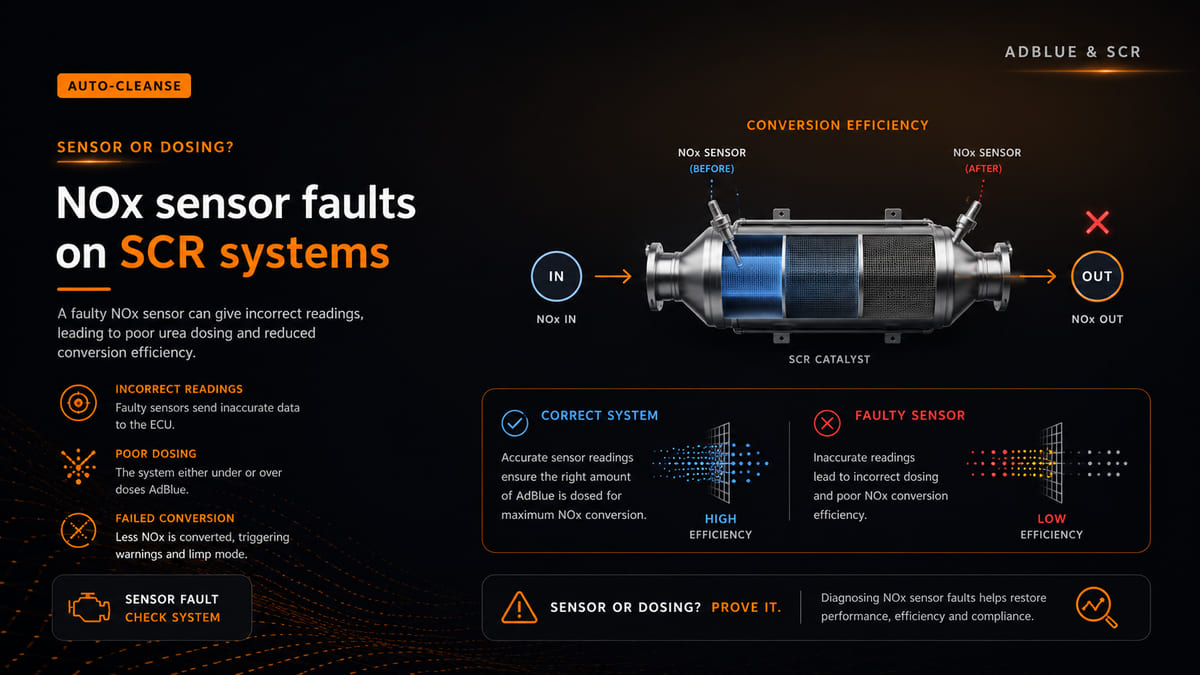 AdBlue
NOx sensors decide whether the SCR system passes or fails its own efficiency check. Here is why they fail, and why swapping one first is rarely the fix.
Read more →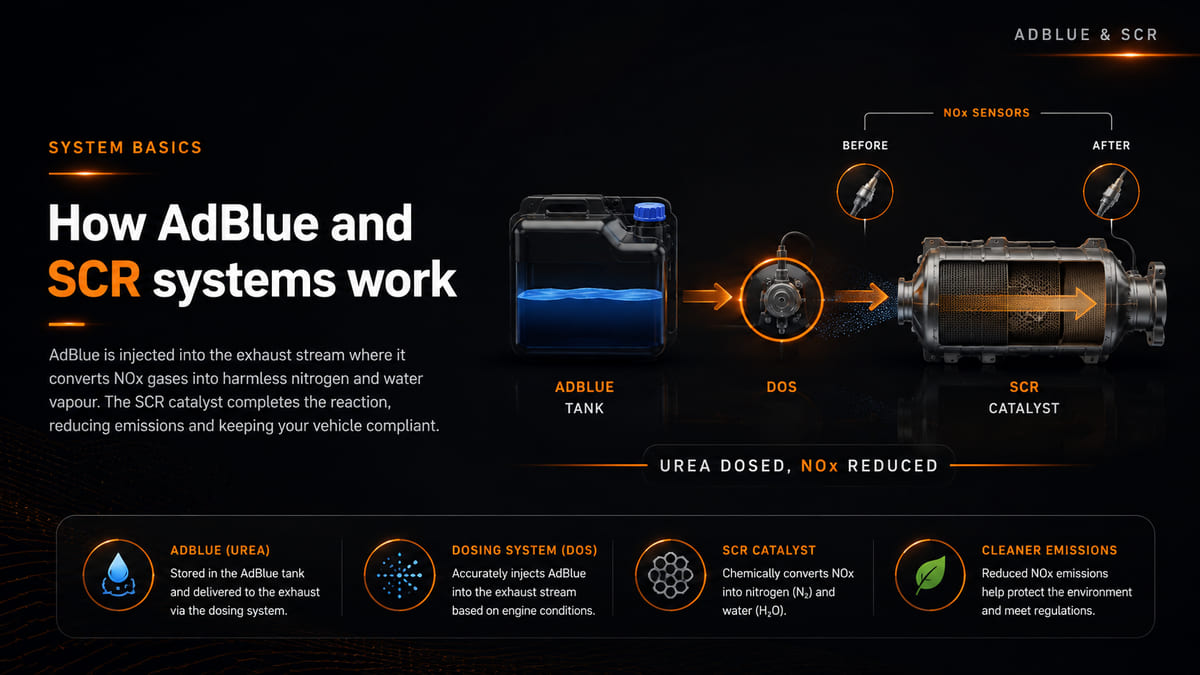 AdBlue
AdBlue is not a fuel additive. Here is how selective catalytic reduction actually works, and why the warnings escalate towards reduced power and no-start.
Read more →Ring with your reg and the warning message. We'll tell you what it's likely to be, who'd come out and what happens next.
Sources
Last reviewed 13 October 2026.