

 AdBlue
13 Jul 2026 5 min read
AdBlue Crystallisation and Dosing Faults
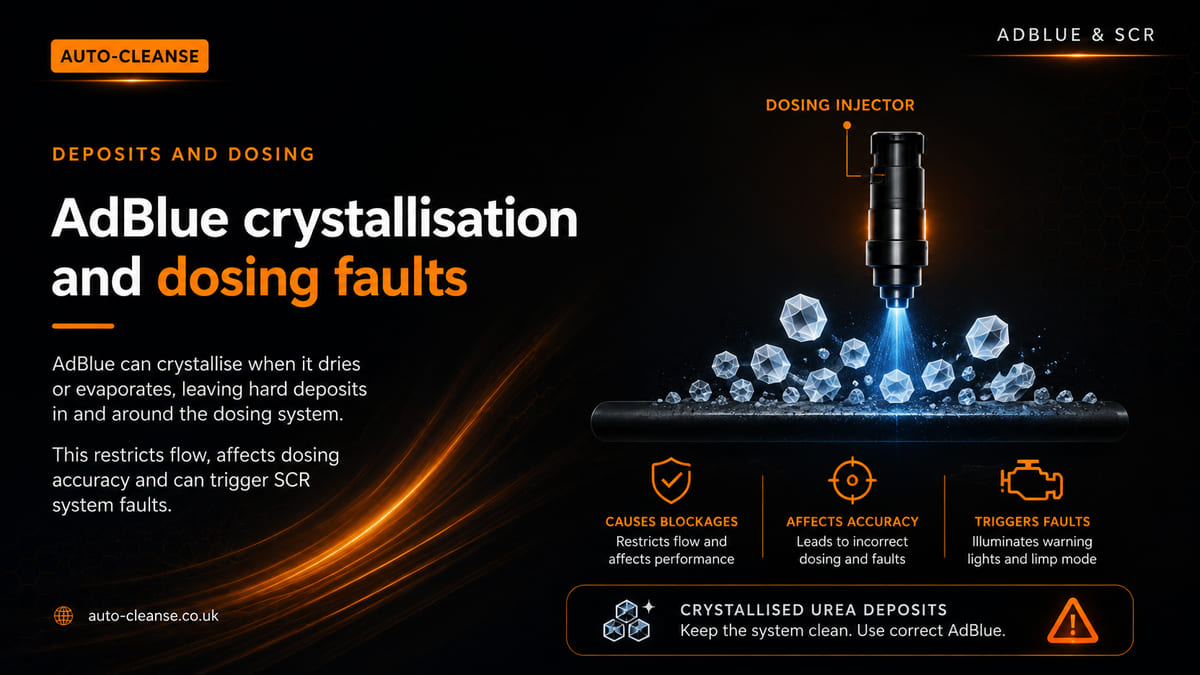
White crystalline deposits around an AdBlue injector are evidence, not the fault. Here is why urea crystallises, what causes it, and what to check.
Read more →P20E8 means the AdBlue pump has not built, or could not hold, the pressure the system asked for, so it can't dose properly. The code names the symptom, not the failed part. Left alone, it leads to a countdown to no-start or a similar restriction, so get it tested rather than cleared.
Have your reg, the exact dash message and any fault codes to hand. We'll tell you on the call what it's likely to be and what happens next.
A pump draws AdBlue from the tank and holds it under pressure in the line to the dosing injector in the exhaust. A sensor reports that pressure to the control unit. If the reading stays below target for longer than the software allows, it stores P20E8.
Makes and scan tools word it differently: reductant, AdBlue or DEF pressure too low, or just low pressure. Some add a suffix to the code with extra detail. The meaning is the same.
It is not a pressure sensor circuit fault: those have their own codes, P204A to P204D. With P20E8 the reading passes those checks and is simply low, so the job is finding out why.
Anything that stops the pump getting fluid, stops it pushing, or lets pressure escape can set this code.
On some vans the pump, heater and level sender are one assembly inside the tank; on others the pump is a separate module. That changes the repair, not the diagnosis.
The first question is whether the pump can't build pressure, or builds it and then loses it. That gets answered before any parts are ordered.
Read everything first
All stored codes, not just P20E8, plus the freeze-frame data showing temperatures and conditions when it set. A report is saved before anything is cleared.
Check the fluid and look for leaks
Tank level, a quality check of the AdBlue, and a close look along the pump, lines and injector for wet joints or crystals.
Live data and actuator tests
Commanded against actual pressure, tank temperature and heater operation. Then the pump, heater and injector, and the line purge where fitted, are run from the scan tool to see each respond.
Pressure build and hold test
Never reaching target points to the supply, the pump or air. Reaching it then falling away with the injector shut points to a leak or a leaking injector. Where the system allows, a gauge confirms the sensor is telling the truth.
Dosing quantity test
The injector doses into a measuring container during a scan-tool routine. If the routine aborts because pressure won't build, it points back to the pump once leaks and air are ruled out. If it runs but the amount is outside the maker's figure, the injector is suspect.
Repair, bleed and prove it
The system is bled or primed, codes are cleared, and the maker's check routine and a road test confirm it builds pressure and doses.
Usually the van drives normally at first. The trouble is what comes next. Under the type-approval rules for Euro 6 cars and light vans, if dosing is interrupted and not put right within 50 km of the warning, the driver inducement system has to come into play.
Depending on the make, that can mean a countdown to no restart, no start after refuelling, or a speed restriction. The same rules say it must not switch itself off until the cause is fixed. Heavier vans approved under the heavy-duty rules have their own warning and inducement system, with different triggers.
Then there is the MOT. On diesels first used from 1 July 2008, an engine warning light showing a fault is a major defect.
If a countdown is already showing, call before it reaches zero. A van that still starts is far easier to diagnose and repair.
The combination matters. P20E8 alone after a hard frost reads very differently from P20E8 with a pump circuit code.
We don't put AdBlue repair prices online because the same warning can mean very different repairs. Call with your reg and the warning message and we'll quote for your vehicle. How we quote
In Devon, our own technicians from the Totnes workshop. Outside Devon, we book a vetted independent technician near you where we have one.
Either way you deal with us: we quote, take payment and look after anything afterwards. Call and we'll tell you straight away whether we can get someone to you.
We find the actual fault and fix it, so the vehicle stays road-legal and passes its MOT. We don't remove, disable or emulate AdBlue systems.
Genuine Google feedback on our AdBlue, SCR and diagnostic work.
Very impressed with the professional service offered. They diagnosed and sorted the adblue issues on my car, explained the process well and I believe the price was very reasonable. I would highly recommend them.
I took my VW Golf diesel to AutoClean after it went into limp mode with a flashing glow-plug light and suspected DPF blockage. Tom carried out proper diagnostics and confirmed the DPF itself was healthy. Instead of replacing parts unnecessarily, they identified a faulty DPF differential pressure sensor as the root cause. The issue was explained clearly, the costs were transparent, and the repair was completed promptly. Limp mode resolved immediately and no further work was pushed. I appreciated that they didn't default to a costly DPF removal when it wasn't needed. Good diagnostics, straightforward communication, and a proportionate fix. Would recommend if you're dealing with DPF or emissions-related issues.
Very professional and incredibly helpful services from Tom at Auto-Cleanse, walked me through the findings on the diagnostic tool and thankfully didn't need a DPF clean! Excellent piece of mind and whilst I hope I don't need their services again (!) I will be recommending them to everyone!
No. The pump is one cause, but the same code comes from frozen fluid, heater faults, leaks, a starved inlet, air and contaminated AdBlue. A pressure and dosing test shows which.
It can, if frozen fluid was the only cause and the system builds pressure once it has thawed. If it keeps coming back on cold mornings, the heater and its wiring need testing.
Clearing it doesn't fix the cause, so it comes back if the fault is still there, and a basic code reader may not cancel a countdown. Save or write down the codes first, because they help with diagnosis.
Only if the tank was low enough for the pump to draw air, and even then the system may need priming before the code clears. If diesel or the wrong fluid went in, don't add more or drive further: call us first.
Not if it has put the engine warning light on. For diesels first used from 1 July 2008, an engine warning light showing a fault is a major defect.
P20E8 is pressure too low, P20E9 pressure too high. Low suggests the pump is starved, weak or losing fluid; high suggests fluid isn't getting away as it should, or a pump control or sensor fault, so the checks differ.
AdBlueWhite crystalline deposits around an AdBlue injector are evidence, not the fault. Here is why urea crystallises, what causes it, and what to check.
Read more →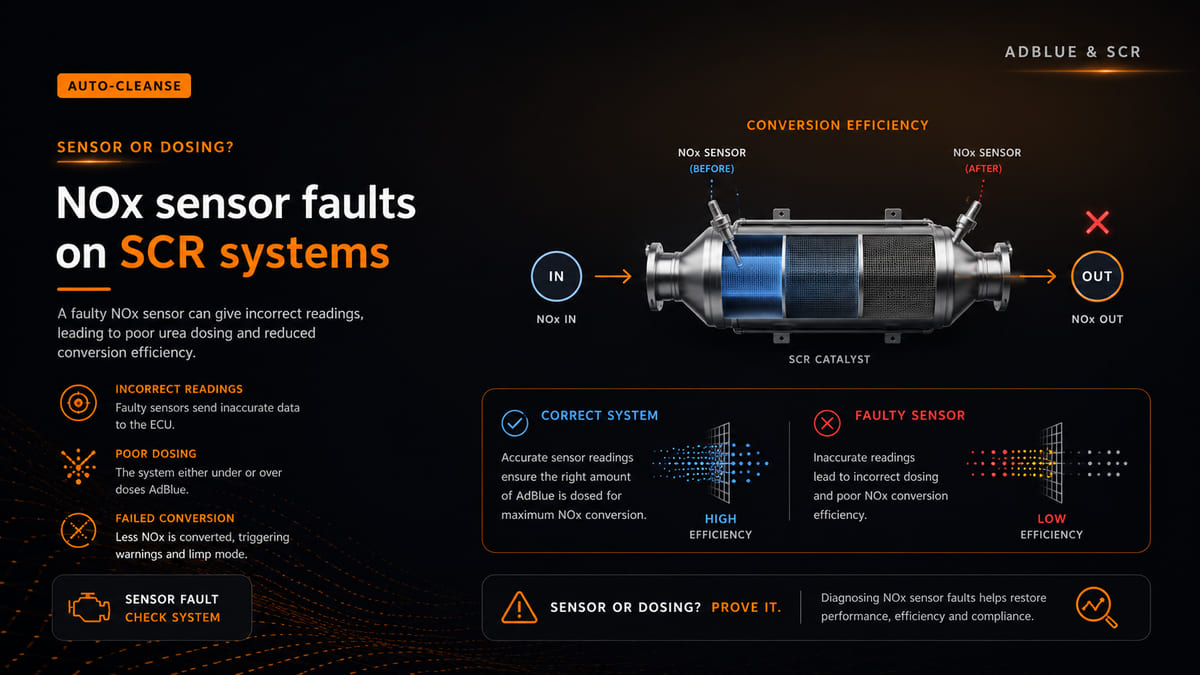 AdBlue
NOx sensors decide whether the SCR system passes or fails its own efficiency check. Here is why they fail, and why swapping one first is rarely the fix.
Read more →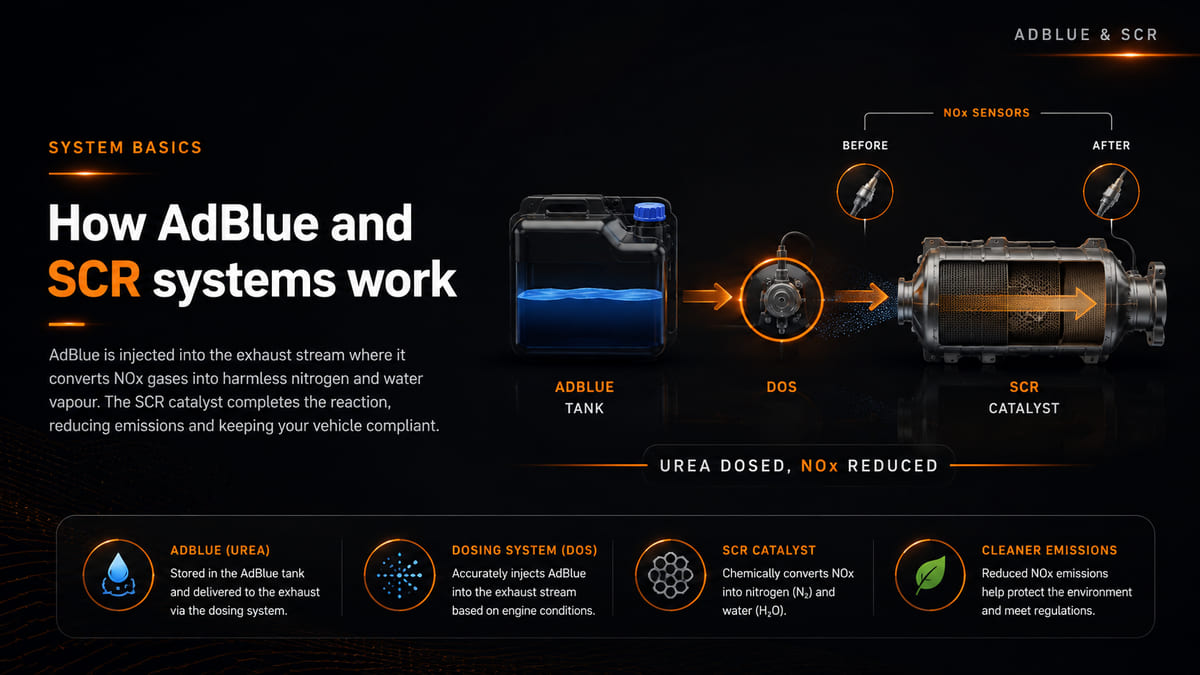 AdBlue
AdBlue is not a fuel additive. Here is how selective catalytic reduction actually works, and why the warnings escalate towards reduced power and no-start.
Read more →Ring with your reg and the warning message. We'll tell you what it's likely to be, who'd come out and what happens next.
Sources
Last reviewed 13 October 2026.