Will a Remap Cause DPF or AdBlue Problems?
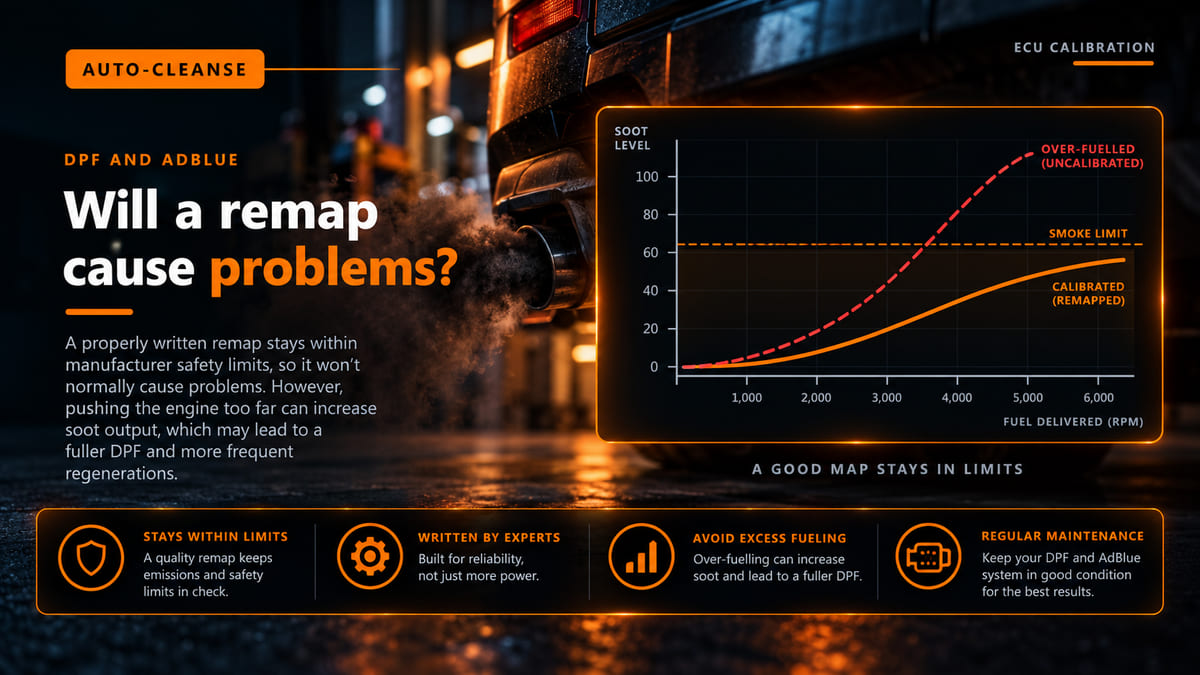
A well-made remap should not cause DPF or AdBlue problems. When trouble does follow a remap, there are two likely causes: a map that adds more fuel than the engine has air to burn, which loads the DPF with soot faster than it can regenerate, or a fault the vehicle already had - a sticking EGR valve, a boost leak or a failing injector - that the extra demand brings to the surface. On the AdBlue side, a legitimate map leaves the SCR system working as designed, though it may give it more NOx to treat.
A remap does not block a DPF by itself. Fuel the engine cannot burn cleanly does - and so does a fault that was already there.
Does remapping affect the DPF?
Only if the map adds fuel the engine cannot burn cleanly. A DPF stays healthy while the soot it traps is burned off during regeneration as fast as it builds up, and an over-fuelled map tips that balance.
On a diesel, extra torque comes mainly from extra fuel. If that fuel arrives without enough air to burn it completely, the surplus leaves as soot. Without a filter, that shows as black smoke; with one, it shows as faster loading and more frequent regenerations.
Why smoke limits exist
Factory diesel calibrations already guard against this. The ECU limits how much fuel it will inject for the air mass it measures or models - usually called the smoke limit - and some strategies also cap the richest air-fuel ratio the engine may run. A competent calibration keeps that relationship sensible: if more fuel is requested, it is matched to air the turbocharger can genuinely deliver.
The trouble starts when a map raises fuel and loosens those limits without the air to match. That over-fuelled map is a calibration choice, not something built into remapping.
Are hotter exhaust temperatures bad for the filter?
Not in itself. A remapped engine may run a hotter exhaust under sustained load, and that heat helps passive regeneration - soot reacting with nitrogen dioxide made by the oxidation catalyst (and, on many systems, a catalyst coating on the filter).
The real risk to the ceramic is a soot overload. US Mine Safety and Health Administration guidance explains that soot in a filter loaded beyond its design limit can burn uncontrollably, cracking or melting the ceramic. Avoiding that comes down to fuelling and condition.
Why DPF problems after a remap often start before it
A common route to DPF trouble after a remap is not the file itself but a vehicle that already had a soot or air problem. Our post on why vehicle condition matters before a remap covers the full pre-remap check; for the DPF, these are the faults to rule out:
- An existing soot problem. A filter that is already loading fast, failing to finish regenerations or carrying heavy ash will not improve because the engine makes more power.
- A sticky or sooted EGR valve. Recirculated exhaust displaces fresh air, so a valve that does not close properly leaves less oxygen for combustion and more soot.
- A boost leak. A split hose or leaking intercooler joint means less air than the ECU expects, so fuel and air no longer match.
- A failing injector. Poor atomisation or a leaking nozzle makes soot whatever the calibration says - see our post on injector and fuelling faults behind excess soot.
Common misdiagnosis: "The DPF blocked after the remap, so the remap blocked it." Sometimes that is true. Often the filter was already loading, an EGR valve was sticking or a boost hose was leaking, and the extra demand brought it to the surface. Check the data before blaming the file.
Will a remap affect my AdBlue system?
A legitimate remap should not change how the AdBlue system works, though it can change how much work the system has to do.
Selective catalytic reduction (SCR) converts NOx into nitrogen and water using ammonia released from AdBlue. NOx formation rises with peak combustion temperature, so a calibration that adds fuel and raises combustion temperatures under load can raise engine-out NOx in those conditions. The SCR system works out how much AdBlue to dose, so a working system may dose more to keep up. How much, if any, depends on the engine, the calibration, how the system calculates its dose and how the vehicle is driven.
A file that alters or switches off the SCR system's dosing strategy, NOx sensors or self-monitoring is no longer a performance calibration - it is interfering with the emissions system.
DPF or AdBlue warning after a remap? What to do
Work through these steps in order:
- Don't keep clearing codes or forcing regenerations. If the filter is heavily loaded, a forced regeneration risks the uncontrolled burn described above.
- Get the live data read, not just the codes. For the DPF that means soot loading, differential pressure, regeneration history, and boost and EGR values. For an AdBlue warning, start with the stored fault code.
- Ask the remapper what the file changed and whether the original was saved. Once the filter has been checked, refitting the original file is one way to separate the calibration from the hardware.
- Fix whatever loaded the filter before it is cleaned or replaced, or it can load again.
Our DPF diagnostics service is a paid OBD and live-data check, with the vehicle normally coming to Totnes. For an AdBlue fault, our AdBlue repair service starts with phone triage, using our own technicians in Devon and an independent technician from our national network elsewhere.
Remap and emissions: what has to stay in place
On a road vehicle, the MOT checks the emissions equipment fitted as standard: missing, obviously modified or obviously defective equipment is a major defect. The DVSA inspection manual covers visible and identifiable emission control components such as the DPF, EGR valve and SCR (AdBlue) valve. It also includes a metered smoke test against the limit on the manufacturer's plate, or a default limit set by the vehicle's age where there is no plate value. Visible smoke of any colour from a DPF-equipped vehicle is a major defect, and on diesels first used from 1 July 2008, so is an engine-management lamp that does not work or shows a malfunction.
A sensible calibration should therefore leave a diesel that stays within its smoke limit, keeps its warning lamps clear and regenerates normally. Deleting or disabling the DPF, EGR or AdBlue system is not a legal fix for a road vehicle - see our guides to the law on AdBlue deletes and DPF removal and the law.
Questions to ask a remapper
These questions separate a careful job from a quick one:
- Do you check the vehicle first? Ask what it covers - fault memory, DPF loading and regeneration history, EGR and boost data.
- What happens if you find a fault? The right answer is that it gets repaired first, not mapped around.
- Is the calibration written for my exact vehicle and software? A generic file for "the same engine" is not the same thing.
- How do you handle smoke and fuel limits? You want to hear that extra fuel is matched to the air available.
- Will the DPF, EGR and AdBlue systems stay intact and working? On a road vehicle the answer should be yes.
- Will you back up my original file and scan for faults afterwards? Both should be standard.
How Auto-Cleanse can help
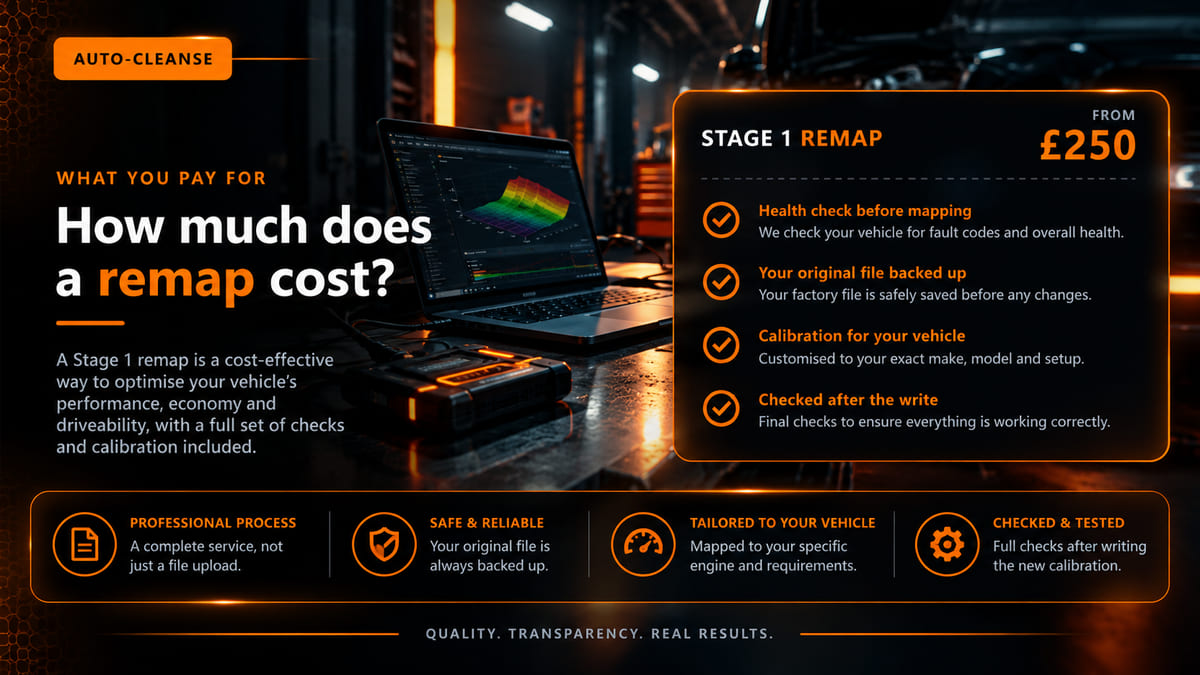
Every ECU remap we carry out starts with a diagnostic health check, included in the Stage 1 price, and we only proceed if the engine is healthy. If there is a DPF, EGR or AdBlue fault, we quote to repair that first. On road cars the DPF, EGR and AdBlue systems are kept intact and road-legal, and the original file is backed up so the car can be returned to stock. A Stage 1 remap is £250 at our Totnes workshop or £270 mobile - call 07823 649190 to book.
Frequently asked questions
Will a remap block my DPF?
A well-made remap should not. A DPF blocks when soot output outruns regeneration, and an over-fuelled map can cause that by injecting more fuel than the air can burn. Short journeys, interrupted regenerations and existing faults can block a filter whatever the calibration.
Does a remap make a car use more AdBlue?
In some cases it can use more. If a calibration raises combustion temperatures under load, engine-out NOx can rise, and a working SCR system may dose more to treat it. How much depends on the vehicle, the calibration and how it is driven.
Will a remap make my DPF regenerate more often?
Not noticeably, if the extra fuel is matched to the air available. Active regenerations are triggered mainly by soot load, so if they become clearly more frequent after a remap, get the soot and regeneration data read - over-fuelling or an existing fault are the likely causes.
Can a remap fix a DPF problem?
No. A remap does not clear soot or ash from a filter or repair the fault that loaded it, and a file that hides or switches off DPF monitoring is a delete, not a fix. The fault is repaired first, and the remap goes on a healthy vehicle.
The takeaway
A remap does not have to mean DPF or AdBlue problems. Keep the smoke limits sensible, leave the emissions systems working, and fix any fault before the map goes on - the vehicle should then carry on regenerating and dosing as normal.
Sources
- DieselNet - diesel filter regeneration technical guide
- HP Academy - diesel tuning fundamentals: the smoke limit
- Snap-on - technical focus: how NOx forms in engines
- Bosch - Denoxtronic AdBlue dosing system technical information
- US Mine Safety and Health Administration - ceramic DPF runaway regeneration best practice
- DVSA - MOT inspection manual for cars and passenger vehicles
General technical guidance only. Manufacturer-specific handbook information, workshop procedures and specifications always take precedence.
Need help with this on your vehicle?
Auto-Cleanse can sort it. See our ECU Remapping service, or get in touch.
Related: Stage 1 Remaps in Devon · DPF Diagnostics