Van and Commercial Remapping: Towing, Payload and Gearing
Most remap enquiries for cars open with a power figure. Enquiries about vans, pickups and light commercials rarely do. What the owner usually describes is a vehicle that feels fine empty and hard work loaded - dropping a gear on every incline, sitting awkwardly between ratios with a trailer on the back, or needing far more pedal than seems reasonable to hold a steady speed up a long hill.
That is a driveability complaint, not a horsepower complaint, and it is why commercial calibration work is approached differently from a performance job on a private car.
On a working vehicle the useful question is not how much power it makes, but how it behaves at the loads it actually carries.
Loaded running is a different operating point
An unladen van and the same van at its plated weight are, as far as the engine is concerned, two different vehicles. Modern diesels use torque-based engine management: pedal position expresses driver demand, and the control system coordinates air, fuel and boost to deliver a requested torque within the limits its strategy permits.
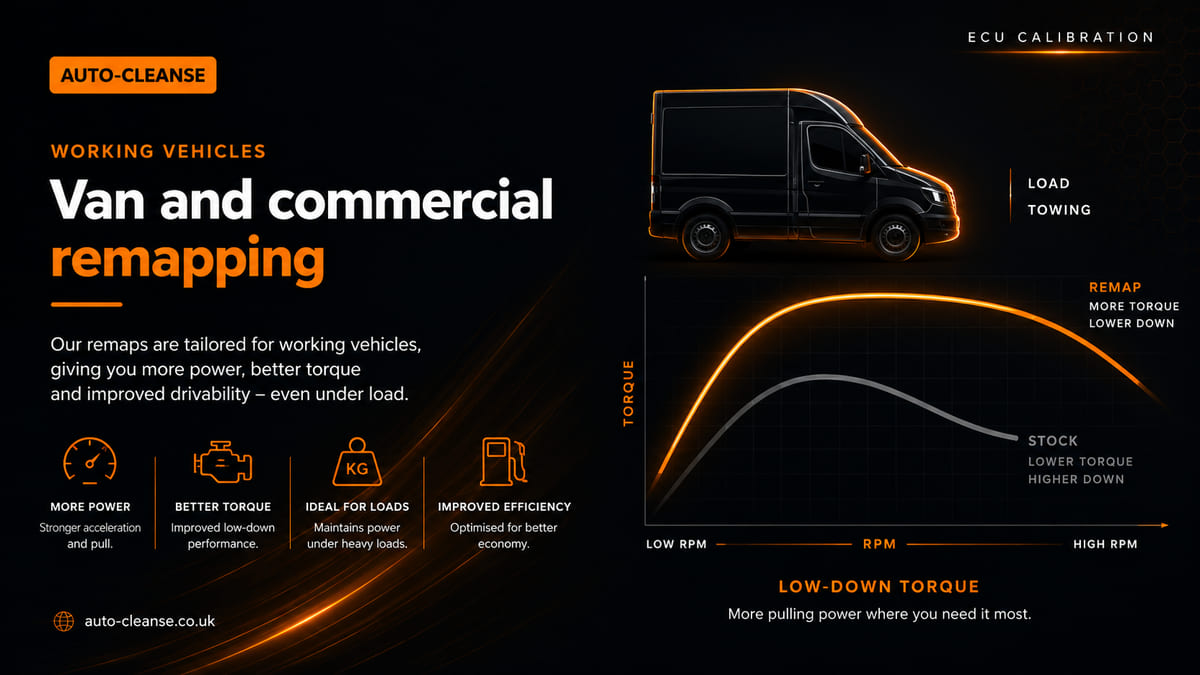
Under load, the driver spends far more time asking for torque low and mid-range - pulling away, climbing, or holding a speed against a gradient and the drag of a trailer. How the engine behaves in that region is what gets described as gutless or willing. Peak output, produced near the top of the rev range, barely enters into it on a vehicle that rarely goes there.
What a commercial calibration aims at
Response low in the rev range
The practical goal of a Stage 1 remap on a commercial vehicle is usually a fuller, earlier and more progressive torque delivery in the range the vehicle actually works in, rather than a larger number at the top. A loaded vehicle that responds cleanly from low revs is easier to place at junctions, easier to launch on a slope and far less tiring over a working day.
Fewer gear changes on gradients
Much of the fatigue in driving a loaded van comes from hunting between gears. If the engine can hold the higher ratio through a gradient instead of dropping down and revving out, the vehicle settles. That is a gearing outcome as much as an engine one, and it is often the single change owners notice most.
Steady-state running
Where a vehicle spends long periods at a constant speed and load, a calibration that reduces how hard the driver has to work the pedal to hold that state can bring a fuel benefit. It is entirely condition-dependent - route, weight, driving style, tyre pressures and vehicle condition all move the result, and no honest figure can be promised in advance.
A common misunderstanding: more torque means more towing capacity. It does not. Gross vehicle weight and gross train weight are set by the manufacturer and recorded on the vehicle's plate, with the towing limits given in the handbook and vehicle documents. They are structural, braking and legal limits - a calibration change does not raise any of them, and using a vehicle above them remains an offence regardless of how the engine has been mapped.
The limits that decide whether it is sensible
Clutch and gearbox
The engine produces torque; the clutch and gearbox have to transmit it. Commercial drivelines are specified around the manufacturer's torque figure and the duty they were designed for. A clutch already slipping under load, or a gearbox near the end of its life, will not be improved by more input torque - it will simply reach its limit sooner.
Cooling and sustained load
Towing and loaded hill work put the engine, cooling system and transmission under sustained demand rather than short bursts. A vehicle with a marginal cooling system, a tired charge-air path or restricted airflow is the wrong candidate for any increase in output.
Vehicle condition first
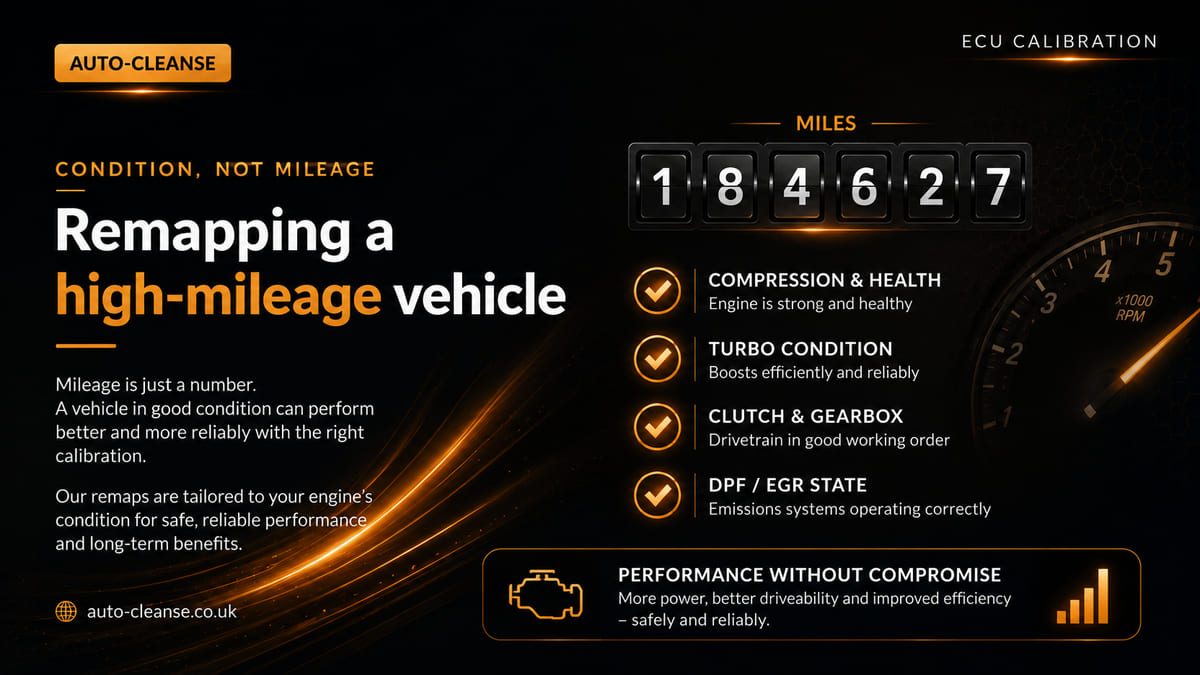
Boost-side leaks, injector condition, EGR operation, air filtration, service history and existing fault codes all need reviewing before any file is written. A calibration applied over an unresolved fault does not fix it - it masks it for a while and can make the eventual failure worse.
Emissions systems stay intact
This is not negotiable. The DPF and, where fitted, the SCR and AdBlue system remain fully functional and fully monitored. Using a road vehicle whose emissions control equipment has been removed or rendered inoperative is an offence, a missing or defeated filter is grounds for MOT failure, and on a commercial vehicle it exposes the operator to enforcement risk as well.
There is a practical reason too. A vehicle that spends its life loaded generates soot at a rate the aftertreatment system has to keep up with, so regeneration behaviour and dosing strategy stay intact rather than being treated as obstacles.
Disclosure on a working vehicle
Commercial vehicles carry more paperwork than private cars, and every party with an interest needs telling.
- Insurer. A remap is a modification and must be declared, on a fleet policy exactly as on a private one.
- Finance, lease or contract-hire provider. Most agreements restrict modification. Check the terms before the work, not after.
- Fleet operator or employer. If the vehicle is not solely yours to alter, the decision is not solely yours to make.
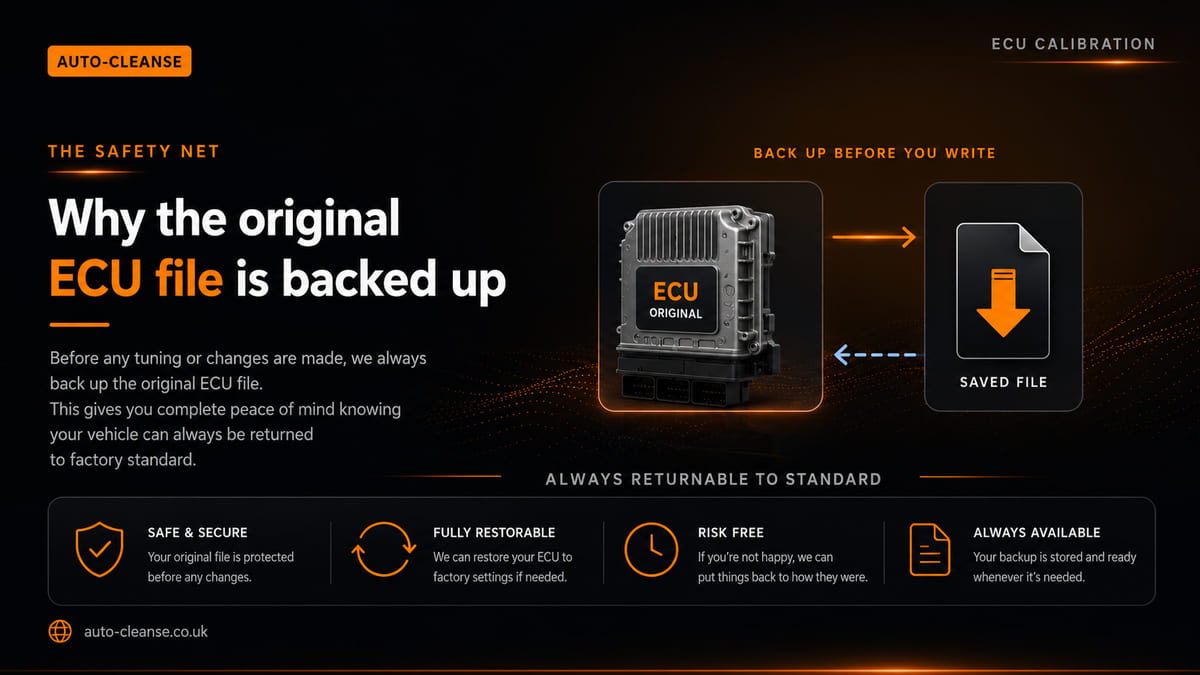
For fleets, mobile remapping on site keeps vehicles off the road for less time, but it does not shorten the checks - the condition assessment and the original file backup happen either way.
The takeaway
A commercial remap is worth considering when the complaint is how the vehicle behaves loaded, and when the driveline, cooling and emissions systems are all in a condition to support it. If any of those is in doubt, fix that first - the calibration is the last step, not the first.
Sources
- Bosch Mobility - diesel engine management and torque-based control information
- HELLA TechWorld - diesel exhaust aftertreatment and SCR system technical information
- Motorservice - technical information on diesel engine and turbocharging components
- DVSA - guidance on vehicle roadworthiness, MOT emissions requirements and vehicle weights
- Manufacturer workshop information - towing limits, plated weights and driveline specifications
General technical guidance only. Manufacturer-specific workshop information, plated weights and specifications always take precedence.
Need help with this on your vehicle?
Auto-Cleanse can sort it. See our ECU Remapping service, or get in touch.
Related: Mobile ECU Remapping · Stage 1 Remaps in Devon