Why Vehicle Condition Matters Before a Remap

A remap changes how engine torque is requested and delivered - it alters airflow, fuelling and boost strategy. None of that behaves as intended if the systems producing and transmitting that torque are not already working correctly, so the vehicle needs a credible baseline before any calibration begins.
A remap changes engine torque delivery. The vehicle should have a credible mechanical, electrical and emissions-system baseline before calibration begins.
Why the baseline matters
Modern engine management coordinates driver demand with air, fuel, combustion, exhaust-system requirements, diagnostics and communication with other control units. Torque is the central reference used to bring all of that together, so a weakness elsewhere in the system feeds directly into how a calibration behaves.
Air and boost
Air-mass, manifold-pressure and boost-control information must be credible before that data is used as the basis for a new calibration.
Fuel and combustion
Fuel pressure, injection and combustion control must respond as intended, or the extra demand a remap introduces will simply expose the weakness.
Drivetrain and exhaust
The clutch, transmission and emissions systems still have to manage the result once torque delivery changes.
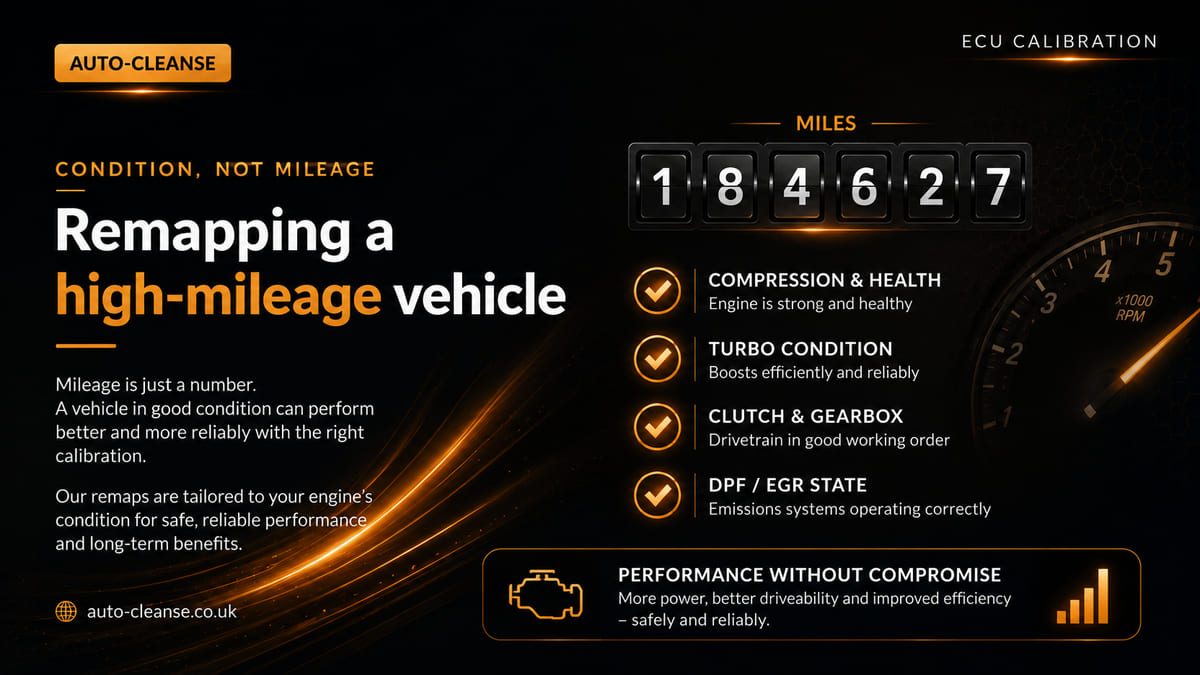
Five areas to check before calibration
- Fault context. Scan every relevant control unit and record current, pending and stored faults where the diagnostic platform makes them available. Review freeze-frame information and establish whether any warning, reduced-power condition or communication fault is active.
- Air path and boost control. Inspect intake pipework, charge-air hoses, intercooler connections, vacuum supply and actuator operation as applicable. Compare requested and actual data under suitable conditions, using the vehicle manufacturer's procedure.
- Fuel and combustion. Review fuel-pressure control and any manufacturer-supported combustion or injector information available for the application. Investigate misfire, smoke, unstable running or pressure-control faults before calibration.
- Temperature and aftertreatment. Coolant-temperature information affects engine-management decisions. On diesel vehicles, DPF loading, pressure-sensing integrity and regeneration history should be understood - a DPF diagnostics check is the way to establish that - before torque demand is altered.
- Drivetrain condition. Clutch slip, transmission faults, harsh shifts, driveline vibration or overdue maintenance deserve investigation before additional torque is requested. The exact checks depend on the gearbox and vehicle application.
Do not tune around the fault. Clearing a warning light does not create a healthy baseline. An active boost, fuel-pressure, temperature, misfire, aftertreatment or transmission fault should be diagnosed on its own merits - altering the calibration is not a substitute for repairing the mechanical or electrical cause.
A scan is only one part
No fault codes does not prove perfect condition. Electronic and physical evidence answer different questions, and a pre-calibration assessment needs both.
Electronic evidence
Fault memory and live data are useful for comparing target against actual values, sensor plausibility, actuator tests, temperature behaviour and control-unit communication.
Physical evidence
Inspection and functional testing are needed for leaks, damaged hoses, contamination, actuator movement, clutch behaviour, unusual noise and faults that fall outside the ECU's detection strategy.
A defensible process
- Establish the baseline. Scan, inspect and road-test where safe and appropriate.
- Resolve faults first. Repair active problems and confirm the repair has worked.
- Match the calibration. Consider engine, gearbox, vehicle use, fuel and customer requirements - this is where a Stage 1 remap is scoped to suit the vehicle rather than applied as a generic file.
- Program safely. Use the correct file, protocol, power support and recovery procedure.
- Verify the result. Rescan, review relevant data and confirm the vehicle performs correctly.
The takeaway
A remap should build on a healthy baseline, not disguise an unhealthy one. The better the assessment before calibration, the easier it is to choose a sensible torque strategy and identify any issue that appears afterwards.
Sources
- Bosch Mobility: Electronic engine control unit and torque-based engine management
- Bosch Mobility: Hot-film air-mass meter, boost-pressure sensing and fuel-pressure sensing
- BorgWarner Aftermarket: Turbocharger troubleshooting and primary engine-system causes
- HELLA TechWorld: Boost-control diagnosis and coolant-temperature sensor function
- NTK Vehicle Electronics: Exhaust differential-pressure sensing and DPF monitoring
- ZF: Powertrain coordination between engine and transmission control
General technical guidance only. Suitable checks, diagnostic limits, calibration methods and acceptable vehicle condition vary by manufacturer, engine, transmission, ECU strategy and intended use. Manufacturer workshop information always takes precedence.
Need help with this on your vehicle?
Auto-Cleanse can sort it. See our ECU Remapping service, or get in touch.
Related: Stage 1 Remaps in Devon · DPF Diagnostics