Injector and Fuelling Faults Behind Excess Soot
A diesel particulate filter deals with the consequences of combustion. Everything it collects was created upstream, in the cylinder, by the way fuel and air were mixed and burned. So when a DPF reloads far faster than it should, the fuelling system is one of the first places worth looking, not one of the last.
Injection faults rarely announce themselves with an obvious misfire. A tired set of injectors can idle acceptably, drive reasonably and still push far more particulate into the exhaust than the filter was designed to handle.
Soot is made at the injector tip long before it is measured at the filter.
Why injection quality drives soot output
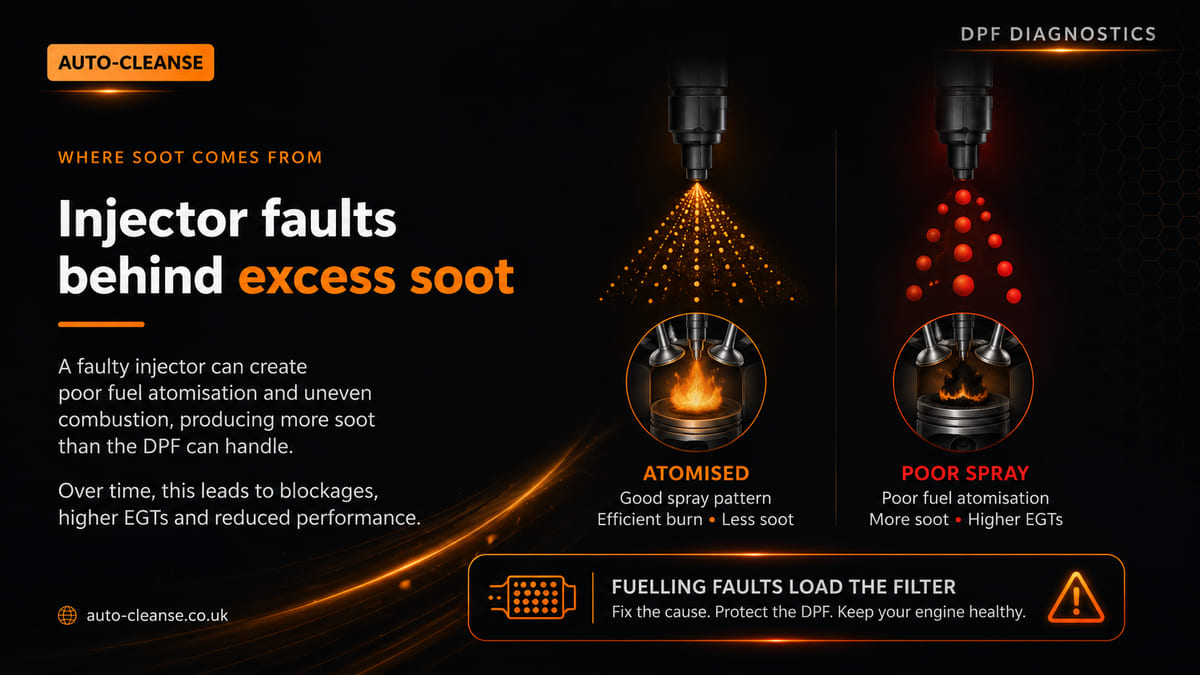
How finely and how evenly the fuel is broken up as it leaves the nozzle largely decides how cleanly it burns. Anything that puts fuel in the wrong place, at the wrong time, or in droplets that are too large to burn cleanly will raise particulate production. Almost every fuelling fault feeds into that mechanism.
Worn or leaking nozzles
Nozzle holes erode and enlarge with mileage and with poor fuel quality. An eroded hole delivers a coarser spray, and the injector may also dribble at the end of the injection event rather than closing sharply. Late, poorly atomised fuel arriving after the main burn has little chance of oxidising properly, and it tends to leave the cylinder as particulate and unburnt hydrocarbon.
Excessive back-leakage past the injector control valve is the related fault. Where return volume exceeds the manufacturer specification, the pump has to work harder to maintain rail pressure, pressure can become unstable under load, and delivery drifts between cylinders.
Poor atomisation and spray pattern
Carbon build-up around the nozzle tip, a partially blocked hole or a distorted spray cone all change how the fuel plume develops. The result is uneven mixing, cooler local burn zones and more soot, often with a slight roughness at idle that owners describe as normal for a diesel.
Incorrect coding or correction values
Modern common-rail injectors are individually calibrated, and the ECU relies on the correct code being entered against the correct cylinder. If injectors are swapped between cylinders during a repair, or codes are transposed or never written, the ECU applies the wrong correction for the life of the fault. Delivery drifts from the intended quantity, and the resulting imbalance shows up as raised soot long before it becomes a driveability complaint.
Injector correction and balancing values in live data are a useful starting point. Values well outside the normal range for the application, or one cylinder behaving very differently from the others, are worth investigating as part of DPF diagnostics.
Rail pressure and the high-pressure pump
Injection pressure is one of the main influences on droplet size. Low rail pressure tends to produce larger droplets, slower evaporation and poorer mixing, so soot production rises, typically most noticeably under load.
Common contributors include a worn high-pressure pump, a leaking pressure-control or metering valve, restricted low-pressure supply or a blocked filter, air ingress on the suction side, and excessive combined injector return flow. Comparing commanded against actual rail pressure under load, and checking pressure-control valve duty against the manufacturer specification, separates a supply problem from a control problem.
Pump wear matters for a second reason: metallic debris from a failing high-pressure pump can circulate and damage injectors, which is why a fuelling repair should establish whether contamination is present before new components are fitted.
Post-injection, regeneration and oil dilution
Many systems raise exhaust temperature for regeneration by injecting a small extra quantity of fuel after the main combustion event. Where that is done in-cylinder, some of the late fuel can wash down the bore wall and pass into the sump instead of burning. Applications that dose fuel directly into the exhaust stream avoid that route, so whether dilution is a concern depends on the strategy used.
Two situations make this worse: regenerations that are frequent because soot production is high, and regenerations repeatedly interrupted by short journeys before they complete. Either way, the oil accumulates fuel. Diluted oil loses viscosity and film strength, which puts the turbocharger and the bearings at greater risk. There is a knock-on effect for the filter: the ash a DPF retains comes largely from lubricant additives, so anything that raises oil consumption adds to the ash load regeneration cannot burn away.
- Check the oil level and condition first. A rising oil level with a fuel smell is a strong indication of dilution and should be treated as urgent.
- Review the regeneration history. Frequent or repeatedly aborted regenerations point at either an upstream fault or a duty cycle that never allows completion.
- Establish why regenerations are being demanded so often. The answer is often fuelling rather than the filter.
- Observe the manufacturer's oil-change interval and specification. Dilution shortens the useful life of the oil regardless of what the service schedule says.
Common misdiagnosis: "The injectors must be fine because there are no injector fault codes." Codes are set when a monitored value breaches a threshold. Injectors can atomise poorly, dribble slightly or carry wrong correction values while every monitored parameter stays inside its limits, and the only symptom is a filter that keeps loading.
Where this leaves the filter
A filter loaded by an unresolved fuelling fault will often need cleaning as well as the mechanical repair. Removing the filter for off-vehicle cleaning is the correct route where soot and ash have accumulated, but if a leaking injector or low rail pressure is left in place the filter is likely to load again. Getting a blocked DPF sorted properly means treating the clean and the fuelling repair as one job, not two unrelated ones.
The takeaway
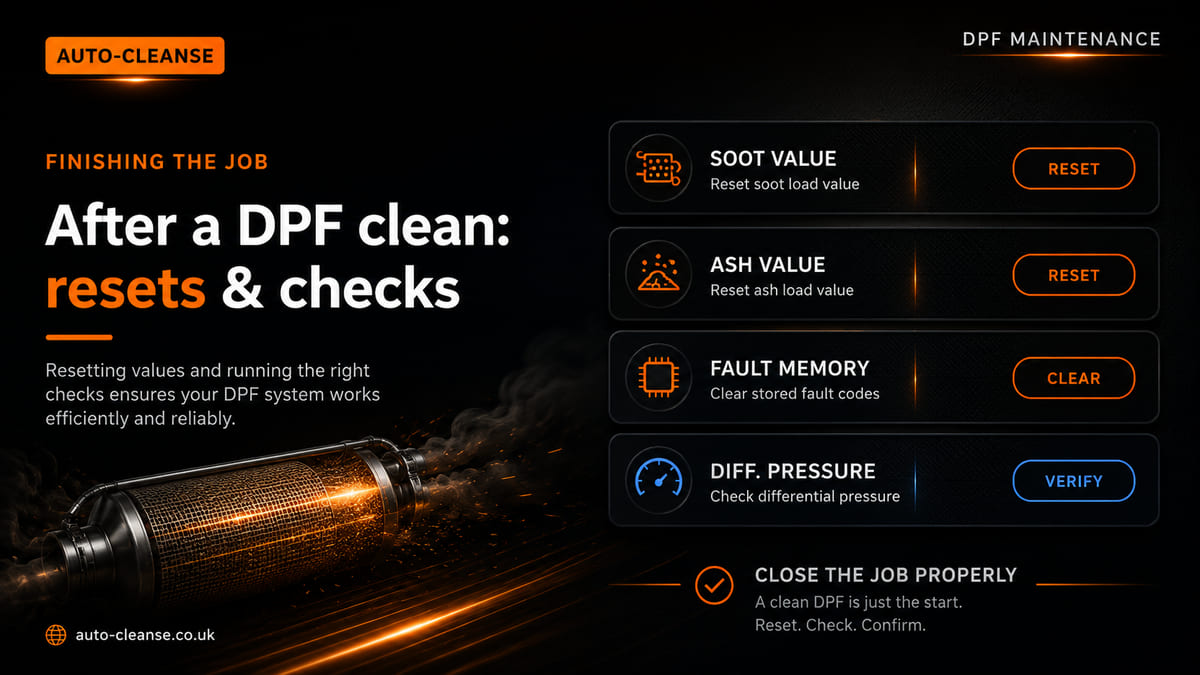
If a DPF reloads quickly, assess injector condition, correction coding and rail pressure before assuming the filter is at fault. Clean the filter by all means, but leave the reason it filled unresolved and the loading tends to return.
Sources
- Bosch Mobility - common-rail diesel injection technical information
- Delphi Technologies - diesel fuel injection diagnostics guidance
- HELLA TechWorld - diesel particulate filter and injection system fault diagnosis
- Motorservice - diesel injection and particle filter technical information
- Manufacturer workshop information - injector coding, rail pressure testing and oil dilution procedures
General technical guidance only. Manufacturer-specific workshop information, test conditions and specifications always take precedence.
Need help with this on your vehicle?
Auto-Cleanse can sort it. See our DPF Diagnostics service, or get in touch.
Related: Blocked DPF Cleaning · DPF Cleaning in Devon