Does DPF Cleaner Work? What Additives Can and Can't Do
Sometimes. A DPF cleaner additive can help a healthy diesel burn off a light build-up of soot, as long as it gets a proper drive so a regeneration can finish. It cannot remove ash, and it cannot fix whatever made the filter block, such as an EGR, injector or sensor fault. Sprays injected through a sensor port and forced regenerations at a garage have the same limit: they work on soot, not ash.
Does DPF cleaner work? The short answer
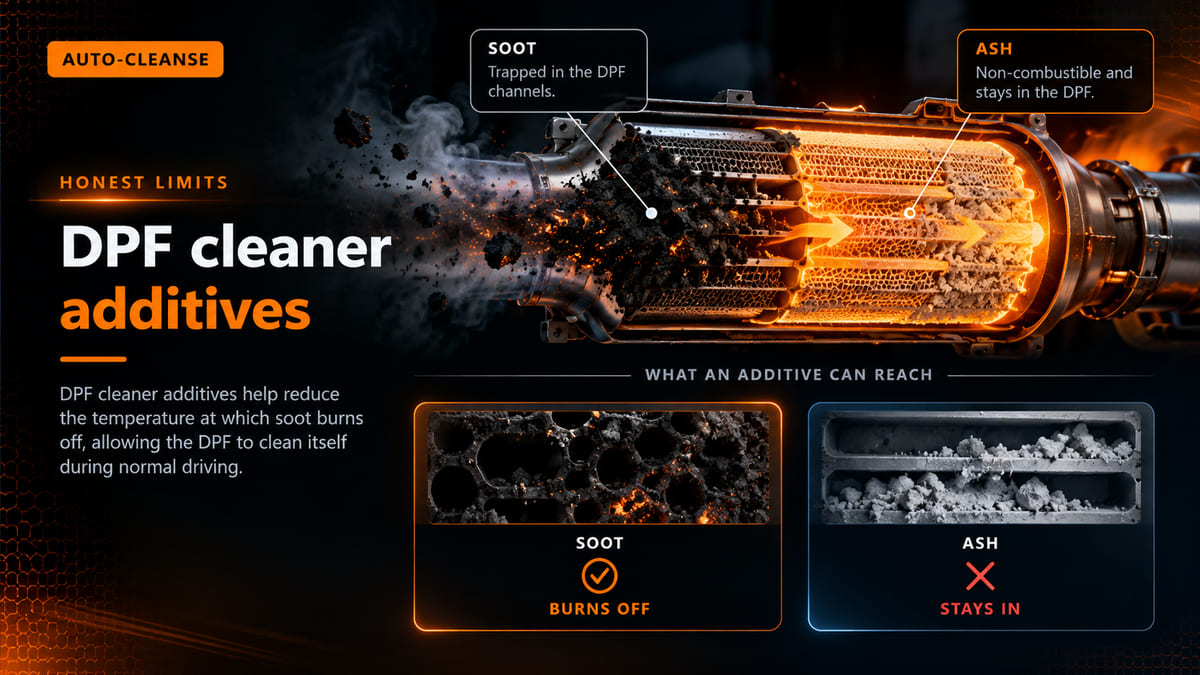
A diesel particulate filter collects two kinds of material. Soot is carbon from combustion, and it burns. Ash is the non-combustible residue left mainly by engine oil additives, and it does not. Every on-car option - an additive in the tank, a spray into the filter, or a commanded regeneration - is a way of getting soot to burn, or to burn more easily.
That makes them useful when the problem is light soot loading on an otherwise healthy vehicle. It makes them close to useless when the problem is ash, physical damage, or an engine fault producing soot faster than any regeneration can clear it. Ash builds up over the filter's life and can only be removed by taking the filter off for a physical clean - the difference is explained in when a DPF needs off-vehicle cleaning.
How in-tank DPF cleaner additives claim to work
A DPF cleaner additive is poured into the fuel tank and burned with the fuel. Products generally make one or both of two claims.
Lowering the temperature at which soot burns
Some additives are described as helping trapped soot burn off at a lower temperature, making regeneration easier. The principle is well established: catalytic metal compounds carried in the fuel end up mixed into the soot in the filter and reduce the temperature needed to oxidise it.
The realistic limit is that "lower" does not mean "low". The exhaust still has to get hot enough, for long enough, for the soot to burn, so an additive helps a regeneration happen rather than replacing one. There is also a catch: metal compounds that promote soot combustion leave metallic ash behind, and ash stays in the filter.
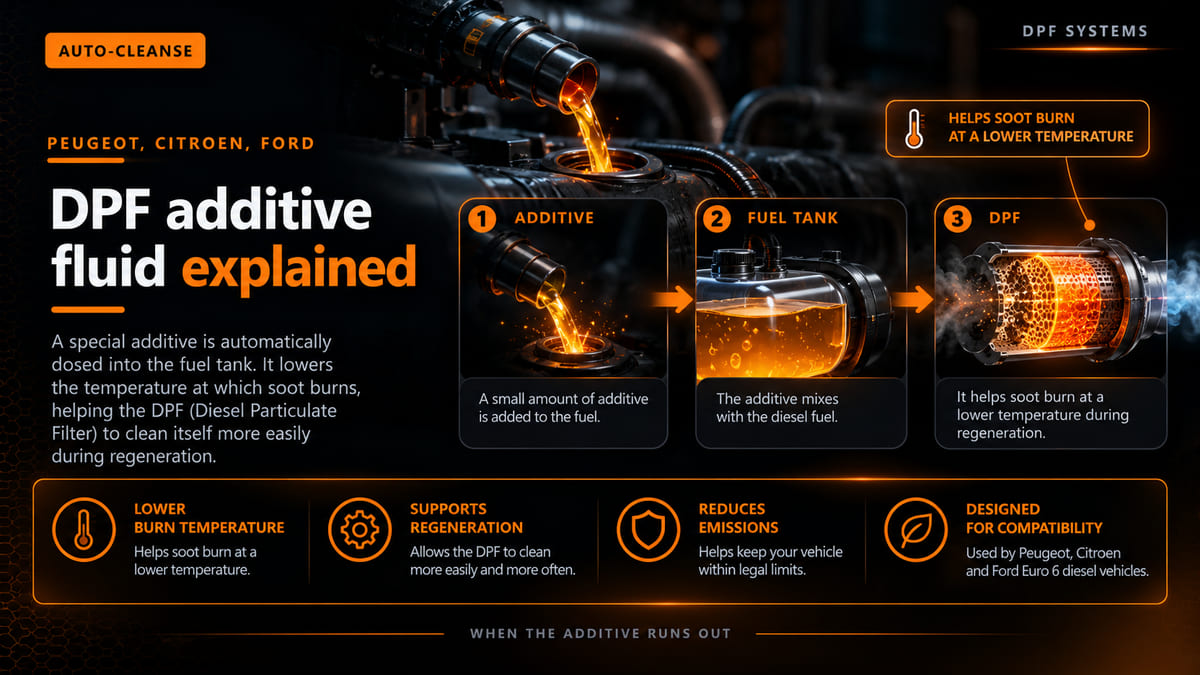
Some Peugeot, Citroen and Ford diesels instead have a manufacturer-fitted DPF additive fluid system with its own tank, dosed automatically - a different thing from a bottle of additive.
Cleaner combustion
Other claims centre on combustion: keeping injectors and the combustion chamber clean, and cetane improvers to help the fuel burn more completely, so less soot is produced in the first place. Independent test results on whether this cuts soot from a modern common-rail car engine are mixed, so treat it as a possible small benefit on a healthy engine at best. It will not correct worn injectors, wrong injector coding or an EGR fault, which produce excess soot for reasons no fuel additive can fix.
When is a DPF additive worth trying?
An additive is a reasonable thing to try when:
- the filter warning is early and the vehicle has not gone into reduced power;
- there are no stored engine faults and the engine is otherwise running well;
- the handbook does not rule out aftermarket fuel additives;
- it is used alongside a proper drive - sustained, steady running at full operating temperature, following any procedure in the handbook.
It is wasted money when:
- the vehicle has covered a high mileage and the restriction is likely to be ash;
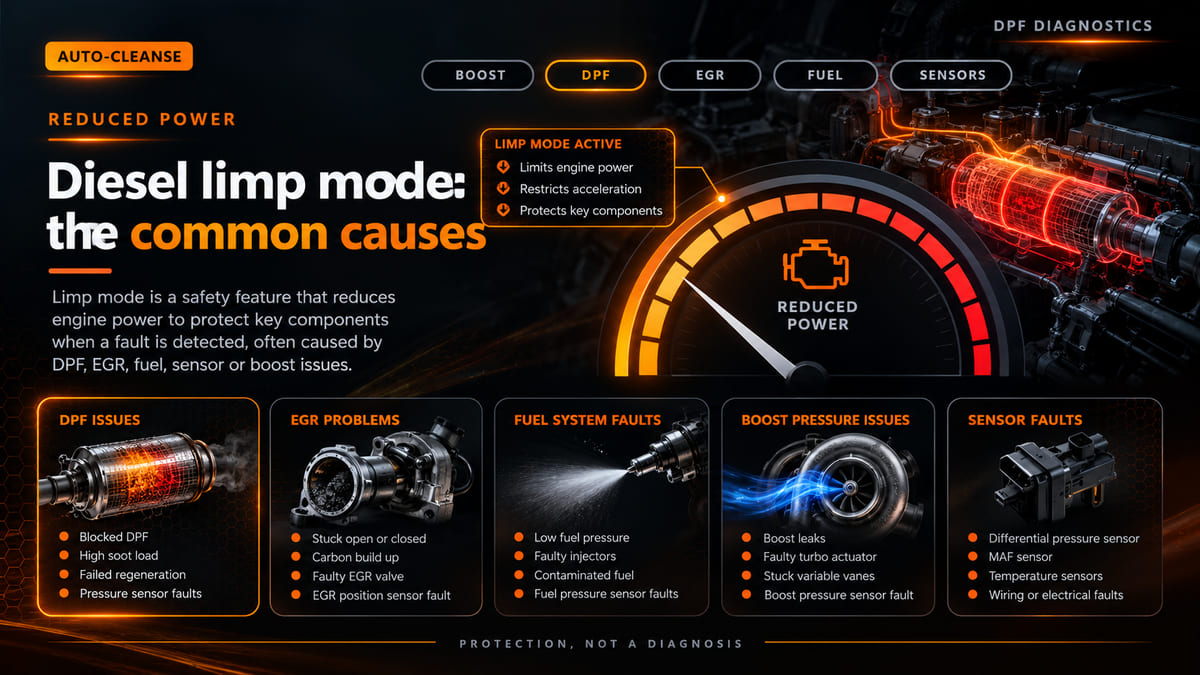
- the filter is loaded past the point where the ECU will allow a regeneration, or the vehicle is in limp mode;
- a sensor or pressure pipe fault is giving the ECU false readings;
- an upstream fault is producing excess soot, such as EGR faults or injector and fuelling faults;
- the warning comes back soon after every attempt.
Give it one fair attempt: one dose at the label rate and one proper drive as the handbook describes, where it is safe and legal to do so. If the warning has not cleared, or comes back, stop buying bottles and have the codes and live data read with a DPF diagnostic check.
Common misdiagnosis: "The additive cleared the light, so the filter is fine." A cleared warning means soot came down. It says nothing about ash, the filter's condition or why it loaded, and the light is likely to return if the cause is still there.
Aerosol and foam DPF cleaners
These are sprayed directly into the filter while it is still on the vehicle. Professional products broadly follow the same pattern:
- Access through a sensor port. A temperature sensor, or the pressure-sensing pipe connection on the filter housing, is removed, and a probe or nozzle is fed through the opening so the fluid reaches the filter face.
- Spray, and sometimes soak. The cleaner is applied in bursts. Some products are left to soak for a set time, and some are then followed by a separate flushing fluid.
- Burn off the residue. The fluid loosens and disperses soot through the filter. A drive or a commanded regeneration is then needed to burn off the loosened material and the moisture left behind.
The risks are worth knowing before anyone sprays anything:
- Instructions differ, and matter. Products differ on filter temperature, soak time and follow-up steps. What is correct for one product is not correct for another.
- Fluid can reach the engine. Where the filter sits close to the exhaust manifold or turbocharger, product instructions warn that fluid can enter the combustion chamber through an open exhaust valve.
- Seized sensors. A sensor that has been through years of heat cycles can be reluctant to come out, and a damaged sensor or thread adds a repair.
- The job is not finished until the regeneration is. If the follow-up regeneration does not complete, the loosened soot stays in the filter, and the filter may still be wet.
- Check what is measured. Unless someone records differential-pressure readings before and after, there is no record of what the treatment achieved, and only a flow test on the removed filter shows directly how clear it is.
If a service is described as on-car or mobile DPF cleaning, it is reasonable to ask which of these methods it uses.
Forced regeneration at a garage
A forced regeneration is a procedure commanded with a diagnostic tool to raise exhaust temperature and burn soot in place. It is not an additive, but it has the same fundamental limit: it works on soot, and only when the system is healthy and the loading is within the range the manufacturer allows. We explain how it differs from the other types in passive, active and forced DPF regeneration.
When on-car options have run out
When additives, sprays and regenerations stop working, the next step is a professional off-vehicle DPF clean. Once the filter is off the vehicle, it is cleaned in a dedicated machine with high-pressure water, dried with controlled hot air, and flow tested before and after so you can see exactly what changed. It removes ash as well as soot.
Before that, get the cause checked. Reading the fault codes and live data first means a clean filter is not refitted to an engine that will block it again.
How Auto-Cleanse can help
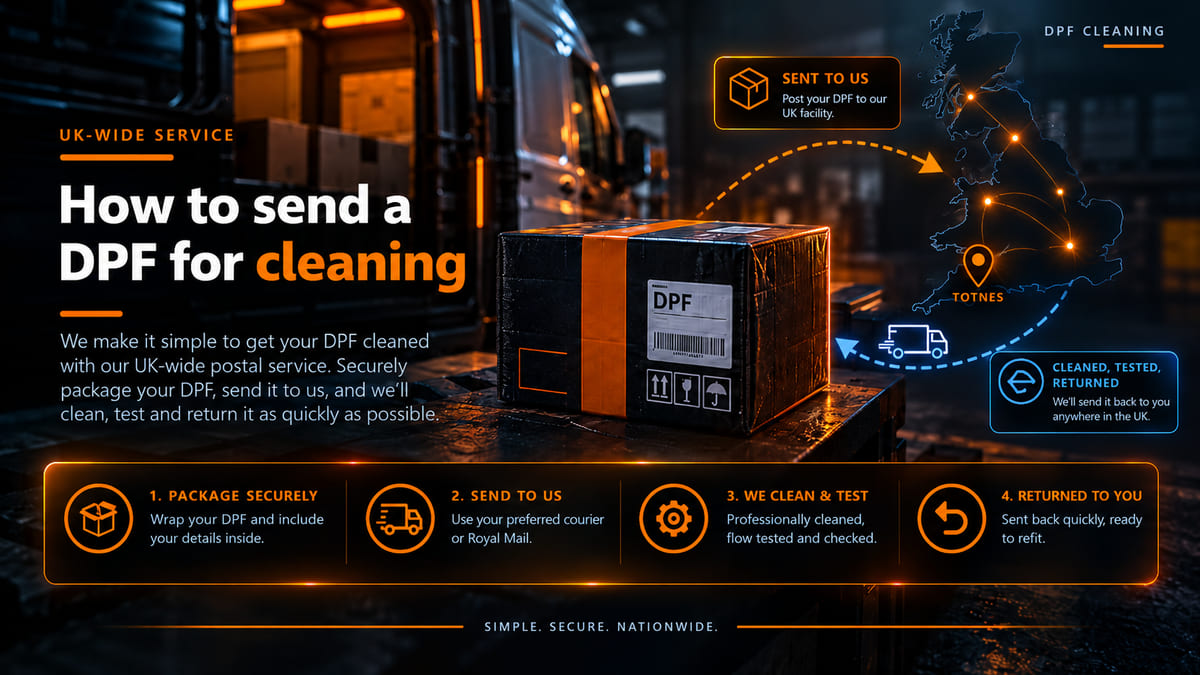
We clean removed filters off the vehicle, with before-and-after flow and back-pressure testing and an honest report on whether the filter is worth saving. Removed filters can be collected and returned locally in Devon, and our postal DPF cleaning service covers the whole UK. It costs £210 within 10 miles of Totnes and £230 further afield or by post, and prices are confirmed when you contact us with your vehicle details. If you need help with removing and refitting the filter, call 07823 649190 to discuss current availability.
Frequently asked questions
Will a DPF cleaner turn off the warning light?
Only if soot was the cause and a regeneration completes on the drive afterwards. A light that stays on, or comes back, points to a fault or to ash, not to a need for more product.
Can a DPF be cleaned without removing it?
Soot can be reduced on the vehicle with an additive, a spray treatment or a forced regeneration. Ash cannot be burned off, and published guidance from the US EPA and HELLA is that an ash-loaded filter has to be removed and cleaned, or replaced.
What is the best DPF cleaner?
There is no single best product. Check that your handbook allows aftermarket fuel additives, choose one made for vehicles with a DPF and follow its label dose. If the filter is ash-loaded or a fault is driving the soot, no product is the right one.
Can a DPF cleaner damage my engine or filter?
It can. Some handbooks, Kia's among them, warn against fuel additives the manufacturer has not approved, so check yours and your warranty terms before adding anything. With sprays, instructions vary between products, some warn about fluid reaching the engine where the filter is mounted close to it, and seized sensors can be damaged on removal.
The takeaway
DPF cleaner additives, sprays and forced regenerations all do the same job: they help soot burn. That is worth trying on a healthy vehicle with light loading, but once the restriction is ash, or a fault is driving the soot, the money is better spent on diagnosis and an off-vehicle clean.
Sources
- HELLA TechWorld - diesel particulate filter system, additive systems and ash
- DieselNet - diesel filter systems and fuel borne catalysts
- US EPA - diesel particulate filter operation and maintenance technical bulletin
- SAE International - cetane improver effects on emissions from a common rail diesel passenger car
- LIQUI MOLY - Pro-Line diesel particulate filter cleaner application information
- Kia - owner's manual (Ceed and XCeed): diesel fuel and fuel additives
General technical guidance only. Product instructions, manufacturer-specific handbook information, workshop procedures and specifications always take precedence.
Need help with this on your vehicle?
Auto-Cleanse can sort it. See our DPF Cleaning service, or get in touch.
Related: DPF Diagnostics · Nationwide Postal DPF