EGR Faults and DPF Loading: The Link
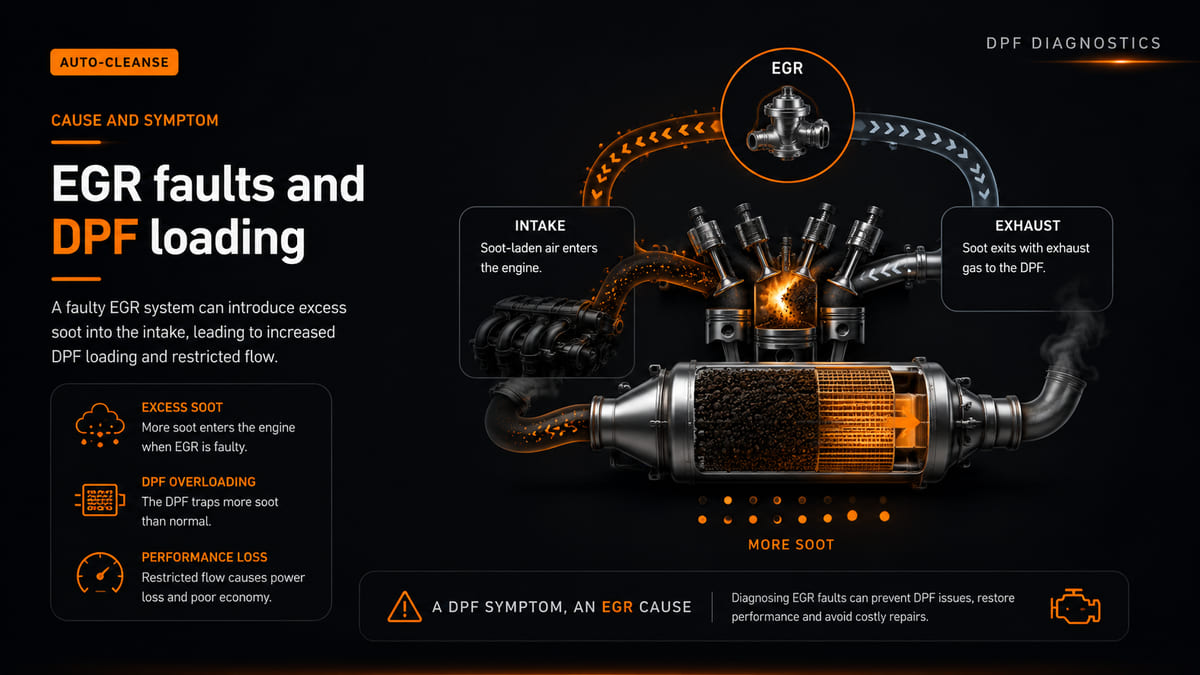
A DPF that fills faster than it should is often treated as a filter problem. Frequently it is not. The filter sits downstream of everything, so it collects the consequences of whatever the engine is doing upstream - and exhaust gas recirculation (EGR) is one of the few systems deliberately designed to change combustion in a way that increases soot.
That trade-off is not a fault; it is how the system is meant to work. The trouble starts when EGR stops behaving as the calibration assumes, because the engine then produces more soot than the regeneration strategy expects.
If a DPF keeps loading, the EGR system is part of the diagnosis, not a separate job.
What EGR is actually doing to combustion
EGR feeds a metered quantity of exhaust gas back into the intake charge. That gas is largely inert, so it dilutes the oxygen available in the cylinder and raises the heat capacity of the charge, lowering peak combustion temperature. Lower peak temperature means less nitrogen oxide (NOx) formation, which is the point of the system.
The cost is particulate matter. Less oxygen and a cooler flame make it harder for the fuel to burn completely, so soot production rises. That inverse relationship between NOx and particulates is the balance every diesel calibration manages: the ECU sets an EGR rate for each operating point assuming the resulting soot can be cleared by regeneration. Move the recirculated mass away from that assumption and the balance moves with it.
How EGR faults change soot output
A valve stuck or leaking open
Recirculating exhaust gas where the calibration wanted little or none reduces oxygen availability exactly when the engine needs it. Combustion quality falls and soot production rises with it. Rough running at low load, smoke under acceleration and poor response are common pointers, but a partially seized or carbon-fouled valve can leak enough to raise soot output without any obvious driveability complaint.
A valve stuck or restricted closed
A closed or heavily coked valve shows up first as raised NOx rather than raised soot, but it still matters to the filter. On many applications EGR position is controlled as part of the regeneration strategy, and a stored EGR fault can stop the engine management authorising a regeneration at all. Soot then accumulates normally while the means of clearing it is unavailable.
A leaking EGR cooler
An internally leaking cooler allows coolant into the gas path. That affects combustion and introduces a contaminant the aftertreatment was never intended to receive. Coolant loss with no external leak, a pressurising cooling system or white smoke are the usual pointers. Contamination reaching the filter is a different problem from soot loading, and regeneration will not resolve it.
A sticking cooler bypass
The bypass flap decides whether recirculated gas is cooled or routed around the cooler. Stuck in the wrong position, gas arrives at the wrong temperature, so its density - and therefore the mass actually recirculated - no longer matches what the control strategy expects. Combustion then sits away from its calibrated point.
Fouling and deposits
EGR carries soot and oil vapour back into the intake tract, and deposits build in the valve, cooler and inlet manifold. The restricted airflow raises soot production in its own right, which creates more deposits - a loop that worsens rather than settles.
Common misdiagnosis: "No EGR fault code stored, so EGR is not the issue." Many systems control EGR in closed loop using measured air mass, so the ECU can hold its target while the mechanical condition is poor. Absence of a code is not evidence of correct EGR mass flow.
Working through it in the right order
- Read the full picture before clearing anything. Record stored and pending faults across engine and aftertreatment, freeze-frame data and regeneration history together.
- Check air metering first. EGR control depends on it, so confirm measured air mass and boost data are plausible before judging EGR behaviour.
- Compare commanded and actual EGR position across load. Look for lag, sticking or a position that will not follow demand, not a single idle snapshot.
- Inspect the hardware. Valve, cooler, pipework, bypass actuator and its control, plus the inlet tract for deposits and the cooling system for signs of an internal leak.
- Assess the filter separately. Establish its actual condition through proper DPF diagnostics rather than assuming it is fine or finished.
Where an upstream fault has overloaded the filter and the substrate is still sound, off-vehicle cleaning addresses the restriction - but only the EGR repair deals with why it loaded. Resolve one without the other and the symptom tends to return.
EGR removal is not a repair
Deleting or blanking EGR on a road vehicle is not a legal fix. Road traffic law makes it an offence to use a vehicle that has been modified so that it no longer complies with the air pollutant emissions standards it was built to meet, and emissions-control equipment falls within the scope of MOT and roadside enforcement. It can also have implications for insurance cover and resale, and it does nothing about a coked inlet, a leaking cooler or a filter already blocked with soot. The proper route is the same as for any other system: find the failed component, repair or replace it, then confirm the system meets specification.
The takeaway
A DPF that keeps loading is a symptom, and EGR is one of the most direct influences on how much soot the engine puts into it. Diagnose the EGR system properly and repair it correctly - deleting it is not a lawful alternative on a road vehicle, and it leaves the underlying fault in place.
Sources
- Bosch Mobility - diesel engine management and exhaust gas recirculation
- HELLA TechWorld - exhaust gas recirculation system diagnosis
- Motorservice - exhaust gas recirculation and particle filter information
- DVSA - MOT inspection requirements and emissions-control tampering
General technical guidance only. Manufacturer-specific test procedures, EGR control strategies, regeneration criteria and specifications always take precedence for the exact vehicle and engine.
Need help with this on your vehicle?
Auto-Cleanse can sort it. See our DPF Diagnostics service, or get in touch.
Related: Blocked DPF Cleaning · DPF Cleaning in Devon