Diesel Limp Mode: Common Causes and What to Check
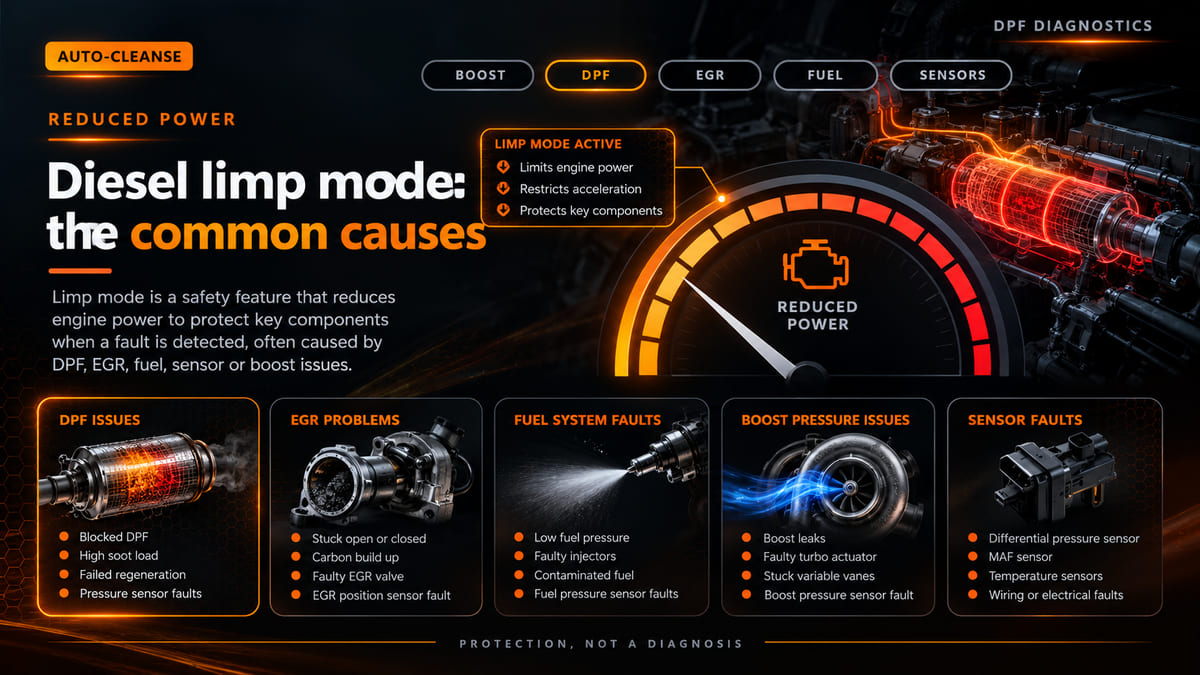
Diesel limp mode is the engine management deliberately cutting power - and sometimes revs, speed or gear selection - to protect the engine, gearbox or emissions system after it detects a fault. The usual causes are a boost leak or turbo control fault, a blocked DPF or a false DPF pressure reading, a sticking EGR valve, low fuel-rail pressure, a failed sensor or wiring fault, a gearbox fault on an automatic, or a weak battery.
You can usually drive a short distance in limp mode to get somewhere safe or to a garage. A restart often brings full power back, but the fault is still there.
Limp mode is a symptom with a stored reason behind it. Read the reason before replacing anything.
What limp mode is, and why a car goes into it
Manufacturers call it different things - limp-home, emergency running, reduced engine power - and apply it differently. Typical signs are a sudden loss of power, an engine that will not rev past a certain point, a limited top speed, restricted gear selection on an automatic, and a warning light or message on the dash.
The ECU does this when a value goes outside the range it can trust or tolerate: boost that does not match what it asked for, a sensor reading that makes no sense against the others, or a pressure or temperature beyond a limit. Restricting torque is the simplest way to stop a fault turning into damage while still letting the driver move the vehicle.
What causes diesel limp mode?
Boost leaks and turbo faults
The ECU compares the boost it requests with the boost it measures, and a persistent gap in either direction sets a fault - overboost and underboost have the generic codes P0234 and P0299, though manufacturers also use their own.
Boost leaks from hoses, clamps or the intercooler, and a sticking variable-geometry mechanism, are typical culprits - our piece on turbo and boost faults behind DPF problems covers how these are found.
Where the turbo's vanes or wastegate are moved by vacuum, a leaking vacuum hose, a weak vacuum pump or a faulty electropneumatic control valve has the same effect. Motorservice notes that OBD checks these valves for continuity and short circuits, not whether they work, so their faults are often blamed on other parts.
A blocked DPF, or a false DPF pressure reading
A heavily loaded diesel particulate filter raises exhaust back-pressure, and once the soot load or pressure passes the manufacturer's limit, many vehicles restrict power to protect the filter and the engine. The RAC notes that a blocked DPF can sometimes put a car into a restricted limp-home mode.
But DPF limp mode is only as reliable as the reading behind it. A split, blocked or waterlogged pressure pipe can make the reading wrong in either direction - imitating a blocked filter, or hiding one. If the reading is genuine, see blocked DPF diagnosis and cleaning.
Common misdiagnosis: "It went into limp mode with the DPF light on, so the DPF is the fault." The filter may be loaded because of an upstream boost, EGR or fuelling fault. Fix the cause first, then judge the filter.
EGR faults
An exhaust gas recirculation valve that sticks open, sticks shut or does not follow its commanded position upsets air metering and combustion. Motorservice, which supplies Pierburg parts to the aftermarket, lists the engine going into limp-home among the symptoms of EGR flow faults.
Fuel pressure and injector faults
Common-rail diesels compare the rail pressure they request with the pressure they measure. Pressure that stays too low - generic code P0087 - can come from a restricted fuel filter, a weak lift pump, a worn high-pressure pump, a leaking injector or a faulty pressure regulator, and the usual response is a power restriction.
Faulty sensors and wiring
A mass air flow meter, boost (MAP) sensor, accelerator pedal sensor or temperature sensor that reads out of range, or implausibly against the other sensors, can push the ECU into a fallback programme. HELLA lists a switch to an emergency or limp-home programme among the symptoms of a failing air mass sensor and a failing accelerator pedal sensor. Wiring and connector faults look the same, so check the plug, supply and wiring before replacing a sensor.
Automatic gearbox faults
On an automatic, the transmission control unit can hold a gear or restrict shifting to protect itself. It feels much like engine limp mode, but the codes sit in a different control unit, where an engine-only code reader may not look.
A weak battery or poor earth
Control units need a stable supply. A weak battery, a charging fault or a corroded earth can produce a string of unrelated-looking faults and reduced power, and the RAC includes a weak battery and electrical faults among limp-mode causes.
AdBlue and SCR faults
On cars and most vans, AdBlue faults usually bring a warning and a countdown to a no-restart rather than limp mode, though some also restrict speed - our guide to the AdBlue countdown and no-start covers the rules and what to do. Trucks, buses and heavier vans approved to the heavy-duty Euro VI rules differ: an unresolved fault brings a torque reduction, then a low-speed creep mode.
A badly made remap
A calibration that requests more boost than the turbo and charge-air system can deliver creates the same requested-versus-actual boost gap, which is why any remap should start from a healthy engine and stay within what the hardware can do.
What to do when your diesel goes into limp mode
- Get somewhere safe. Pull off when you safely can, and leave fast roads early if you cannot keep up with traffic.
- Check the other warnings. If an oil pressure or coolant temperature warning is on, stop and follow the handbook - that is a different level of urgency. Note any other lamps too, such as DPF, glow plug, AdBlue or gearbox.
- Check what you safely can. With the engine off and cool, check the oil and coolant levels, look for a split or blown-off boost hose, and consider whether the battery has been slow to crank.
- Do not keep clearing codes and driving. Clearing usually wipes the freeze-frame record, often the best clue to an intermittent fault. Treating a restart as the repair is how a cheap hose becomes a turbo.
- Have the codes, freeze-frame and live data read from every control unit, not just the engine. The fault code says what the ECU objected to, the freeze-frame shows the conditions when it set, such as engine speed, load and temperature, and live data shows what the system is doing now, such as requested against actual boost on a road test.
- Note when it happens. Cold or hot, under load, at a particular speed or gear, uphill, after refuelling, in wet weather. A pattern like "only when pulling hard in third" narrows the search faster than "it goes into limp mode sometimes".
Can you drive in limp mode?
For a short distance, gently, to get off the road or to a garage - usually yes, and that is what the mode is for. Follow your handbook and avoid heavy loads and towing. The RAC's advice is that it is possible but not advisable for long.
As covered in DPF warning lights explained, restricted running often stops the DPF regenerating, so the filter keeps loading while the original fault stays put.
How Auto-Cleanse can help
Our paid DPF diagnostics check reads the fault codes and live data, usually in around an hour, with the vehicle normally brought to Totnes. A restricted filter, once removed, can be collected locally in Devon or posted from anywhere in the UK for an off-vehicle machine clean with before-and-after flow and back-pressure testing, and we tell you honestly if it cannot be saved. For help with removal and refitting, call 07823 649190 to discuss current availability.
Frequently asked questions
How do you get a diesel out of limp mode?
A restart often restores power, because many limp-mode strategies reset each key cycle, but the fault usually returns when the same conditions repeat. Clearing the codes is no better and usually erases the freeze-frame data that would help find the cause. The only lasting fix is repairing whatever tripped it.
Can a blocked DPF cause limp mode?
Yes. When soot loading or back-pressure passes the manufacturer's limit, many diesels restrict power to protect the filter and engine. A restricted filter can often be cleaned off the vehicle, but a cracked, melted or collapsed substrate may not be recoverable.
How fast can you drive in limp mode?
It varies by vehicle and by fault. The RAC says drivers will likely not be able to exceed 30mph, though in some vehicles the limit may reach 50mph, and you may not be able to rev beyond about 2,000rpm.
How much does it cost to fix limp mode?
It depends on the cause, which is why diagnosis comes first: anything from a hose, clamp or connector to a turbo, injectors, a fuel pump or gearbox work. If a restricted DPF is the cause, our off-vehicle clean of a removed filter is from £210 within 10 miles of Totnes, or £230 further afield and by post, confirmed with your vehicle details - see what DPF cleaning costs.
The takeaway
Limp mode tells you the engine management has found something it will not tolerate. Get safe, then have the codes, freeze-frame and live data read before anything is cleared or replaced.
Sources
- RAC - limp mode guide and diesel particulate filter guide
- HELLA TechWorld - air mass sensor and accelerator pedal sensor diagnosis
- Motorservice - exhaust gas recirculation and electropneumatic valve fault diagnosis
- legislation.gov.uk - Regulation (EU) 2017/1151, Annex XVI: driver inducement requirements for reagent-based systems
- legislation.gov.uk - Regulation (EU) No 582/2011, Annex XIII: heavy-duty NOx control and driver inducement
General technical guidance only. Manufacturer-specific handbook information, workshop procedures and specifications always take precedence.
Need help with this on your vehicle?
Auto-Cleanse can sort it. See our DPF Diagnostics service, or get in touch.
Related: Blocked DPF Cleaning · DPF Cleaning