Turbo and Boost Faults Behind DPF Problems
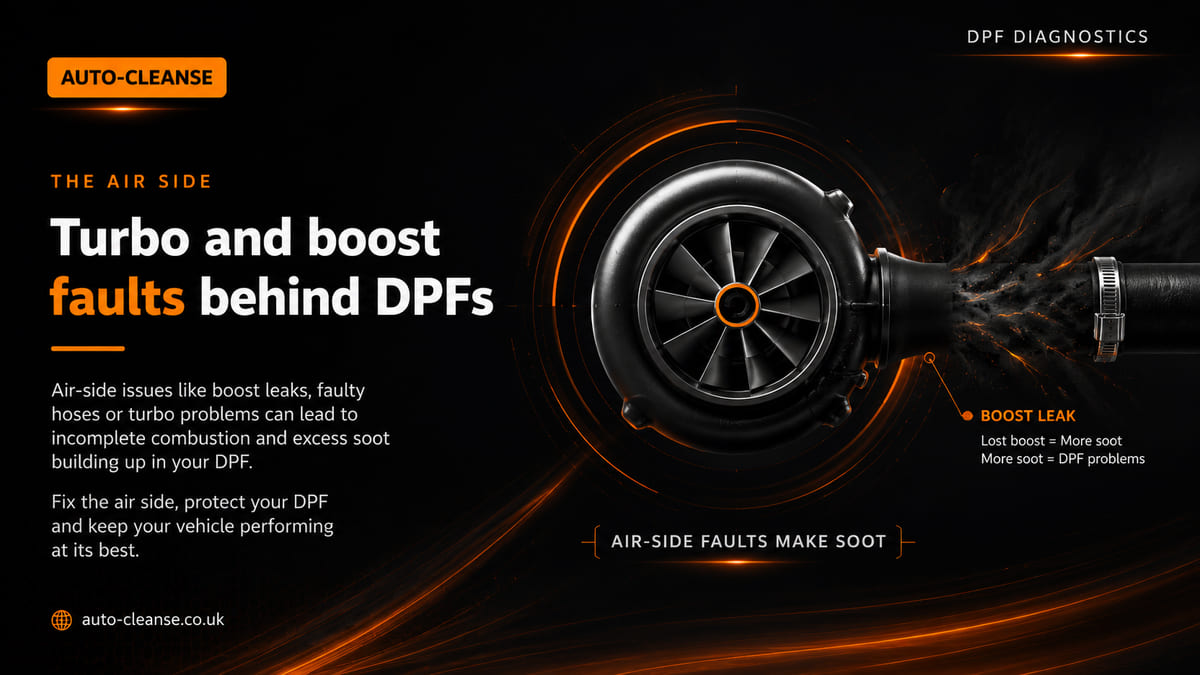
A diesel particulate filter only ever reflects what the engine sends into it. If the filter keeps loading, keeps triggering regenerations, or blocks again shortly after being cleaned, the honest question is not "why is this filter failing" but "why is this engine making so much soot". Very often the answer sits on the air side of the engine, upstream of the exhaust entirely.
Diesel combustion depends on having enough air, at the right pressure, measured accurately. Take away any one of those three and the mixture effectively runs richer than the calibration intended, combustion becomes less complete, and particulate output rises. The DPF then does exactly what it was built to do - it catches the extra soot - and the driver sees a warning light on a filter that may be perfectly serviceable.
A DPF that fills too quickly is usually reporting an air-system fault, not creating one.
Why less air means more soot
Soot forms where fuel burns in a locally oxygen-poor region of the combustion chamber. The engine management system meters fuel against the air it believes is available, working from inputs such as the mass air flow signal, the boost pressure signal and intake air temperature, and applying a smoke-limit strategy that restricts fuelling when the measured air is low.
That strategy only works if the measured air is the real air. If a hose has split, a mechanism has stuck, or a sensor is reading optimistically, the ECU can be fuelling for air that never arrives. The result is a mixture that produces more particulate per mile, higher exhaust opacity under load, and a soot model that climbs far faster than the vehicle's normal duty cycle would explain.
The common air-side offenders
A sticking variable-geometry mechanism
Variable-geometry turbochargers control boost by altering the angle of the vanes in the turbine housing. Soot and oil residue can leave the mechanism stiff or partially seized, so it no longer follows the commanded position. Boost is then wrong across part of the load range, and which way it is wrong depends on where the mechanism has stuck - low where the driver is asking for torque, or high further up the range - with fuelling and soot production affected accordingly. Actuator wear, linkage play and vacuum or electronic control faults produce the same outcome.
Boost leaks and split charge pipework
Charge pipes, silicone elbows, clamps, the intercooler itself and the various joints between them all sit under pressure and heat cycling. A split that opens only under load can be invisible at idle and on a static inspection. Air that has been measured by the meter but escapes before the cylinder is air the ECU still thinks it delivered, so fuelling is set for a charge that was never there.
A failing or worn turbocharger
Bearing wear, shaft play, damaged blades, a leaking seal or restricted oil feed all reduce the turbocharger's ability to make and hold the specified pressure. Oil carried past worn seals also contaminates the intake tract and the filter downstream, adding ash and contamination on top of the soot problem.
A restricted intake
A neglected air filter, a collapsed or blocked intake duct, a heavily fouled intake manifold or a swirl-flap fault all reduce the volume and quality of air reaching the cylinders. Carbon build-up in the intake, often in combination with EGR flow, is a routine finding on higher-mileage engines.
An implausible boost or air-mass signal
A drifting mass air flow meter or a boost sensor reading away from actual pressure can distort fuelling without ever setting an obvious fault code. The value may look reasonable on the scan tool while being wrong in absolute terms, which is why signals need comparing against the manufacturer specification and against each other rather than simply being read.
Common misdiagnosis: "The DPF is blocked, so the DPF is the fault." A restricted filter is a finding, not a diagnosis. If the air side has not been proved, the replacement or cleaned filter inherits the same soot production that filled the last one.
Bringing the air side into DPF diagnosis
- Record the full picture before clearing anything. Current and stored codes, freeze-frame data and regeneration history often point at the air system before the exhaust.
- Compare requested against actual boost under load. A deviation that appears only in a specific load or speed band is the useful evidence, not the idle reading.
- Pressure-test the charge air system. Leaks that only open under boost need the system pressurised to the manufacturer's method to be found reliably.
- Assess the air-mass signal for plausibility. Compare the value against the manufacturer figure at the correct test points, not simply whether a signal is present.
- Inspect the turbocharger and its control. Shaft condition, vane or wastegate movement, actuator response and oil feed all matter.
- Check the intake tract for restriction and contamination. Filter condition, ducting, manifold deposits and any oil carry-over.
Differential-pressure and filter-condition evidence still tells you how restricted the filter is, but only once the air side is proved sound can it be read as the whole picture rather than half of it. This is why proper DPF diagnostics look upstream as well as at the exhaust.
Where cleaning fits
None of this makes cleaning the wrong answer. Where a serviceable filter is genuinely restricted, off-vehicle inspection, controlled cleaning and flow testing is the correct route, and a blocked filter still has to be dealt with on its own merits. The point is sequencing: fix the air-side fault, then restore the filter, so the cleaned DPF starts life behind an engine that is no longer overloading it.
The takeaway
Treat a heavily loaded DPF as evidence about the engine, not just about the filter. Verify boost control, charge-air integrity and air-signal plausibility as part of the diagnosis, or the same filter symptom tends to return.
Sources
- Bosch Mobility - diesel engine management and air-system control technical information
- HELLA TechWorld - turbocharger fault diagnosis and charge air system testing
- Motorservice - turbocharger and charge air system technical information
- Delphi Technologies - diesel fuel and air management diagnostic guidance
- Manufacturer workshop information - boost control specifications and DPF diagnostic procedures
General technical guidance only. Manufacturer-specific workshop information, test conditions and specifications always take precedence.
Need help with this on your vehicle?
Auto-Cleanse can sort it. See our DPF Diagnostics service, or get in touch.
Related: Blocked DPF Cleaning · DPF Cleaning in Devon