DPF Additive Fluid Low? Eolys on Peugeot, Citroen and Ford
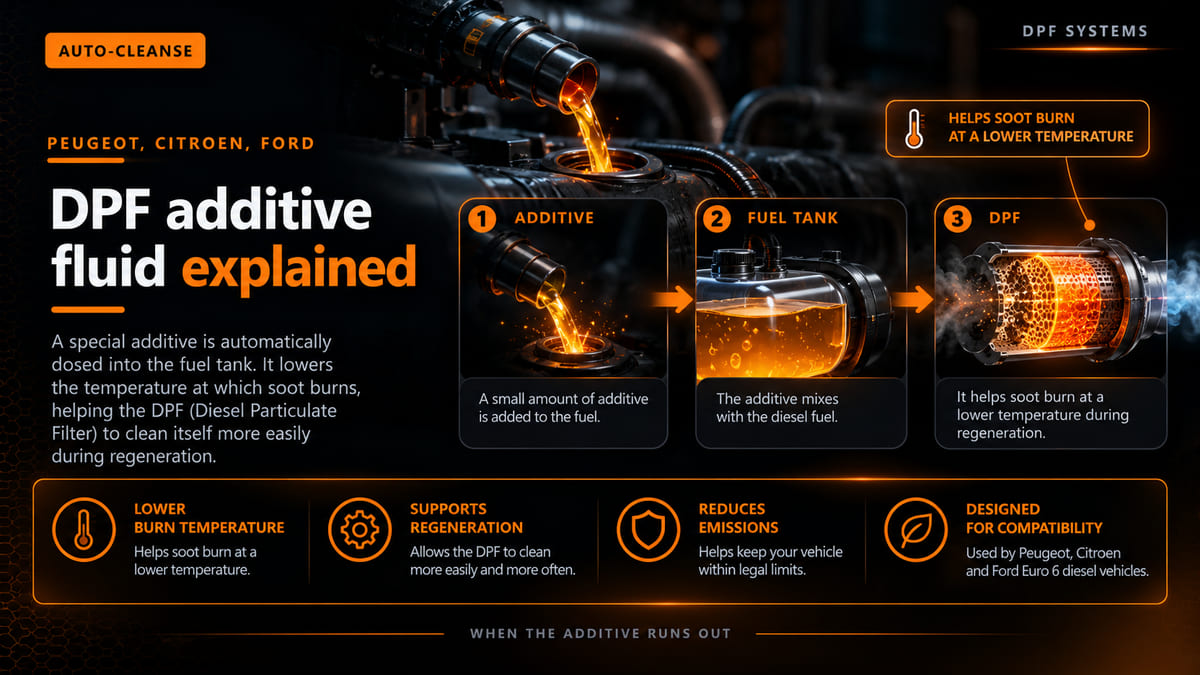
DPF additive fluid is a catalyst that some diesels carry in a small separate tank and dose into the fuel each time you fill up. It passes through the engine, collects with the soot in the diesel particulate filter (DPF), and lets that soot burn off at a lower temperature during regeneration. PSA introduced the system in 2000, and many Peugeot and Citroën diesels since then have used it, as have some Fords.
When the additive runs low, regeneration gets harder and the dashboard tells you - often with a message about the particle filter rather than the additive. If that warning stays on, Peugeot's handbooks say the additive must be topped up by a dealer or qualified workshop without delay. The fix is a refill with the grade specified for the vehicle, then a reset with a diagnostic tool. A refill will not clear ash that a high-mileage filter has built up.
The additive does not clean the filter. It changes the soot so the filter can clean itself.
Peugeot and Citroën DPF additive low: the warnings you may see
Wording varies by model and year, so treat these as examples:
- "Risk of particle filter clogging", or "filter at risk of blockage", usually with a warning lamp.
- A low additive level message, on many Peugeot models with the service warning lamp and an audible warning.
- "Anti-pollution system faulty" or similar, with the engine warning lamp - a general message with many possible causes.
Peugeot's 208 and 308 handbooks separate two situations. If the particle filter lamp comes on, they advise driving at or above a minimum speed, as soon as traffic conditions permit, until it goes off. If it stays on, the additive level is low.
Common misdiagnosis: "The message says particle filter, so the filter is blocked." On an additive system the cause may be an empty tank, a pump or wiring fault, or a refill that was never reset. The filter may be perfectly serviceable, which is why proper DPF diagnostics and the five checks before condemning a DPF come first.
What goes wrong, and what to do about it
- An empty or low tank. Once dosing stops, regenerations lose their help and soot loading climbs.
- Pump faults. The pump can fail electrically or mechanically, leaving a full tank unused.
- Wiring and connector faults. Under the car, the tank, pump and wiring are exposed to water, salt and road dirt.
- Refuel detection problems. If the system cannot see a refuel properly, it cannot work out the dose.
Left alone, any of these can lead to failed regenerations and restricted performance. A DPF that keeps blocking on one of these vehicles is worth checking for an additive fault first.
- Do follow the handbook's driving advice once, where safe and legal, then have the codes and additive data read if the warning persists or returns.
- Do have the correct fluid identified from the VIN and the refill reset with a suitable tool.
- Do not top up with a guessed fluid, mix grades, or clear the codes and carry on. The filter keeps loading while the additive is missing.
What is DPF additive fluid (Eolys)?
The fluid most owners have heard of is Eolys, a fuel-borne catalyst originally developed by Rhodia, now part of Solvay. PSA, now part of Stellantis, was the first manufacturer to fit a DPF to European diesel cars, in 2000, and built that system around this additive.
The original Eolys grades were cerium-based; the current Eolys PowerFlex is described by its developers as iron-based. Solvay still lists the earlier DPX42 and 176 for the aftermarket, and some vehicles use Infineum F7995 instead. Parts listings often call it "FAP additive", after the French filtre à particules, or "cerine" for the cerium-based grades.
Ford DPF additive systems use the same technology. A 2003 WardsAuto report said Ford would use Eolys on its European diesels with particulate filters, starting with the Focus, and Ford's 1.6 TDCi engine family was developed jointly with PSA. Not every DPF diesel works this way - other designs use a catalyst-coated filter and no additive.
To check a vehicle, look for an additive level warning in its handbook. As one handbook often covers several engines, the definitive check is the VIN, which a dealer or parts counter can look up.
How the additive system works
Layouts vary, but the principle is the same: a separate additive tank, usually near the fuel tank, and an electric pump, controlled by the engine ECU or on some systems a separate additive control unit, that delivers additive into the fuel tank.
- You refuel. The system detects it, and works out how much fuel went in.
- It doses the fuel. The pump adds a matched dose, at a concentration measured in parts per million.
- The catalyst reaches the filter. It leaves with the exhaust and collects alongside the soot.
- Regeneration starts more easily. In contact with the soot, the catalyst lowers the temperature soot needs to burn, so a regeneration is more likely to finish - particularly on a car that rarely gets a long run.
Why it has to be the right fluid
Each grade is formulated for a particular system, and parts departments treat it as a VIN-specific item. The grades are not interchangeable: suppliers advise against mixing Eolys PowerFlex with the older DPX42 grade or with Infineum F7995, and guidance on other combinations varies, so do not guess.
Some aftermarket fluids are sold as replacements for more than one Eolys grade; if you use one, have the supplier confirm it suits the grade specified for your VIN.
A bottle of "DPF cleaner" is a different product and does not refill the additive system. Peugeot's 308 handbook says the only diesel additives authorised are those meeting the B715000 standard, so check your handbook before adding anything.
Why a refill normally needs a reset
On many of these systems the ECU keeps a running calculation of the additive left, based on how much it has dosed. After a refill that figure still reads low until a technician tells the ECU the tank is full, with a diagnostic tool that supports the additive refill function.
Skip that step and the warning can stay on, or come straight back, even with a full tank. Replacing an additive tank, pump or filter can involve setting values in the ECU as well.
Why additive filters collect extra ash
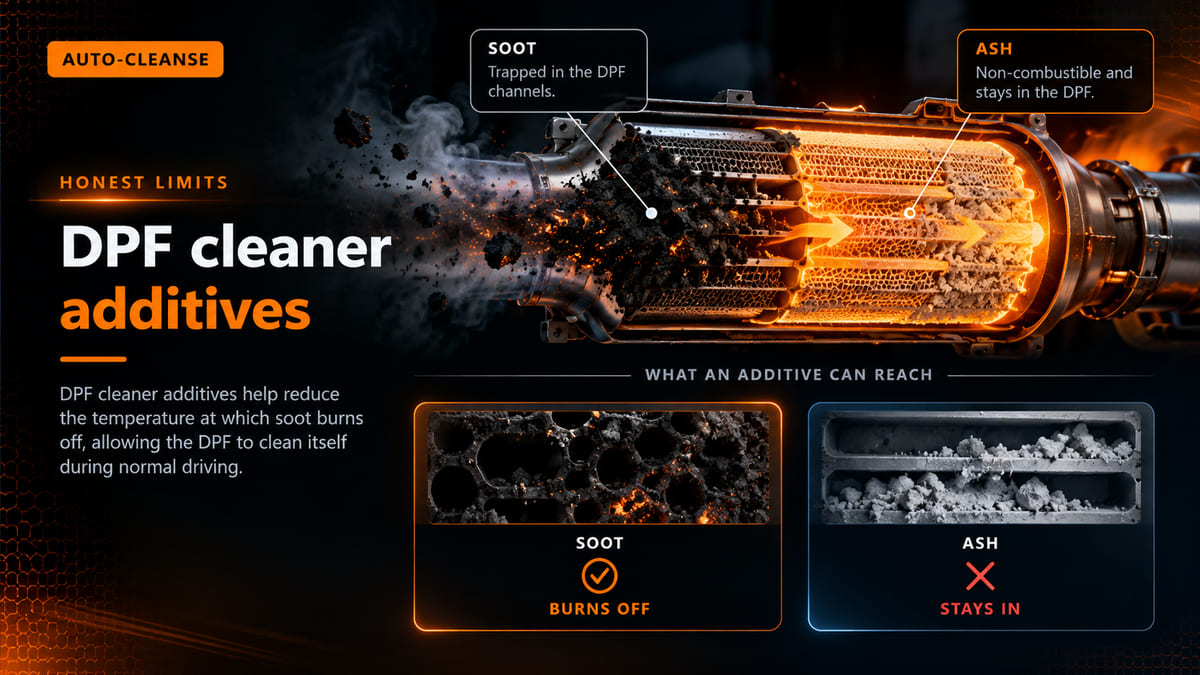
The catalyst does not burn. It stays in the filter as fine metal-oxide ash, adding to the ash left by engine oil. The Manufacturers of Emission Controls Association reported that the additive made up the majority of the ash in PSA's first-generation system, and that later, lower-dose generations reduced that share.
Lower dosing slows the build-up without stopping it, and nothing on the vehicle removes ash, as our piece on engine oil, ash and DPF service life explains.
Early systems were designed around the filter being replaced or cleaned of ash at intervals. Later generations stretched that interval considerably, but ash still builds up, so a high-mileage additive filter can end up restricted even when the additive system works perfectly. An ash-loaded but undamaged filter is a candidate for off-vehicle DPF cleaning rather than automatic replacement.
How Auto-Cleanse can help
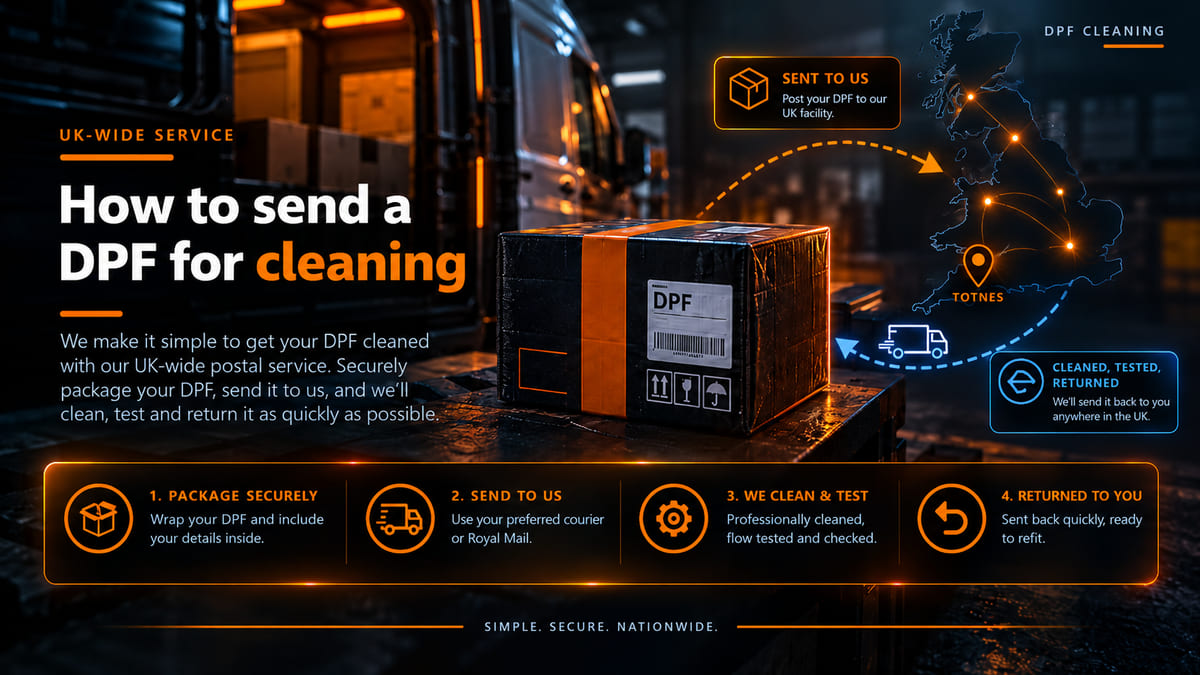
If a filter or additive warning will not clear, call 07823 649190 about our paid DPF diagnostic check: fault codes and live data, usually in around an hour, with the vehicle normally brought to our Totnes workshop. If the filter is ash-loaded, we clean it off the vehicle with before-and-after flow and back-pressure testing - £210 within 10 miles of Totnes, or £230 further afield and through our postal DPF service. The filter needs to come to us already removed; for help with removal and refit, call us to discuss current availability. Prices are confirmed when you contact us with your vehicle details.
Frequently asked questions
Can I keep driving with the DPF additive warning on?
Peugeot's handbooks treat a low additive level as something to top up without delay. Once dosing stops, soot loading climbs and the risk of a blocked filter rises, so follow the handbook's driving advice if the particle filter lamp comes on and get the system checked.
Can I top up DPF additive fluid myself?
Peugeot's handbooks say a dealer or qualified workshop must do it, and one practical reason is the reset: on many systems the ECU has to be told about the refill with a diagnostic tool, or the warning stays on.
How long does DPF additive fluid last?
For its current PowerFlex grade, Solvay quotes 1.2 to 1.9 litres on board for around 250,000 km (about 155,000 miles), based on fuel consumption of 7 litres per 100 km. Older grades differ, so follow the service schedule and the vehicle's own warning.
Is DPF additive the same as AdBlue?
No. AdBlue is a urea solution used by a separate system, selective catalytic reduction, to cut nitrogen oxides, with its own tank and filler. DPF additive is a catalyst dosed into the fuel to help the filter regenerate. Never put one in the other's tank.
The takeaway
On many PSA diesels and some Fords of the same era, the particulate filter relies on an additive to regenerate properly. When the warning appears, check the fluid, dosing system and filter, refill with the correct grade and have the system reset before assuming the filter has failed.
Sources
- Solvay - Eolys PowerFlex product information
- SAE International - Rhodia paper on the iron-based Eolys PowerFlex catalyst
- DieselNet - Rhodia paper on the cerium-based Eolys catalyst
- Manufacturers of Emission Controls Association - diesel particulate filter maintenance practices
- Peugeot - 208 and 308 owner's handbooks: particle filter, additive warnings and fuel additives
- WardsAuto - Ford adoption of Eolys
General technical guidance only. Manufacturer-specific handbook information, workshop procedures and specifications always take precedence.
Need help with this on your vehicle?
Auto-Cleanse can sort it. See our DPF Diagnostics service, or get in touch.
Related: DPF Cleaning · Blocked DPF Cleaning