Engine Oil, Ash and DPF Service Life
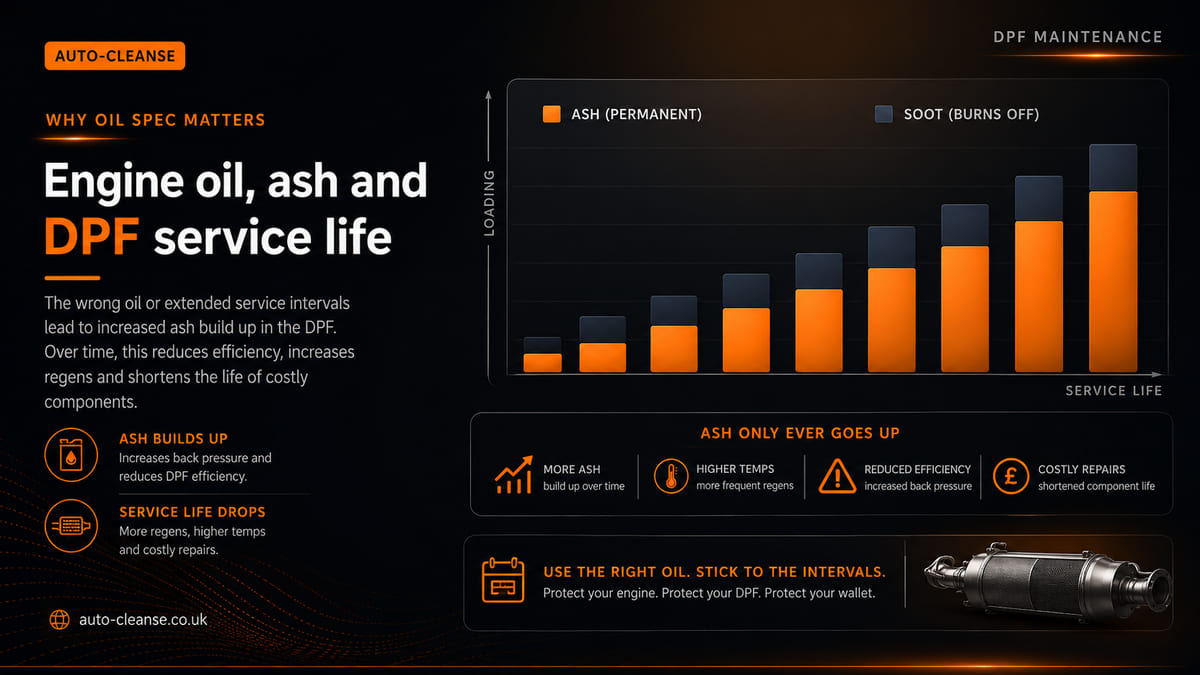
Most conversations about diesel particulate filters focus on soot, because soot is what the warning light and the regeneration strategy are built around. Soot is also the easy part: it is carbon, it burns, and a completed regeneration deals with it. Ash is the other half of the story, and it behaves in the opposite way.
Ash is the non-combustible residue left behind by the engine's lubricant, mainly from the metallic additives that make a modern oil work. It is carried into the exhaust in small quantities alongside the soot, collects in the filter, and stays there. That is why oil specification is not a detail to trade away on price or convenience.
Regeneration removes soot. Nothing that happens on the vehicle removes ash.
Why ash accumulates and soot does not
A wall-flow DPF forces exhaust gas through porous ceramic walls, trapping particulate on the inlet side. During regeneration the filter reaches a temperature high enough to oxidise the trapped carbon, which leaves as gas. The soot load falls and flow improves.
Ash cannot be oxidised. It is already fully oxidised - metallic oxides and sulphates derived from the oil's detergent and anti-wear chemistry, along with engine wear and corrosion products. When the soot around it burns away the ash remains, gradually packing into the channels and typically collecting towards the plugged ends of the filter.
The practical consequence is that ash loading is cumulative and one-directional: usable filter volume only ever goes down. Over a long service life that tends to show as a gradual rise in baseline differential pressure, shorter intervals between regenerations, and eventually a filter needing off-vehicle cleaning or replacement even though nothing has actually failed.
Why low-SAPS oils exist
Low-SAPS stands for low sulphated ash, phosphorus and sulphur. These oils exist because the additive chemistry that protects the engine also produces the ash that fills the filter, and because phosphorus and sulphur affect the catalyst coatings used in exhaust aftertreatment.
Reducing the ash-forming content slows the rate at which the filter loads, without leaving the engine unprotected. That balance between wear protection, drain interval and aftertreatment service life is set by the manufacturer, which is why the specification is published per engine rather than as a general rule.
The point for owners is that the correct oil is not simply a viscosity match. Viscosity and specification are separate requirements, and it is the specification that matters for the DPF.
What accelerates ash loading
Using the wrong oil specification
A full-SAPS or non-approved oil in an engine that requires a low-SAPS specification puts more ash-forming material through the system for every litre consumed. The engine will usually run normally, often with no warning light and nothing obviously wrong. The cost is paid later, as premature ash loading and a shortened filter life.
Oil consumption
Ash reaches the filter mainly through oil that gets past the piston rings, valve stem seals or turbocharger seals into the combustion or exhaust path. An engine consuming more oil than it should is delivering ash-forming additives at a higher rate. Persistent consumption is worth diagnosing rather than simply topping up.
Overfilling
Overfilling raises the risk of crankcase oil being aerated or drawn into the intake through the breather system. It is an easy mistake to make and an easy one to avoid: fill to the manufacturer's level, and check it on level ground using the correct procedure for that engine.
Fuel dilution
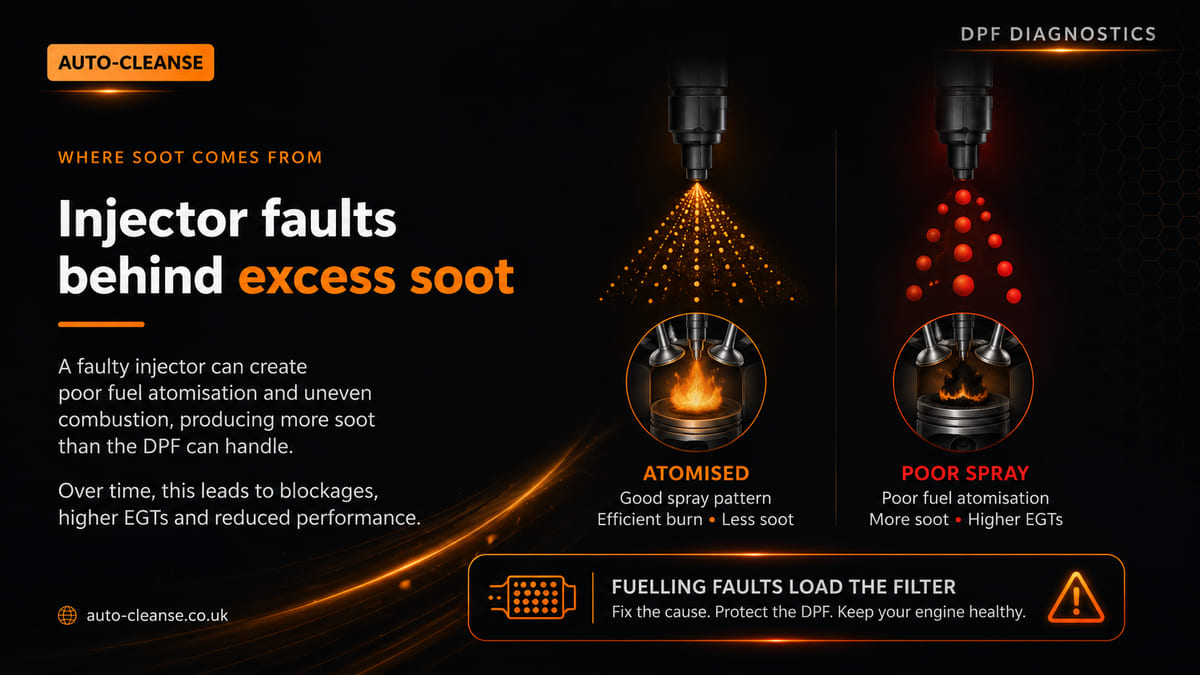
Post-injection strategies used to raise exhaust temperature for regeneration can allow a small amount of fuel to pass the rings into the sump. Where regenerations are frequently attempted and rarely completed, dilution can build up, degrade the oil and raise the sump level - which brings the overfilling problem with it.
Common misdiagnosis: "It is a good quality oil, so it will be fine." Quality and specification are not interchangeable. A very good oil built to the wrong specification still puts the wrong chemistry through the filter. Approval to the manufacturer's specification is the test that counts.
What this means in the workshop
- Use the manufacturer specification, every time. Confirm the oil is approved to the specification for that exact engine, and do not substitute on viscosity alone.
- Fill to the correct level. Follow the specified checking procedure and do not overfill.
- Investigate oil consumption. Treat unexplained consumption as a fault to be diagnosed, not a top-up schedule.
- Take repeated incomplete regenerations seriously. They point to a fault or a duty-cycle problem, and they carry a fuel-dilution risk alongside the soot loading.
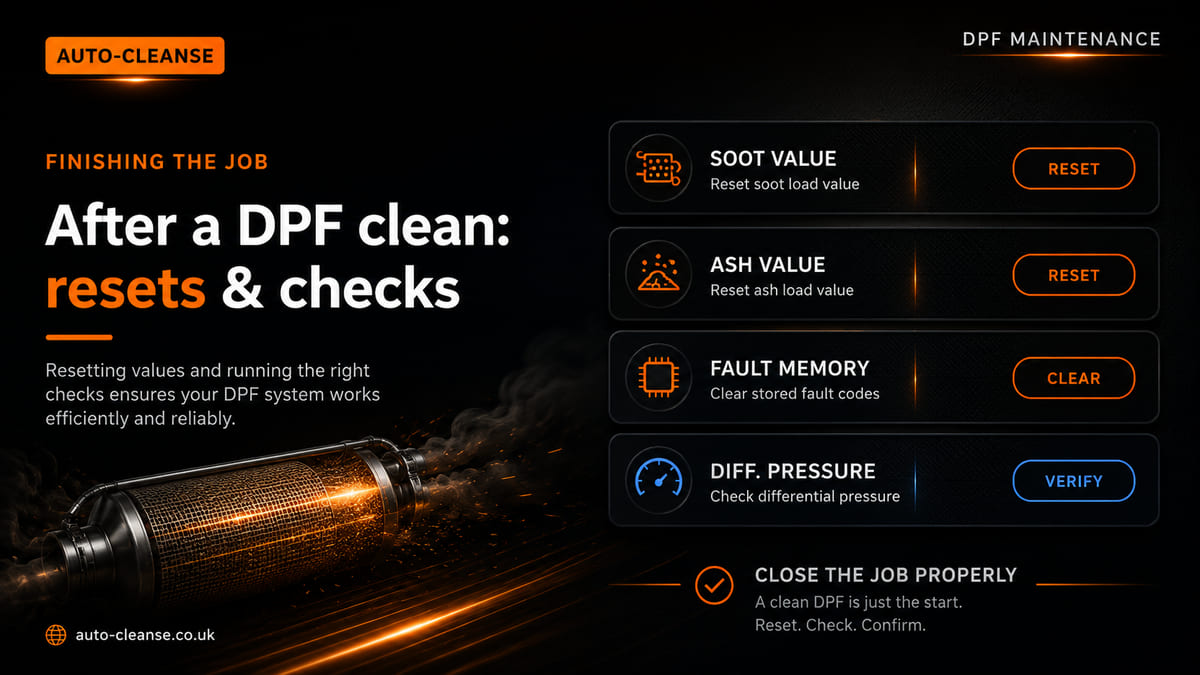
- Separate ash from soot when assessing a filter. A high baseline pressure with a low soot reading and a long service history points somewhere different from a filter that has blocked quickly, which is what DPF diagnostics is for.
Ash and the end of a filter's life
Because ash is permanent, there comes a point on a high-mileage vehicle where the filter holds material that no on-vehicle process can shift. That is not a failure or a fault - it is the filter reaching the end of its useful interval.
The route from there is removal, inspection and controlled off-vehicle cleaning, or replacement in line with manufacturer guidance if the substrate is damaged. Where a filter is blocking repeatedly at a mileage that does not fit its expected life, oil-related ash is worth considering before the filter takes the blame.
The takeaway
Soot is a maintenance issue; ash is a service-life issue. No oil choice makes a filter last forever, but using the specification the manufacturer requires, keeping the level correct and dealing with consumption or dilution properly give a DPF the best chance of reaching the service life it was designed for.
Sources
- Motorservice - technical information on particle filters and engine lubricants
- HELLA TechWorld - diesel particulate filter system technical information
- Bosch Mobility - diesel engine management and exhaust aftertreatment technical information
- Manufacturer workshop information - engine oil specification and filling procedures
General technical guidance only. Manufacturer-specific workshop information, oil specifications and service procedures always take precedence.
Need help with this on your vehicle?
Auto-Cleanse can sort it. See our DPF Cleaning in Devon service, or get in touch.
Related: Blocked DPF Cleaning