DPF Pressure Sensor and Pipe Faults
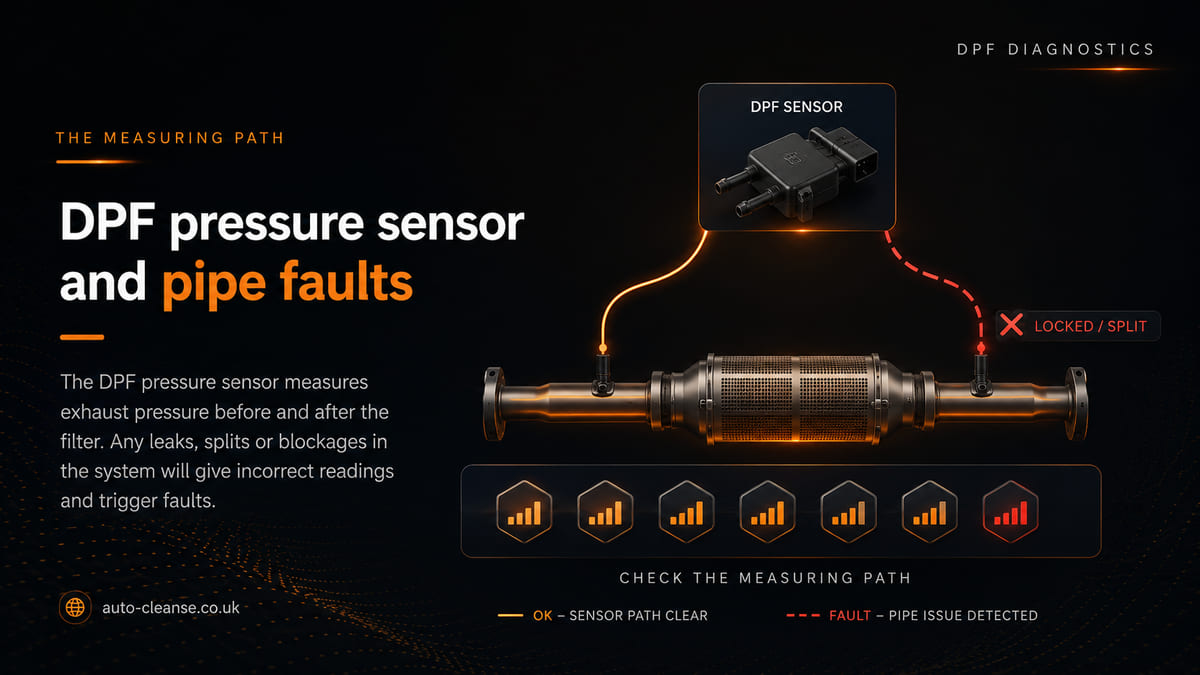
The ECU cannot see inside a diesel particulate filter. It infers loading from what the differential-pressure sensor reports, and that report arrives through a physical path: two take-off points on the exhaust, two pipes, a sensor, a connector and a length of wiring. Any of those can fail in a way that changes the number while the filter itself is fine.
A high or erratic pressure reading is a common reason a DPF gets removed, cleaned or replaced. If the fault lies in the measuring path, the filter comes off for nothing and the symptom returns. What the reading itself means is covered in understanding DPF differential pressure; this article is about the faults that corrupt it before it reaches the ECU.
The sensor does not measure the filter - it measures whatever pressure reaches it through two pipes.
Faults in the measuring path
Soot-clogged or carboned take-off pipes
The pipes tap into a hot, sooty exhaust stream, so deposits build up over time - usually worst at the take-off union or in the narrow-bore section. A partial restriction damps the signal and slows its response; a fully blocked pipe traps a static pressure or leaves that side reading almost nothing. Either produces a value that bears little relation to the real state of the filter.
Check both pipes, not just the pre-filter one. A restriction on the post-filter side distorts the calculated difference just as readily, and neither has anything to do with the condition of the substrate.
Splits, chafing, kinks and loose unions
The metal tubes are usually joined to the sensor by short rubber or silicone hoses. Those harden with heat, split at the ends, or pull off a spigot after previous work. A leak on the pre-filter side bleeds that port towards atmosphere and lowers the measured difference, which can mask a loaded filter and delay regeneration; a leak on the post-filter side skews it the other way.
Kinked or crushed pipes and cracked metal tubes cause the same class of error, often after earlier exhaust work, so check routing and clipping too.
Condensation and water traps
Exhaust gas contains water vapour. If a pipe run has a low point, or no longer drains back towards the exhaust after being rerouted, condensate collects there. A slug of water in a narrow pipe blocks the signal path intermittently and can freeze in cold weather, giving a fault that appears only in certain conditions and then clears on its own.
Check pipe orientation, that the sensor sits at the correct height relative to its take-off points, and that any drain or vent feature specified by the manufacturer is intact.
Sensor offset, drift and plausibility
Differential-pressure sensors drift. With the engine off and both ports at atmospheric pressure, the reported differential should sit at the offset given in the manufacturer specification; a value clearly away from that points to a sensor or wiring problem before the exhaust is even involved. Some systems store a learned offset or need an adaptation after a sensor is replaced or disturbed, and skipping that leaves the system working from an incorrect zero.
Compare the reading at idle, at raised engine speed and under load. A sensor that responds sluggishly, sticks at a value or fails to change with airflow is telling you about itself, not the filter.
Wiring, connectors and supply
The signal reaching the ECU depends on a stable reference supply, a good earth and a clean signal line. Corroded or water-ingressed connectors, chafed looms near the exhaust, spread terminals and previous repair joints all produce intermittent or out-of-range readings. Where a code points at a signal circuit, test the circuit rather than assuming the sensor has failed - wiring faults often look like a failed component.
Why this looks like a blocked filter
A high differential-pressure reading, a DPF warning and a request for regeneration are exactly what a loaded filter produces - and every measuring-path fault above generates the same picture. Scan-tool data alone rarely separates the two, so a vehicle can lose a filter that was never the problem.
Common misdiagnosis: "Differential pressure is high, so the DPF is blocked." It only proves the pressure difference reaching the sensor is high. Restricted pipes, a water trap, a drifted sensor or a wiring fault all produce the same value. Confirm the measuring path first, then interpret the number.
A sensible order of testing
- Record the full picture before clearing anything. Current and stored codes, freeze frame and live differential pressure across a range of engine speeds.
- Check the offset with the engine off. Compare the reported value against the manufacturer specification.
- Remove and inspect both pipes. Look for soot build-up, splits, kinks, corrosion and trapped condensate, and check the take-off unions are clear.
- Test the sensor's response. Once the path is clear, confirm the reading changes sensibly and promptly with airflow.
- Test the circuit, not just the component. Check supply, earth, signal and connector condition before replacing a sensor.
- Re-assess the filter afterwards. Only once the path is proven should pressure data judge the filter, and proper DPF diagnostics should rest on more than one piece of evidence.
When the filter really is restricted
None of this means pressure data should be ignored. Once the path is verified, a consistently high differential across the rev range remains a strong indicator, and a filter genuinely loaded with ash or contamination needs an off-vehicle clean rather than another regeneration attempt. If a filter keeps blocking, the measuring path is worth revisiting early.
The takeaway
Before condemning a DPF on pressure data, confirm that the pressure data is real. Two pipes, a sensor and a connector are far cheaper to check than a filter is to remove.
Sources
- Bosch Mobility - diesel engine management and exhaust-gas sensor technical information
- HELLA TechWorld - differential-pressure sensor function and diagnosis
- Delphi Technologies - diesel aftertreatment diagnostic guidance
- Motorservice - particulate filter system technical information
General technical guidance only. Manufacturer-specific workshop information, test conditions and specifications always take precedence.
Need help with this on your vehicle?
Auto-Cleanse can sort it. See our DPF Diagnostics service, or get in touch.
Related: Blocked DPF Cleaning · DPF Cleaning in Devon