Passive, Active and Forced DPF Regeneration Explained
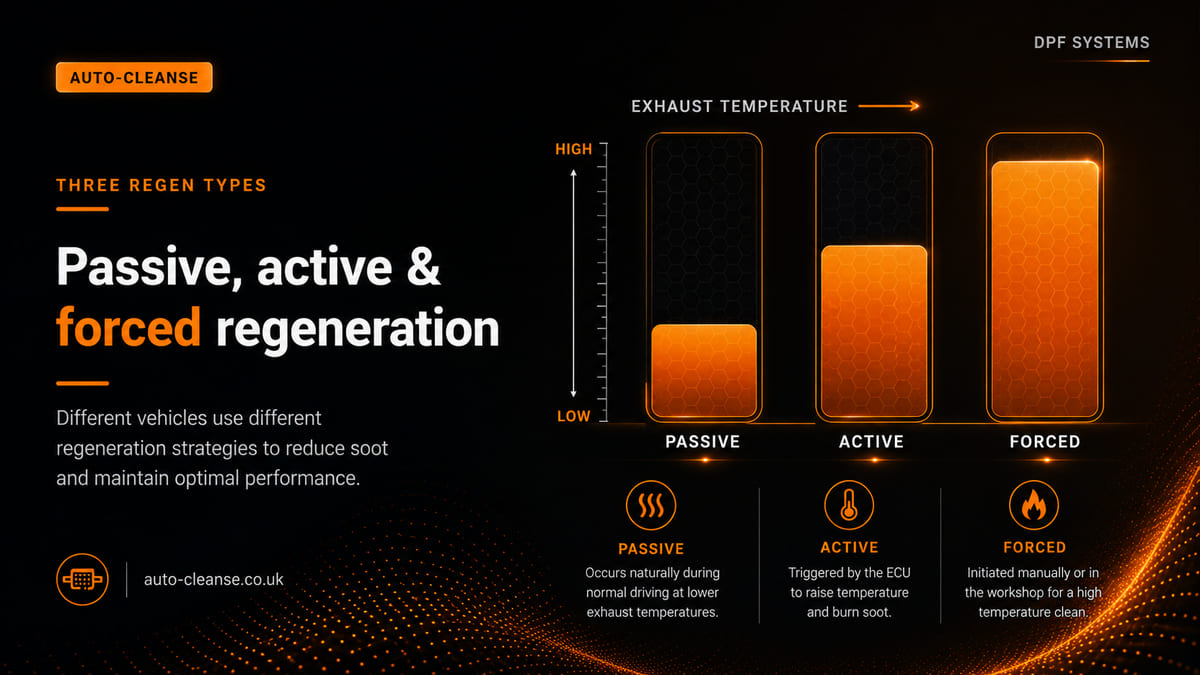
"Regeneration" is often used as though it describes a single process. In practice a filter can clear soot through suitable normal driving, through the ECU deliberately raising exhaust temperature, or through a manual procedure commanded by the vehicle or a diagnostic tool. All three exist to oxidise combustible soot, but they reach and control the required conditions in different ways, and none of them repairs a filter that is restricted for a different reason.
Terminology also differs between manufacturers. Some vehicles offer a driver-initiated stationary procedure; others require a workshop diagnostic tool to command regeneration at all. The vehicle's own documentation and service information always take precedence over generic descriptions.
Passive, active and forced regeneration are not interchangeable processes, and none of them should be treated as a substitute for diagnosing why the filter loaded in the first place.
Passive regeneration
Passive regeneration is soot oxidation that happens using exhaust temperature already present during normal operation. It can occur without any distinct driver request, provided the system and the operating conditions allow it. Ford describes passive regeneration as cleaning caused by normal exhaust-system temperature, most likely during suitable sustained operation - though the exact conditions depend on the vehicle and aftertreatment design.
Driving conditions can help a healthy system complete a regeneration, but they cannot overcome every inhibited regeneration, failed sensor, excessive soot load, ash restriction, contamination or mechanical fault. A DPF diagnostic check is the way to establish whether passive regeneration is actually achievable on a given vehicle, rather than assuming more miles will sort it.
Active regeneration
Active regeneration is where the ECU deliberately manages the engine and aftertreatment system to raise filter temperature to the level needed for soot oxidation. Depending on the application, the strategy can involve changes to injection, airflow, EGR operation or additional aftertreatment hardware. It should not be assumed that every vehicle achieves active regeneration the same way.
An automatic regeneration can fail to complete for several reasons:
- The journey ends before the process can finish.
- The required engine or aftertreatment conditions are not met.
- A relevant fault causes the ECU to inhibit or abandon regeneration.
- The filter's condition or loading is outside the permitted regeneration range.
The exact enabling and abort conditions are manufacturer-specific and need to be read from the correct workshop information rather than assumed from experience on another vehicle.
Manual or forced regeneration
Manual or forced regeneration is a commanded procedure, started through an approved vehicle function or a diagnostic tool. Ford documents vehicle-specific manual regeneration functions, while HELLA describes forced regeneration as a workshop procedure carried out with diagnostic equipment according to specified instructions. The two are not interchangeable generic routines, and each must follow the exact manufacturer procedure and safety conditions for that vehicle.
The procedure creates extremely high exhaust-system temperatures and a genuine fire risk. Ford instructs operators to use a suitable outdoor location, keep the exhaust clear of combustible or heat-sensitive materials, and follow the vehicle's prompts throughout. A workshop procedure needs to include the exact manufacturer precautions and abort conditions, not a generic assumption carried over from a different model.
Before commanding a regeneration
- Is regeneration permitted? Confirm the exact soot-load range, fault status and manufacturer prerequisites.
- Are the sensor values credible? Pressure, temperature and loading information must be plausible before the procedure is trusted.
- Has the reason for loading been investigated? Regeneration should not be used to conceal an unresolved air, fuel, temperature, EGR, sensor or mechanical fault.
- Is the filter structurally suitable? Regeneration cannot repair a cracked, melted, collapsed or heavily contaminated substrate.
- Can it be performed and monitored safely? Use the approved location, checks, equipment, supervision and stop conditions.
Common misdiagnosis: "It's done a run on the motorway, so the DPF must be fine now." A completed passive regeneration only confirms that suitable exhaust heat was reached for long enough on that journey. It says nothing about ash loading, sensor plausibility, filter condition or the underlying cause of the soot build-up.
After the procedure
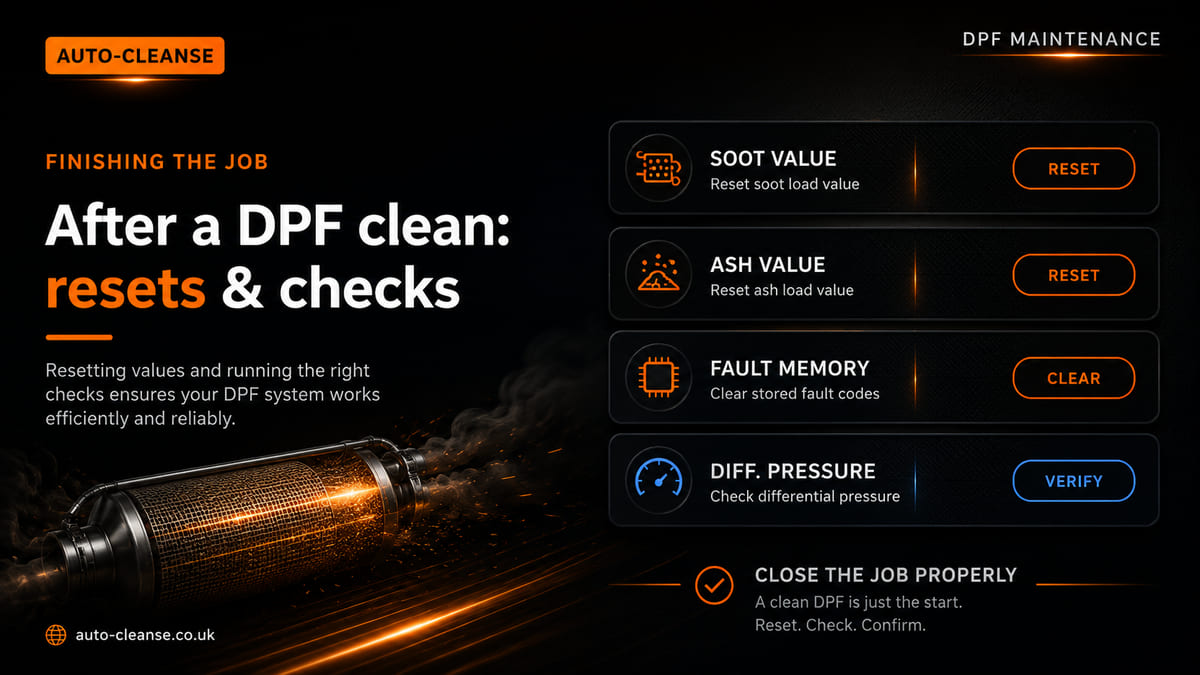
Completion does not automatically prove the repair is finished. The regeneration result needs to be confirmed, the relevant fault and live-data information reviewed, pressure behaviour assessed under known conditions, and the cause of excessive soot production or failed regeneration verified as corrected. Where a filter turns out to be physically restricted rather than simply soot-loaded, that is a job for off-vehicle DPF cleaning rather than another attempt at regeneration - and if the same warning keeps returning after a regen, the cause of the loading still needs to be found.
The takeaway
Passive, active and forced regeneration are three different processes with different enabling conditions and limits, and none of them is a universal answer to a DPF warning - the regeneration type, filter condition, sensor credibility and the cause of the loading all need to be established first.
Sources
- Ford Owner Manuals: Passive, active and manual DPF regeneration descriptions
- Ford Owner Manuals: Manual regeneration prerequisites, operating prompts and fire-safety warnings
- HELLA TechWorld: Passive, active and forced regeneration procedures
- Cummins Emission Solutions: Passive and active regeneration within DPF aftertreatment systems
General technical guidance only. Regeneration terminology, enabling conditions, soot limits, temperatures, safety precautions and abort criteria vary by manufacturer, engine and aftertreatment system - the vehicle's own manufacturer workshop information always takes precedence.
Need help with this on your vehicle?
Auto-Cleanse can sort it. See our DPF Diagnostics service, or get in touch.
Related: DPF Cleaning in Devon · Blocked DPF Cleaning