DPF Removal and the Law: Why We Clean Instead
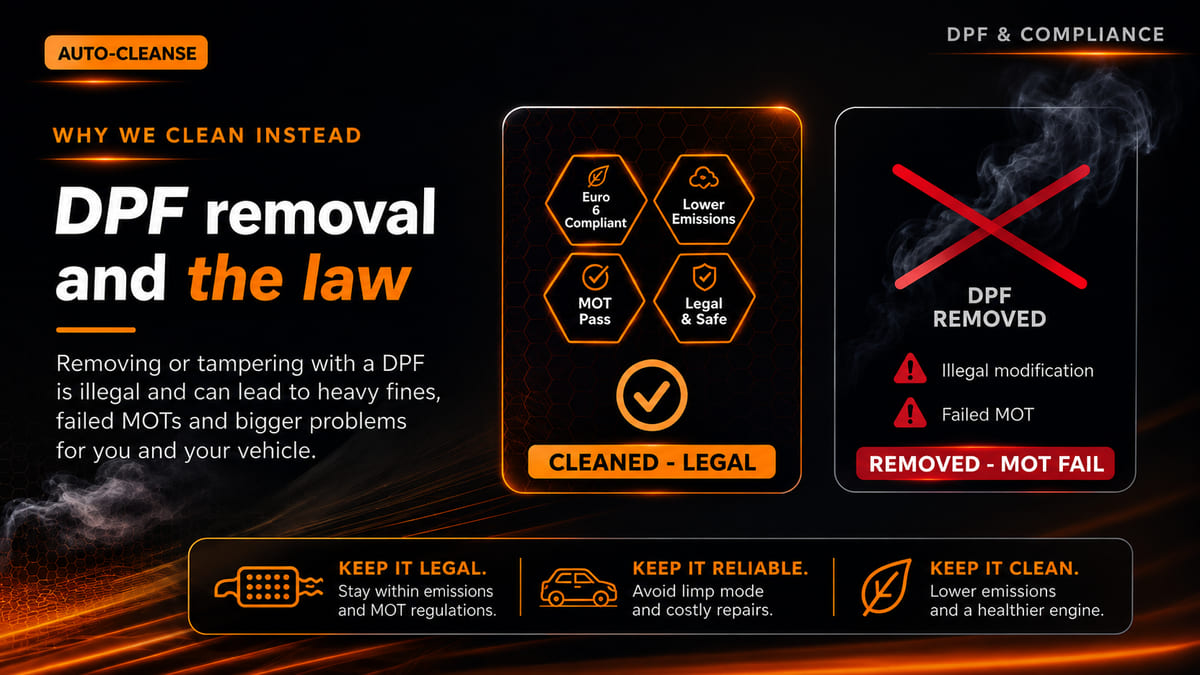
It is a question we hear often, usually from someone who has just been quoted for a new filter: can you take it out instead. A blocked diesel particulate filter (DPF) is inconvenient, the replacement part is rarely cheap, and plenty online suggests removal is a normal repair option.
It is not. On a road-going vehicle in the UK, removing or defeating a DPF that the vehicle left the factory with is not a legal repair, and it is not something Auto-Cleanse does. Here is why, and what we do instead.
A DPF that has been removed is not a repaired vehicle - it is a non-compliant one.
Where the law sits
The MOT has checked for it since 2014
Since 2014 the MOT test has included a check of the exhaust for a DPF that has been removed from a vehicle originally fitted with one. The tester is looking for a missing filter, or an exhaust obviously modified in a way that indicates the filter is no longer doing its job. Where that is found, the vehicle does not pass.
Emissions scrutiny at MOT has broadened since. Hoping a change goes unnoticed at test is not the same thing as holding a legitimate repair.
Using a vehicle that no longer meets its emissions standard
The MOT is only the visible part of it. A vehicle is built and approved to a particular emissions standard, and it is an offence to use one on the road that has been modified so that it no longer meets that standard. That applies whether or not an MOT is due, and whether the change is physical, in software, or both.
This matters for trade as much as for private owners. A workshop that carries out the work, or knowingly supplies a vehicle in that condition, takes on exposure that a cleaning or repair job does not create.
Insurance and disclosure
Insurers treat emissions-system changes as a modification. An undeclared modification can give an insurer grounds to alter or refuse cover, and that exposure sits with the policyholder at the worst possible moment. The problem also carries forward on sale, because the condition does not disappear with a change of keeper.
Common misconception: "It only affects the emissions test, so it is a paperwork issue." It is not. The MOT check, the offence of using a modified vehicle, the insurance position and the resale position are four separate problems, and none of them resolves the others.
Why cleaning is the proper repair
A DPF is a serviceable component, not a consumable that fails once and is finished. It traps particulate matter, and regeneration oxidises the combustible soot. What regeneration does not remove is the non-combustible ash, or the oil, coolant or fuel contamination that has found its way into the substrate.
That residue is what usually leaves a filter restricted after every regeneration attempt has been made. It is a physical loading problem, and it responds to a physical solution. Taking the filter off the vehicle, inspecting it, cleaning it under controlled conditions, drying it and flow testing it against the expected condition tackles the restriction directly, and leaves the vehicle in the specification it was built to. That is the point of a proper off-vehicle DPF clean.
Cleaning also keeps the rest of the system honest. The differential-pressure signal, the soot model and the regeneration strategy carry on working as designed, because the component they monitor is still there and still doing its job. Nothing has to be masked or explained away at the next MOT or the next sale.
What we do instead of removal
- Diagnose before condemning. Read the current and stored fault codes, freeze-frame data and relevant live values before anything is disturbed. A restriction, a sensor fault and an upstream engine fault look similar from the driver's seat.
- Establish whether the filter is serviceable. Ash and contamination loading are cleanable. A cracked, melted or collapsed substrate is a different diagnosis, and cleaning is not the answer to it.
- Clean off-vehicle and verify. Inspect, clean, dry and flow test, then compare the result against the expected condition for that filter rather than assuming the process worked.
- Fix the reason it loaded. A filter that keeps blocking is telling you something about combustion, air management, sensing or duty cycle. Clean the filter and leave the cause, and it comes back.
- Return the vehicle to standard. The filter goes back in, the vehicle keeps the emissions specification it was approved to, and a repair of that kind is not a modification to declare.
For customers outside our area, or for trade work where the vehicle stays with the garage, the same process runs through our postal DPF cleaning service - the filter travels, the vehicle does not.
When a filter genuinely cannot be saved
Sometimes the honest answer is that the substrate is damaged beyond cleaning. That is a replacement job, and we will say so rather than sell a clean that will not hold. Replacement with the correct filter for the application keeps the vehicle legal - deletion does not become sensible because the first option was ruled out.
The takeaway
Where a filter is serviceable, cleaning is aimed at returning it to doing its job within the specification the vehicle was approved to. Removal trades a mechanical problem for a legal, insurance and resale one. If a filter can be cleaned we clean it, and if it cannot we say so.
Sources
- DVSA - MOT inspection manual guidance on exhaust systems and emissions equipment
- DVSA - guidance on diesel particulate filters and vehicle use on the road
- VCA - vehicle type approval and emissions standards information
- HELLA TechWorld - diesel particulate filter system technical information
- Motorservice - particle filter technical information
General technical guidance only. Manufacturer-specific workshop information and current DVSA requirements always take precedence.
Need help with this on your vehicle?
Auto-Cleanse can sort it. See our DPF Cleaning in Devon service, or get in touch.
Related: Blocked DPF Cleaning · Nationwide Postal DPF