Remapping a High-Mileage Vehicle: What to Check First
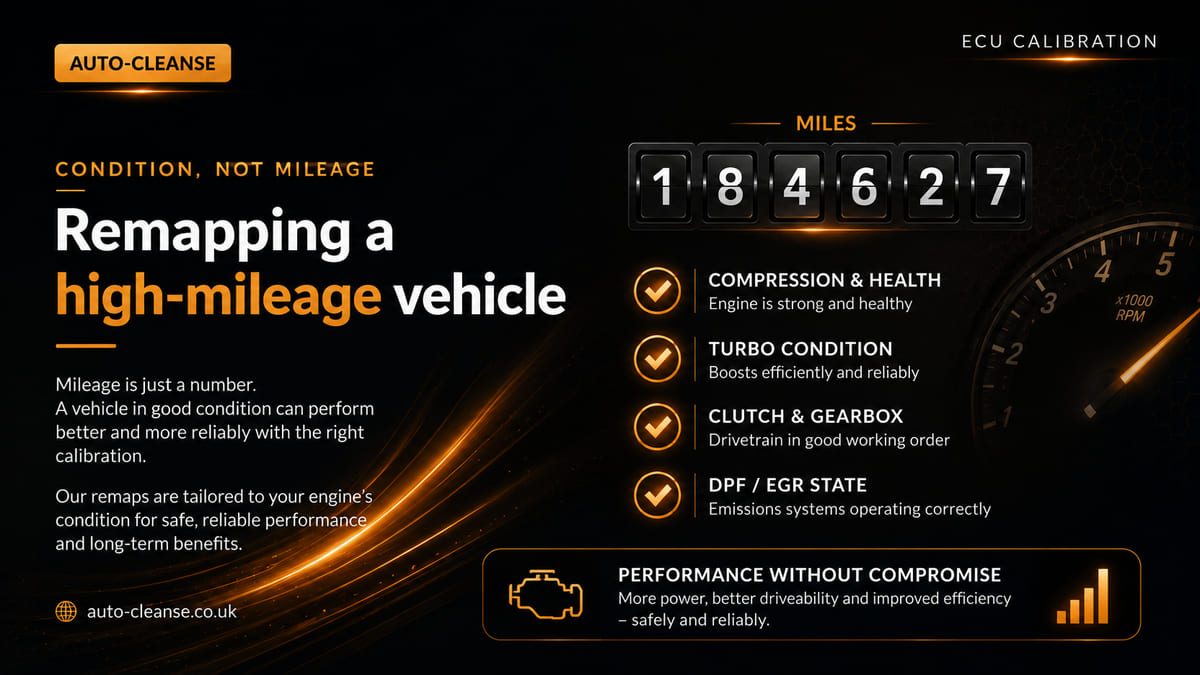
One of the most common questions we are asked is whether a vehicle is "too far gone" for a remap. The odometer figure is usually what prompts it, and on its own it is a poor predictor. A well-maintained high-mileage motorway car can be in far better mechanical condition than a low-mileage one that has spent its life on short, cold, stop-start journeys.
Every vehicle should have its condition established before calibration, whatever the mileage - we have covered that general baseline in why vehicle condition matters before a remap. This post is about the narrower question: what specifically changes as a vehicle ages, and how that should shape the decision.
Mileage measures opportunity for wear, not the wear itself.
Why the odometer is the wrong measure
Two vehicles with identical readings can be in completely different states. Duty cycle, servicing intervals, oil specification, warm-up and cool-down habits, and whether previous faults were repaired properly all matter more than total distance.
A vehicle that has covered long, steady, fully warmed journeys has spent most of its life in the conditions an engine tolerates best. One that has done a fraction of the distance in short cold hops has seen more cold starts, more fuel dilution of the oil, more incomplete regenerations and more thermal cycling. The second is often the harder case, despite the friendlier number on the dash.
What actually wears, and why calibration finds it
Age does not degrade an engine uniformly. A few specific things drift, and they happen to be the same things a raised torque figure leans on hardest.
Clutch friction material
On manual vehicles this is the single most common post-remap complaint, and it is almost always pre-existing. A clutch approaching the end of its friction life can still hold standard torque perfectly well and then slip under a raised figure - typically in the higher gears, under load, on a gradient. Nothing was broken by the calibration; the margin it had been living on simply disappeared. It should be assessed and honestly declared beforehand, never diagnosed afterwards.
Turbocharger tolerances
The turbo is the component most directly affected by a change in requested boost. Shaft play widens gradually, variable-geometry mechanisms stiffen with soot and heat cycling, and oil carryover creeps up long before anything is obviously wrong. A mechanism that is merely lazy at standard boost can become an overboost or underboost fault once the calibration asks it to respond faster and hold more.
Cooling and lubrication margin
Higher sustained loads mean more heat to reject at exactly the point in a vehicle's life when the cooling system is least able to do it. Radiator cores silt up, thermostats stick part-open, fan clutches weaken and coolant loses its inhibitors. Oil deserves the same scrutiny: correct specification, within interval, no fuel dilution, no emulsion under the filler cap. Fresh oil and filters beforehand is sensible on any older engine and removes a variable from any later investigation.
Aftertreatment that is already working hard
On an older diesel the filter has usually accumulated ash it will never regenerate away, so it is closer to its restriction limit than the soot figure alone suggests. That is a condition to establish with proper DPF diagnostics beforehand - and a remap is not a repair for a loaded filter and should never be sold as one. Emissions equipment stays fitted and working.
Common misdiagnosis: "The clutch slipped straight after the remap, so the remap caused it." Raised torque brings forward the point at which an already worn clutch gives up; it does not wear out a sound one in a single drive. The likelier conclusion is that the clutch was near the end of its serviceable life and the assessment should have caught it.
Setting honest expectations
There is a commercial conversation here as well as a technical one. On an older vehicle the sensible order is often to spend first on what is worn and only then on calibration - a tired clutch or a marginal turbo will cost more to put right after a remap has found it than before.
It is also worth being plain about the gain. A healthy older engine can respond well to a Stage 1 calibration, but wear costs efficiency, and a vehicle carrying a tired turbo, restricted aftertreatment or soft compression will not produce what a fresh example does. Quoting a number without seeing the vehicle is how customers end up disappointed.
Being willing to say no
The professional position is neither automatic refusal nor automatic acceptance. Where the assessment finds a marginal clutch, a tired turbo, a cooling fault or an unresolved emissions problem, the right answer is to recommend the repair first and revisit the remap afterwards - or to decline the job outright if the vehicle is not fit for it.
That conversation is far easier to have before the work than after it. A workshop that never turns anything away is not applying a standard.
The takeaway
High mileage is not a barrier to remapping, but unverified condition is. Judge the vehicle on what has actually worn rather than what the odometer reads, put right what the assessment finds, and be prepared to walk away from anything that is not ready for the work.
Sources
- Bosch Mobility - diesel engine management technical information
- HELLA TechWorld - turbocharger and boost-pressure system diagnostics
- Motorservice - engine wear, cooling system and lubrication technical guidance
- Manufacturer workshop information - compression, leak-down and torque-handling specifications
General technical guidance only. Manufacturer-specific workshop information, test conditions and specifications always take precedence.
Need help with this on your vehicle?
Auto-Cleanse can sort it. See our ECU Remapping service, or get in touch.
Related: Stage 1 Remaps in Devon · Mobile ECU Remapping