Diesel MOT Smoke Test: Do DPF or AdBlue Warnings Mean a Fail?
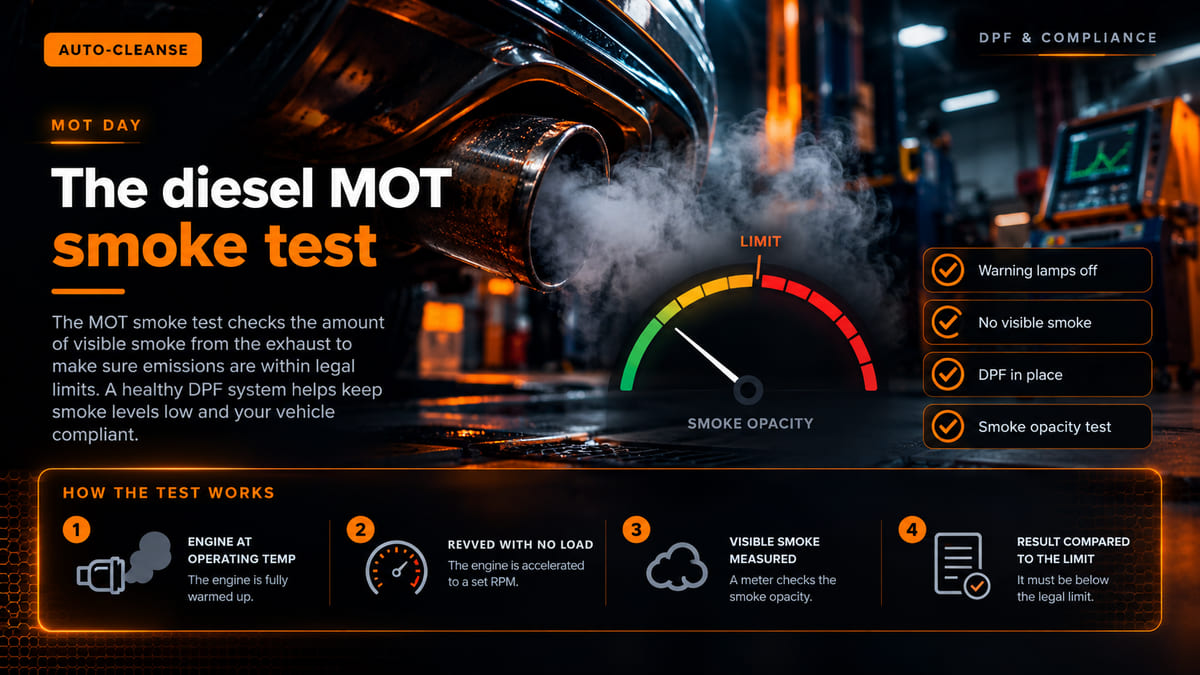
The diesel MOT smoke test in England, Scotland and Wales is a metered check of how opaque the exhaust is. It comes with a visual check of the emission control equipment and, on diesels first used from 1 July 2008, a check that the engine warning light works and is not showing a fault. A DPF or AdBlue warning on its own is not a listed defect, and there is no NOx test. But a lit engine warning light is a major defect, which means a fail, and so is visible smoke of any colour from a car with a diesel particulate filter (DPF).
The MOT does not care why the smoke is there. It measures it, and a major defect is a fail.
Will my car fail its MOT with the DPF light on?
Not on its own. The MOT manual's emissions section does not list a separate DPF warning lamp. It checks the engine malfunction indicator lamp (MIL): on diesels first used on or after 1 July 2008, the MIL must light when the ignition is switched on and then go out - on some vehicles only once the engine is started. A MIL that does not work, or that is indicating a malfunction, is a major defect.
So if the engine warning light is on, alone or alongside a DPF light, the car fails. Whether and when a filter problem lights it varies by manufacturer - our guide to what each DPF warning light means covers that - and a filter at the warning stage is better diagnosed before test day than at the test centre.
What happens in the diesel MOT smoke test
For diesels first used from 1 January 1980 (older ones get a visual smoke check only), the tester uses a diesel smoke meter. It measures how opaque the exhaust gas is during a series of sharp accelerations up to maximum engine speed, after a check that the governor is limiting the revs properly.
- The engine must be warm: at least 80°C, or normal operating temperature if that is lower, checked with an oil temperature probe or another approved method.
- Up to six accelerations. The opacity check passes if the first reading is no more than 60% of the limit, if the average of the first three is within the limit, or if the average of any three consecutive readings is within it.
- A dual exhaust (two separate pipes from the engine manifold to the tailpipes) is tested at both tailpipes and the readings averaged.
- Hybrids, including mild hybrids, are not smoke tested, although the engine warning light check still applies to them.
How the smoke limit is set
The tester uses the manufacturer's plate value where there is one. That figure is on the VIN plate or on a separate plate or sticker, often in the engine compartment, and may be marked "24 R" followed by the value.
Where there is no plate value, the manual sets default limits by the date the vehicle was first used:
- Before 1 July 2008: 2.5m⁻¹ for a non-turbocharged engine, 3.0m⁻¹ for a turbocharged engine
- 1 July 2008 to 31 December 2013: 1.5m⁻¹ for all engines
- On or after 1 January 2014: 0.7m⁻¹ for all engines
A reading over the limit that applies - the plate value, or the default where there is no plate information - is a major defect, which means a diesel emissions MOT fail. Smoke or vapour so bad it is likely to obscure other road users' vision is a dangerous defect.
DPF smoke, tampering and missing equipment
Since the MOT changes of 20 May 2018, the tester also checks that no visible smoke comes from the exhaust of a DPF-equipped vehicle during the metered test. Visible smoke of any colour - black, blue or white - is a separate major defect, even if the meter reading is within the limit.
The other emissions equipment items, all major defects, are:
- Emission control equipment fitted by the manufacturer that is missing, obviously modified or obviously defective. The tester checks the components that are visible and identifiable, such as the oxidation catalyst, DPF, EGR valve and selective catalytic reduction valves.
- Evidence that the DPF has been tampered with. The manual says a DPF that has clearly been cut open and rewelded should be failed unless the presenter can show a valid reason, giving filter cleaning as an example.
- An induction or exhaust leak that could affect emissions levels.
Removal goes well beyond an MOT problem, and our piece on DPF removal and the law covers why.
AdBlue and the MOT: is it tested?
Not directly. The diesel emissions test measures smoke opacity, not nitrogen oxides, and nothing in the emissions section tests AdBlue level or quality. The fluid leaks section even lists the fluid used for selective catalytic reduction, alongside coolant and screenwash, among leaks that are not reasons for failure.
That does not make AdBlue faults irrelevant. SCR valves are among the components covered by the missing or modified rule above, and if an SCR fault has lit the engine MIL, the MIL rule applies. If the AdBlue or emissions warning is on before the test, get the AdBlue system diagnosed and repaired first.
Common misconception: "There is no NOx test, so an AdBlue fault will not matter." A faulty or disabled SCR system can still fail through the engine warning light or the equipment check.
Can the MOT smoke test damage a diesel engine?
The test involves repeated hard accelerations, so the tester will refuse to do it if they think it may damage the engine. DVSA advises owners to tell the tester at the start of the MOT if they think this may happen, and to have the camshaft drive belt replaced at the recommended intervals.
The manual's examples of an engine not in a safe condition include insufficient oil, low oil pressure, abnormal engine noise, a governor that has been tampered with and a camshaft belt in unsatisfactory condition. A refusal means the test is not carried out, which is not the same as a fail. But a test that is started and cannot be completed, or is stopped because smoke is significantly over the limit, is a major defect.
How to prepare a diesel for its MOT
- Fix warning lights first. On a diesel first used on or after 1 July 2008, a lit engine MIL is a major defect on its own, whatever the smoke reading.
- Arrive properly warm, after a real run. Idling in the car park is not normally enough, and a diesel that has only done short, cold trips may also have had regenerations interrupted. DVSA notes that a fully warmed-up engine produces less smoke and is safer to test.
- Have a known regeneration problem diagnosed beforehand. A filter that keeps warning, or regenerates far more often than it should, deserves proper DPF diagnostics rather than a hopeful test booking.
- Check the oil level and, on a belt-driven engine, know the timing belt history. Both affect whether the smoke test can be run safely.
- Bring paperwork for any DPF work. It answers the question before it is asked.
A hard "Italian tune-up" on the way to the test centre will not fix a fault or clear an ash-loaded filter - our guide to short journeys and DPF health explains why it is oversold.
How Auto-Cleanse can help
Our paid DPF diagnostic check reads fault codes and live data, usually in around an hour, with the vehicle normally brought to our Totnes workshop - worth booking well before the MOT. If the filter is restricted rather than damaged, it can be removed for off-vehicle DPF cleaning with before-and-after flow and back-pressure testing - collected locally in Devon or posted to us from anywhere in the UK. In Devon our own technicians handle AdBlue repairs; elsewhere we can book an independent mobile technician from our national network, and if we cannot cover your area we say so. For help with removing and refitting the filter, call or WhatsApp 07823 649190 (Mon-Fri 09:00-17:00) to discuss current availability.
Frequently asked questions
What is the MOT smoke limit for a diesel?
The manufacturer's plate value, where one exists. Otherwise the default is 2.5m⁻¹ (non-turbo) or 3.0m⁻¹ (turbo) for vehicles first used before 1 July 2008, 1.5m⁻¹ from then to 31 December 2013, and 0.7m⁻¹ from 1 January 2014.
Does the MOT check AdBlue?
There is no AdBlue level or NOx test. But an SCR fault that has lit the engine warning light fails the car through the MIL check, and SCR valves are checked for being missing or modified.
Can I drive my car if it fails the MOT on emissions?
Only if your current MOT is still valid and no dangerous problems were listed; otherwise it needs repairing first, and it must meet the minimum standards of roadworthiness at all times. Driving a vehicle that failed on a dangerous problem can bring a fine of up to £2,500, a driving ban and 3 penalty points.
Should I put a DPF cleaner in before the MOT?
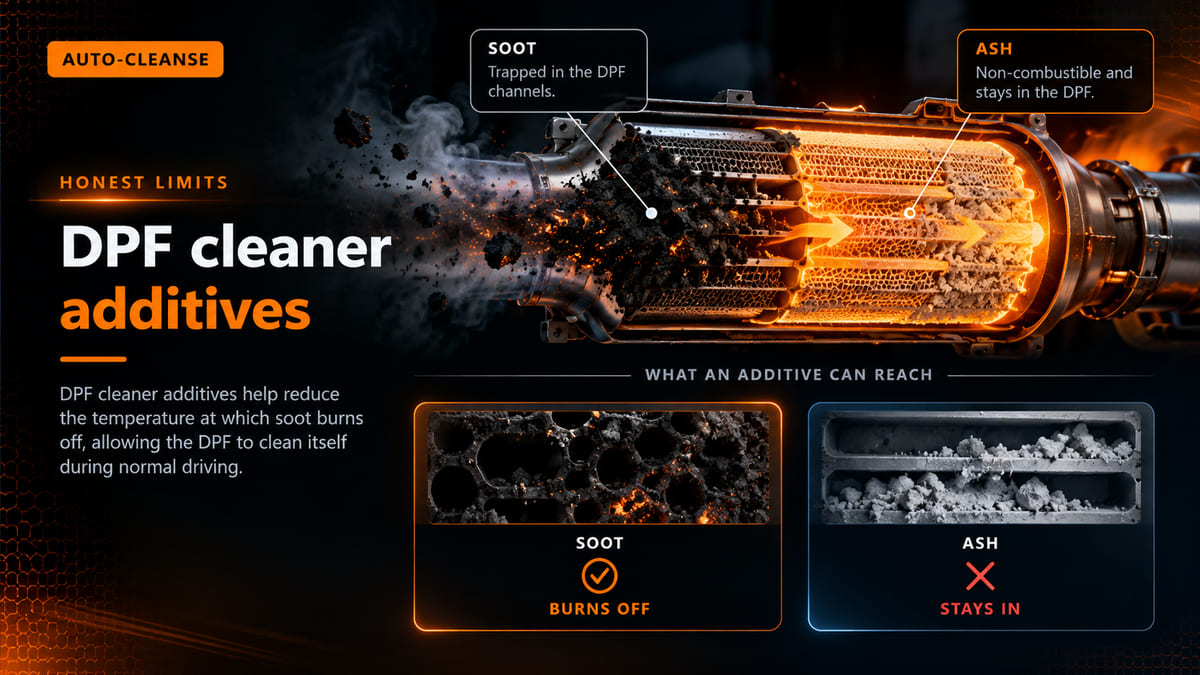
It will not fix a fault. An additive can help a healthy diesel burn off light soot if it gets a proper drive so a regeneration can finish, but it does not remove ash or cure whatever caused a warning light. Our guide to what DPF cleaner additives can and cannot do covers when one is worth trying.
The takeaway
The diesel MOT measures smoke, checks the engine warning light and looks for missing or tampered emissions equipment. Fix warning lights before the test, present the car properly warm, and treat a DPF or AdBlue warning as a diagnostic job rather than something to hope the tester misses.
Sources
- DVSA - MOT inspection manual: cars and passenger vehicles (section 8 and the introduction on refusing to test)
- DVSA - MOT changes: 20 May 2018 (news story)
- DVSA - car parts checked at an MOT
- DVSA - getting an MOT: driving a vehicle that has failed (GOV.UK guide)
General technical guidance only. The current DVSA MOT inspection manual, and manufacturer-specific handbook information and specifications, always take precedence.
Need help with this on your vehicle?
Auto-Cleanse can sort it. See our DPF Diagnostics service, or get in touch.
Related: DPF Cleaning · Adblue Repair