Short Journeys, Driving Style and DPF Health
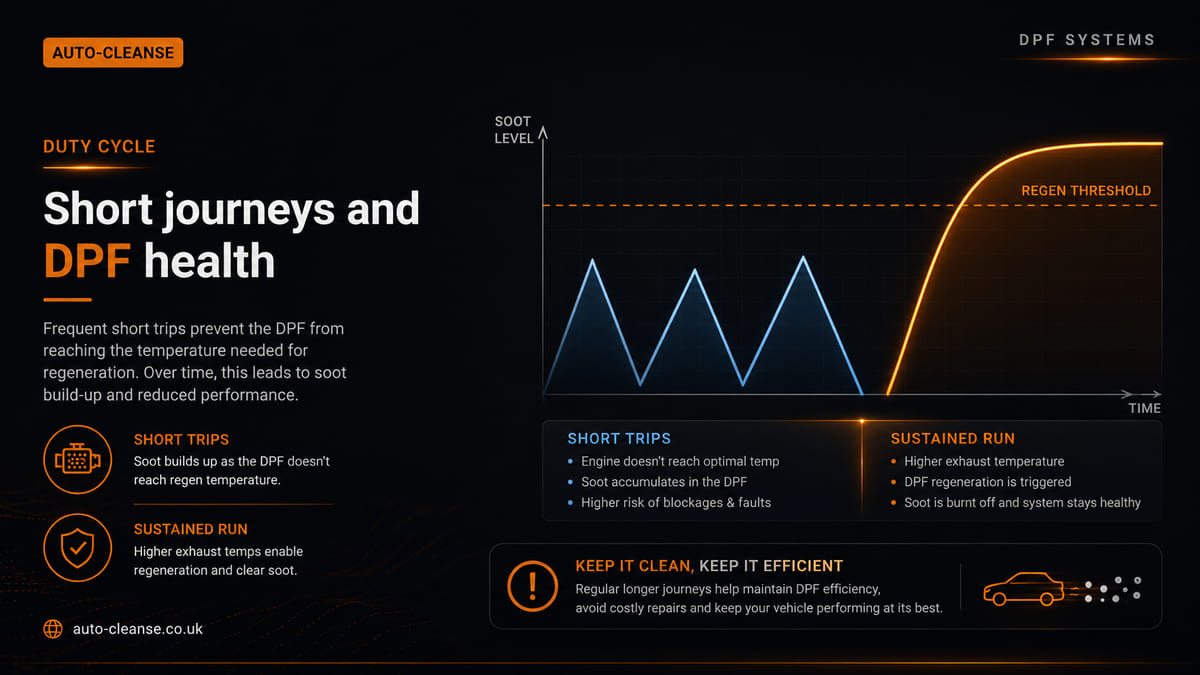
Two identical vehicles, serviced the same way on the same fuel, can end up with very different DPF histories. The difference is often not the filter or the workshop but the duty cycle - what the engine is actually asked to do, day after day. That is not about blaming the driver, because short journeys are a legitimate way to use a vehicle. But regeneration is a controlled heat event, and heat comes from load.
A DPF is not counting miles - it is waiting for the conditions that allow a regeneration to start and to finish.
Why duty cycle matters
A wall-flow DPF collects soot continuously while the engine runs. The ECU tracks that loading using differential pressure and its own soot model, and starts a regeneration when loading and operating conditions both allow it.
Those enabling conditions vary by manufacturer, but the pattern is consistent: the engine at operating temperature, the exhaust hot enough for long enough, sufficient fuel in the tank, and no fault inhibiting the strategy. Exact thresholds and timings are vehicle-specific and defined only by the manufacturer's own service information.
Three things about short-journey use work against that.
Cold running
An engine that never reaches full operating temperature burns fuel less completely, tends to produce more particulate and puts less heat into the exhaust. The system loads the filter faster while being less able to clear it.
Low load and low exhaust temperature
Gentle town driving, long idling and stop-start traffic keep exhaust temperature low. Passive regeneration depends on the exhaust running warm enough for the oxidation catalyst to help oxidise soot gradually, and an active regeneration needs a reasonable starting temperature before the ECU can raise it further. Low load works against both.
Journeys that end before the regeneration does
This is the one most often missed. An active regeneration needs time at stable conditions. If trips are habitually shorter than the process needs, regenerations get started and then abandoned - a different problem from never attempting one.
What actually helps
- Let the engine reach full operating temperature. Not just coolant on the gauge - the exhaust needs to be warm too.
- Include periods of sustained, steady, higher-load running where it is safe and legal to do so. A consistent moderate load in a suitable gear does more than brief bursts of acceleration.
- Where a vehicle indicates a regeneration is in progress, allow it to finish if circumstances safely permit. Some vehicles display this clearly, others do not.
- Keep servicing to specification. The correct low-ash oil matters, because ash builds up permanently and regeneration does not remove it.
- Act on the first warning rather than the third. Early loading is a driving and diagnostic problem. Late loading becomes a workshop and off-vehicle cleaning problem.
None of this is a guarantee. Better habits improve the chances of a regeneration completing; they do not fix a vehicle that cannot regenerate for another reason.
Why the Italian tune-up is an oversimplification
The advice to "give it a good run" is not wrong so much as incomplete. It approximates a real requirement - sustained load and exhaust heat - but ignores what determines whether a regeneration can run at all.
A hard drive achieves nothing if a fault is inhibiting regeneration, if the filter is loaded past the point where the ECU will permit an active regeneration, or if the restriction is ash rather than soot. On a heavily loaded filter, generating high exhaust temperature also carries real thermal risk to the substrate - which is why manufacturers set loading limits above which regeneration must be handled under workshop conditions.
Common misdiagnosis: "It only does short trips, so it just needs a good run." Duty cycle is a plausible contributing factor, not a diagnosis. Sensor plausibility, EGR and air-management condition, injection quality and actual filter restriction all need assessing first.
Why repeated interruption is worse than no attempt
On many systems an active regeneration raises exhaust temperature using additional fuel injected late in the cycle. If that process is repeatedly started and cut short, two things tend to follow.
First, the soot loading keeps climbing. Each aborted attempt leaves the filter fuller than before, pushing it from routine active regeneration towards needing a commanded procedure or physical cleaning.
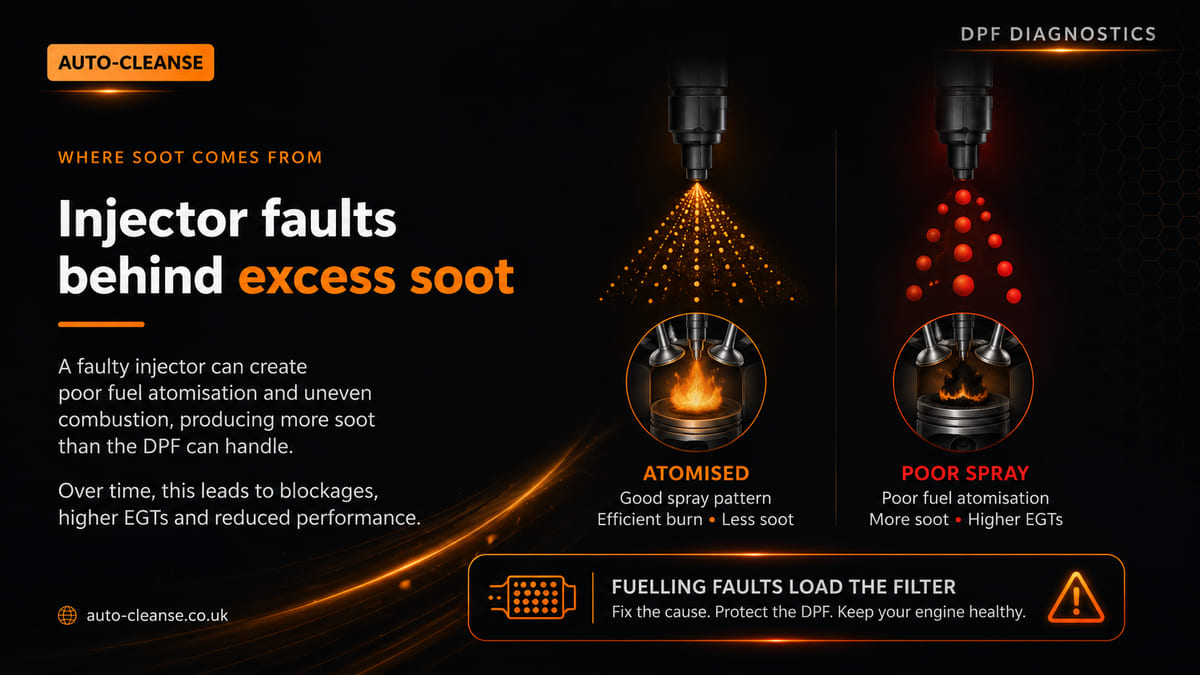
Second, on applications using in-cylinder post-injection, fuel that does not fully burn can pass the bores into the sump. Repeated aborted regenerations are a recognised cause of rising oil level and dilution - an engine durability concern, not just a filter one.
Repeated attempted and abandoned regenerations usually show up in the regeneration history and live data - worth a proper DPF diagnostic assessment rather than another lap of the bypass.
Some vehicles simply suit some usage patterns better
This is the honest part. A modern diesel with an active regeneration strategy is designed around a duty cycle that includes regular sustained running. Used almost entirely for short, cold, urban journeys, it is likely to need more attention and more frequent intervention over its life, however carefully it is driven.
That does not mean the vehicle is faulty or the owner at fault - the application and the use case are simply not well matched. It is fairer to say so plainly than to keep cleaning a filter that is likely to load again under the same conditions. Where the usage cannot change, closer monitoring and planned maintenance beat waiting for the warning light.
The takeaway
Duty cycle is a genuine and often decisive factor in DPF health, but it is a contributing cause to be confirmed, never an assumption. Establish that the system can regenerate before concluding it has simply not been given the chance.
Sources
- HELLA TechWorld - diesel particulate filter system operation and diagnosis
- Bosch Mobility - diesel engine management and exhaust aftertreatment technical information
- Motorservice - particulate filter and injection system technical information
- Delphi Technologies - diesel fuel systems and DPF regeneration guidance
General technical guidance only. Manufacturer-specific workshop information, test conditions and specifications always take precedence.
Need help with this on your vehicle?
Auto-Cleanse can sort it. See our DPF Cleaning in Devon service, or get in touch.
Related: DPF Diagnostics