Stage 1 vs Stage 2 Remaps: What Actually Differs
Ask several tuners what Stage 2 means and you can get several different answers. These are industry shorthand terms, not defined standards, which is part of why the conversation collapses into a single power figure.
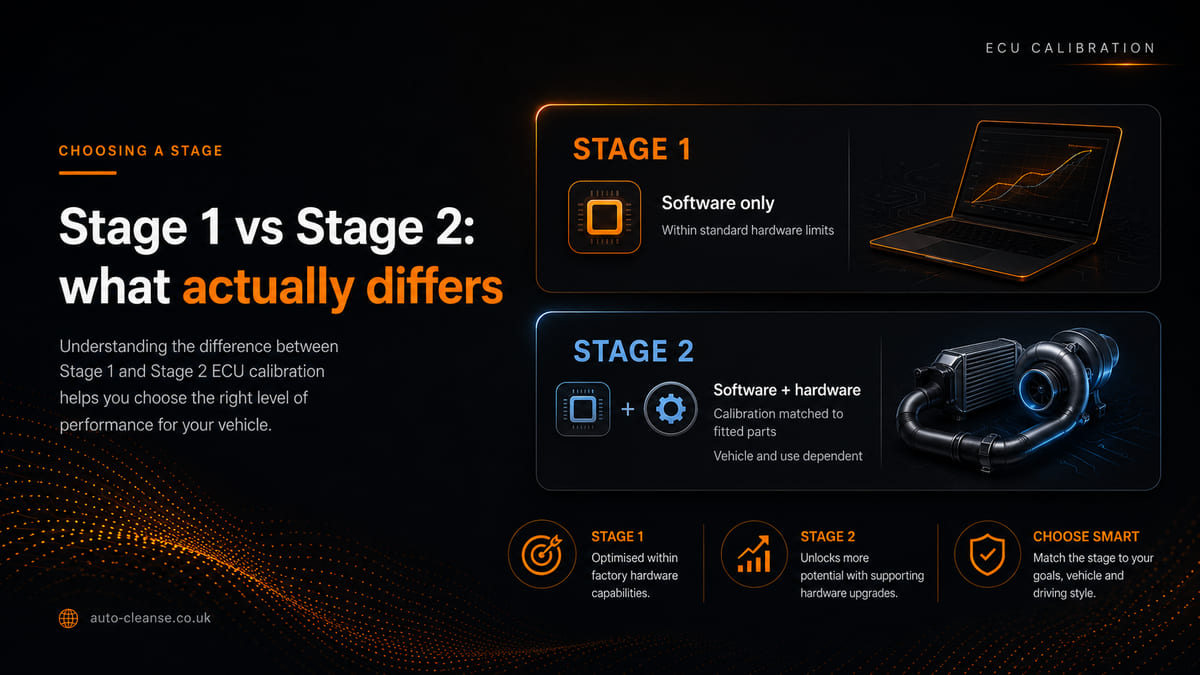
It is more useful to describe what physically changes on the vehicle. Stage 1 is software written to work within the standard hardware. Stage 2 is a calibration written to suit hardware that has already been changed. The difference is not the number on the printout - it is what the engine is physically capable of before anyone opens the file.
Stage 2 is not a bigger file. It is a calibration matched to hardware that is already different.
Stage 1: calibration within the standard hardware
A Stage 1 remap recalibrates the ECU while the turbocharger, induction, intercooler, exhaust, injectors, clutch and emissions equipment all stay as the manufacturer fitted them. The work sits in how torque is requested, limited and delivered, within the airflow, fuelling and boost the standard components can genuinely support.
That constraint is the point rather than a shortcoming. The factory hardware was validated as a system, and a competent Stage 1 aims to stay within what it can tolerate. Nothing is bolted on and nothing is removed.
Stage 2: calibration matched to changed hardware
Stage 2 describes a calibration written after supporting hardware has been fitted. Depending on the application that can mean freer-flowing induction, a larger or more efficient intercooler, a less restrictive exhaust or downpipe, and sometimes fuelling, clutch or cooling upgrades to match.
The order matters. The hardware comes first and the calibration follows it. A Stage 2 file makes use of capability that is already present - it does not create it.
Why the calibration cannot lead the hardware
Load a hardware-matched file onto a standard car and the ECU is asked for something the engine cannot deliver: boost the turbocharger can only reach outside its efficient range, air mass the intake cannot flow, or charge temperatures the intercooler cannot control.
Modern engine management works to targets and monitors whether they are met. Where requested and actual values diverge, the ECU will typically correct, then limit output, and store a fault if the deviation persists. Before that point you tend to get raised charge and exhaust temperatures, knock retard on petrol, or smoke limitation on a diesel. None of it is a tuning benefit.
Why the hardware cannot lead the calibration either
The reverse is just as true. Fitting hardware without recalibration often changes little on a modern boosted engine, because the ECU controls to a target rather than to whatever the pipework allows. A freer exhaust just reaches the same target more easily; the gain appears when the calibration is rewritten to suit.
Common misdiagnosis: "It feels flat, so the file must be wrong." Where hardware and calibration do not match, the ECU is usually behaving as designed, protecting the engine from a request it cannot safely meet. The fix is to reconcile the two, not raise the request.
What a Stage 2 package has to support
Air in
Induction and charge pipework have to flow enough air, with credible measurement, for the requested load to be achievable rather than merely requested.
Heat out
Charge-air temperature control is often the real limiting factor on a road car, particularly in sustained use. An intercooler upgrade is as much about repeatability as peak figures.
Gas out
Exhaust restriction affects turbine behaviour, backpressure and how the engine breathes. On a diesel it also affects exhaust temperatures and aftertreatment, so any downpipe change has to leave the emissions equipment working.
Everything downstream
Clutch, transmission, driveshafts, cooling and brakes all have to live with the result. Proper ECU remapping treats the car as a system, and that system does not stop at the turbocharger outlet.
The road-car caveat that gets skipped
Many packages marketed as Stage 2 are built around removing or defeating emissions equipment. For a UK road vehicle that matters.
Emissions equipment fitted as standard is expected to be present and working. Removing or disabling it can make a vehicle non-compliant for road use and can cause an MOT failure, and no calibration makes that acceptable. Modifications also need declaring to your insurer, and warranty or lease terms may be affected.
A Stage 2 calibration built around retained, working emissions equipment is legitimate on a suitable vehicle. One built around deleting that equipment is competition-use only and should be described as such, not sold as a road upgrade.
Choosing between them
- Be honest about the use case. Commuting, towing and family mileage reward drivability and durability. Track or competition use is where hardware changes earn their keep.
- Assess the vehicle first. Condition, mileage, service history, clutch and gearbox health shape what is sensible before any file is discussed.
- Price the whole package. Stage 2 is hardware plus calibration plus supporting work, and warranty, lease, insurance and resale sit alongside the technical decision.
- Validate the result. Whether on a rolling road or during a mobile ECU remapping visit, the finished calibration should be checked against real data.
For most road-driven vehicles, Stage 1 is the sensible answer: it stays within validated hardware limits, keeps the emissions systems intact, and on a healthy vehicle can give a usable improvement with nothing else to change.
The takeaway
Stage 1 and Stage 2 are not two points on one scale. They are different propositions, one bounded by the standard hardware and one defined by hardware that has changed. Choose on what the vehicle is for, not on which number is larger.
Sources
- Bosch Mobility - torque-based engine management and boost-control technical information
- HELLA TechWorld - charge-air system and turbocharger fault diagnosis
- DVSA - MOT inspection requirements for exhaust and emissions equipment
- VCA - vehicle type approval and emissions requirements for road vehicles
General technical guidance only. Suitable hardware, calibration limits, legal requirements and validation methods vary by vehicle, engine, transmission and intended use. Manufacturer workshop information and current UK regulations always take precedence.
Need help with this on your vehicle?
Auto-Cleanse can sort it. See our ECU Remapping service, or get in touch.
Related: Stage 1 Remaps in Devon · Mobile ECU Remapping