Peak Power vs Usable Torque: What a Remap Should Deliver
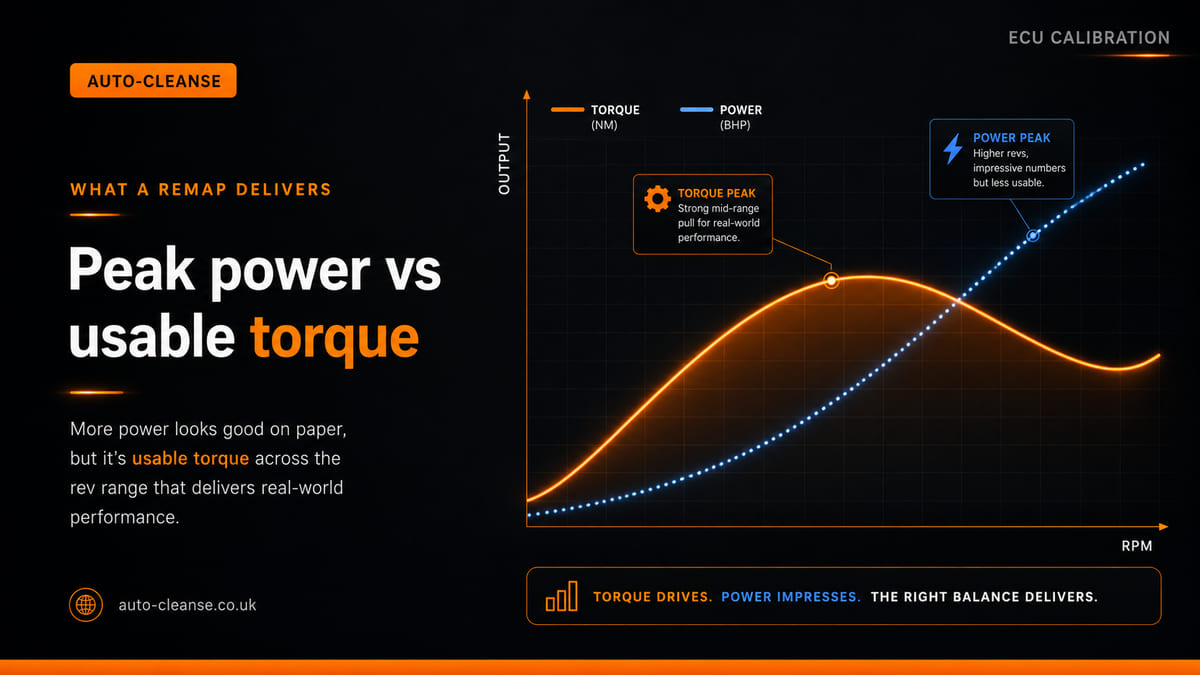
A headline horsepower figure tells you one part of the story. Peak torque and peak power are single points on a curve, and neither one describes what the engine is doing before, between or after that point. What actually shapes response, flexibility and how a vehicle feels to drive is the complete delivery across the usable engine-speed range.
A calibration is a delivery curve, not a single number.
Torque and power are linked, not competing measurements
Torque
Engine torque is the twisting moment produced at the crankshaft. Modern engine-management systems commonly use requested and delivered torque as a central control reference.
Power
Rotational power depends on both torque and rotational speed. The same torque produced at a higher engine speed represents more power.
The relationship
Power (kW) = Torque (Nm) × RPM ÷ 9,549
This is a mathematical relationship. Power is calculated from torque and rotational speed - it is not produced independently from torque.
Why one maximum figure cannot describe the whole result
Maximum torque and maximum power usually occur at particular engine speeds. A peak is one coordinate on the curve; it says nothing about what the engine produces below, between or above those points.
Lower range
Response and initial pull.
Mid range
Overtaking and loaded use.
Upper range
Sustained acceleration.
A real manufacturer example illustrates why this matters. Toyota described a factory performance package that retained the same peak torque figure but delivered it earlier and broadened the torque band, improving response at initial throttle input. The maximum number did not change - the location and width of the curve did, and that is what altered how the vehicle responded.
At the road wheels: gearing changes what's available
1. Gear ratio
Lower gears multiply torque while reducing output speed. ZF describes reduction gearing as reducing motor speed while increasing torque. In a vehicle, transmission ratio, final drive and tyre size all influence the relationship between engine speed, wheel speed and wheel torque.
2. Complete driveline
Engine output alone does not define vehicle performance. Cummins notes that in-vehicle performance depends heavily on the rest of the driveline configuration - gear ratios, vehicle mass, tyre size, traction and transmission behaviour all affect how engine output is converted into acceleration.
What a responsible Stage 1 calibration should consider
Beyond the headline number, a proper Stage 1 calibration should account for:
- How requested torque is delivered through the lower, middle and upper engine-speed range.
- Whether response is smooth and controllable rather than abrupt or inconsistent.
- Air, fuel, boost, combustion and protection strategies for the exact engine and ECU.
- Clutch, transmission and driveline condition, limits and intended duty.
- How the vehicle is actually used, including load, towing and regular driving conditions.
Calibration caution: more low-engine-speed torque is not automatically better. An aggressive torque rise can increase load on the clutch, transmission and driveline, and may be unsuitable for the engine, turbocharger or intended duty. The correct delivery has to be application-specific.
Reading a result properly
- Compare the complete before and after curves, not only the maximum values.
- Check where torque arrives, how long it is sustained and how smoothly it tapers.
- Review relevant logs and operating data, not only the plotted output lines.
- Judge the result against the vehicle, transmission, condition and intended use.
A calibration carried out through ECU remapping should be assessed this way whether it is booked in at the workshop or carried out as a mobile visit - the evidence needed to judge the result is the same either way.
The takeaway
Peak power matters, but so do torque shape, engine speed, gearing, response, repeatability and hardware limits. The best result is the one that suits the complete vehicle and how it is used.
Sources
- Bosch Mobility, Electronic Engine Control Unit
- SAE International, Validation and Calibration Process of Powertrain Model for Engine Torque Control Development
- ZF, E-Reduction Drive
- Cummins, 6.7L Turbo Diesel product and driveline information
- Toyota Motor North America, TRD Performance Package technical release
General technical guidance only. Exact calibration strategy, limits and validation must be determined from the correct ECU, engine, transmission and manufacturer information.
Need help with this on your vehicle?
Auto-Cleanse can sort it. See our ECU Remapping service, or get in touch.
Related: Stage 1 Remaps in Devon · Mobile ECU Remapping