Engine Torque, Gearbox Limits and Stage 1 Calibration
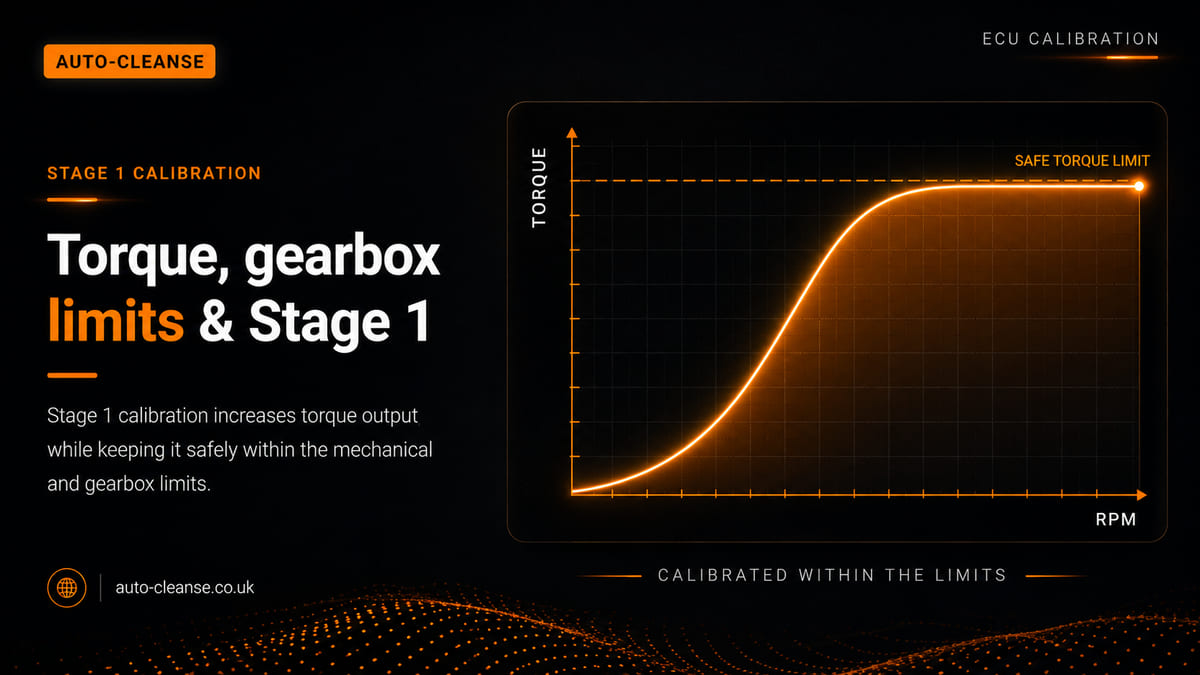
Fitting a Stage 1 remap is often discussed purely in terms of the engine's headline power and torque figures. In a modern vehicle, though, the engine control unit does not treat the engine as an isolated component - torque requests, limits and operating data are shared across the engine and transmission control systems. A calibration that only looks at the engine is only looking at part of the picture.
Anyone considering ECU remapping should expect the gearbox, clutch and duty cycle to get as much attention as the power number itself.
The engine produces the torque, but the clutch, gearbox and rest of the driveline have to transmit and manage it - the calibration should respect the complete system.
Why modern powertrains revolve around torque
Bosch describes torque as a key criterion used by the engine control unit to prioritise and implement driver demand, combustion requirements and requests from other vehicle systems. Transmission control also evaluates operating information such as input torque, engine speed and vehicle speed when controlling gear selection.
Three concepts sit behind that coordination:
Requested
What the driver and vehicle systems are asking the engine to provide.
Permitted
What current limits, protection functions and operating conditions allow.
Delivered
What the engine actually produces, or what the control system estimates it has produced.
A note on scan-tool data: exact channel names and torque models vary by manufacturer and ECU strategy. A label on a scan tool should not be assumed to mean the same thing on every vehicle.
The transmission is part of the decision
Gear selection and shift control
Torque information helps the transmission decide how to operate. Bosch states that integrated transmission control can select gears using input torque together with engine and vehicle speed. The exact control strategy is application-specific, but the principle holds: engine torque information is relevant to gearbox operation.
Torque intervention
Other control units can request changes to engine torque. Engine management is designed to accept and prioritise torque-related requests from other systems - depending on the vehicle, this may include transmission, traction and stability functions. Calibration changes must preserve credible coordination rather than treating every limiter as an obstacle to remove.
Torque reporting
Many powertrains exchange calculated torque information between control units. The implementation varies, so a calibration should be developed for the exact ECU and vehicle rather than assuming that one generic torque structure applies across different platforms.
A published rating is not a remap target
A gearbox name followed by a torque number does not settle a calibration decision on its own. Transmission families can exist in different variants and applications, and ZF states that maximum torque ratings can depend on application approval, duty cycle, operational mission and suitable engine torque-management or limitation strategies. Vehicle-specific information takes precedence over a generic figure quoted online.
There is no single gearbox limit
Hardware and variant
Transmission code, clutch or converter design, internal variant, final drive and vehicle application can all matter. A family name alone may not identify the complete specification.
Condition and maintenance
Capacity on paper is not the same as condition in service. Existing clutch slip, harsh shifts, overheating history, fluid condition, adaptation issues, vibration or mechanical wear should be addressed before additional torque is requested.
Duty cycle
Towing, payload, repeated hill work, stop-start use and sustained high-load operation create a different demand from occasional unloaded road use.
Control strategy
Shift strategy, torque requests, thermal protection and diagnostic monitoring vary between vehicles. They should not be disabled simply to force a larger output figure.
Torque shape matters as much as the peak
A calibration is not defined only by its highest torque figure. The rate of torque rise, the engine-speed range in which it is produced, the selected gear and the vehicle load all affect how the driveline experiences that output.
ZF explains that dual-mass flywheels are used to isolate torsional vibration from the driveline, and notes that high torque at low engine speeds increases the demands associated with engine rotational irregularity. This supports a cautious approach to aggressive low-speed torque delivery, especially where clutch, flywheel or gearbox condition is uncertain.
Five questions before increasing torque
- What exact transmission is fitted? Confirm the code, variant and application where reliable information is available.
- Is the drivetrain healthy? Investigate slip, harsh shifting, vibration, overheating, fault codes and maintenance concerns first.
- How is the vehicle used? Account for load, towing, journey type, terrain and repeated thermal demand.
- How should torque be shaped? Choose a progressive, application-aware delivery rather than chasing the largest peak figure.
- How will the result be verified? Rescan, review relevant data and confirm clutch, shift and driveline behaviour under appropriate conditions.
Where this fits into a Stage 1 remap
A properly considered Stage 1 remap works with the factory torque-management strategy rather than against it, and the same checks apply whether the work is carried out in the workshop or as part of a mobile ECU remapping visit. The transmission, clutch condition and duty cycle are assessed alongside the engine before any calibration is finalised.
The takeaway
A responsible Stage 1 calibration is a powertrain decision, not just an engine decision. The correct torque strategy depends on the exact engine, transmission, control architecture, vehicle condition and intended use - a bigger peak figure is not automatically the right one.
Sources
- Bosch Mobility: Electronic engine control unit and torque-based engine management
- Bosch Mobility: Electronic transmission modules and transmission control units
- ZF PowerLine: Application-specific torque ratings and engine torque-management requirements
- ZF Aftermarket: Clutch torque transfer and dual-mass flywheel vibration control
- ZF: Transmission variants, torque classes and powertrain-specific hardware
General technical guidance only. Transmission variants, torque ratings, control strategies, service requirements and acceptable calibration limits vary by manufacturer, engine, gearbox, vehicle application, condition and intended use. Manufacturer workshop and application information takes precedence.
Need help with this on your vehicle?
Auto-Cleanse can sort it. See our ECU Remapping service, or get in touch.
Related: Stage 1 Remaps in Devon · Mobile ECU Remapping