What Happens During a Professional Off-Vehicle DPF Clean
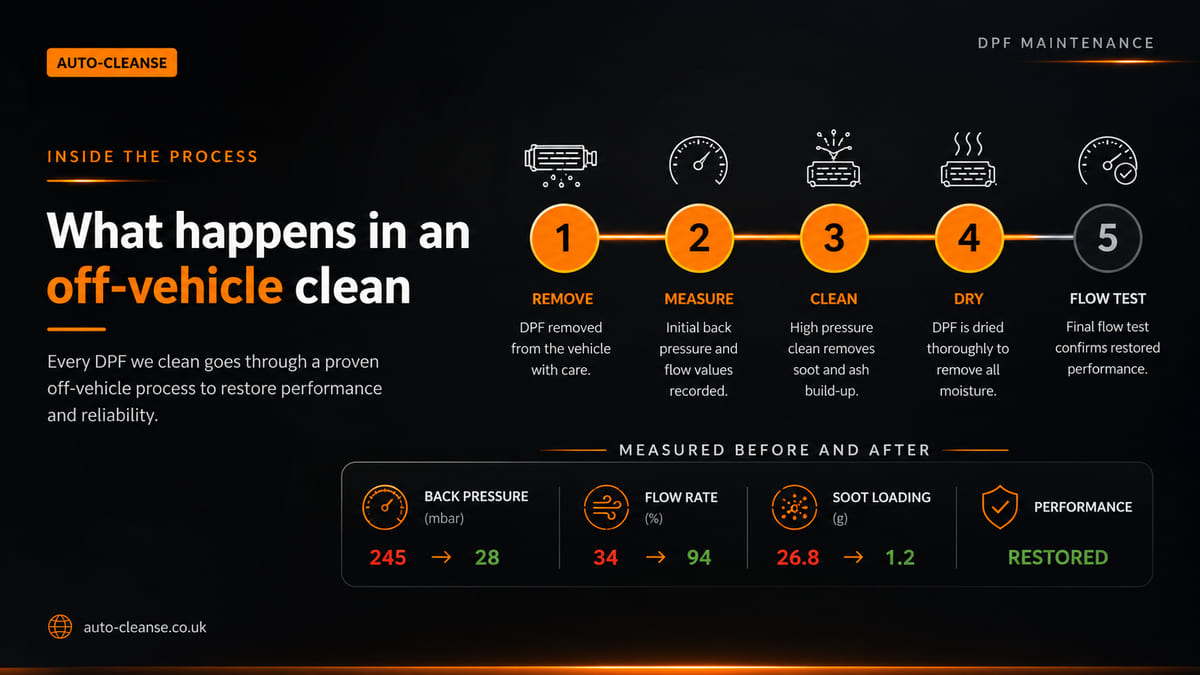
An off-vehicle DPF clean is a workshop process, not a product poured down an exhaust. The filter is removed, inspected, measured, cleaned under controlled conditions, dried, measured again and refitted. Each stage exists for a reason, and the stages that produce evidence matter as much as the one that removes the deposits.
This article deals with the how. Whether a filter should be cleaned at all is a separate decision taken from diagnosis before anything is removed, and we have covered that in when a DPF needs off-vehicle cleaning.
Cleaning removes the deposits. Measurement before and after is what turns that into evidence.
The stages of an off-vehicle clean
1. Removal and identification
The filter is removed following the correct procedure for the application, taking care with clamps, studs, gaskets, sensor hoses and any wiring or probes on the unit. Pressure take-off pipes and temperature sensors are easily damaged by rushed removal.
The unit is then identified and recorded. Construction varies - cordierite or silicon carbide, coated or uncoated, built in with an oxidation catalyst or separate from it - and that affects which cleaning methods are appropriate and how much thermal or mechanical stress the substrate will tolerate.
2. Pre-clean inspection
Both faces of the substrate are inspected for cracking, melting, erosion of the cell walls, internal collapse, a substrate that has moved within its canister, and signs of oil or coolant contamination.
This is where some filters stop being cleaning jobs: a physically damaged substrate cannot be repaired by cleaning, and continuing simply produces a clean filter that still does not work.
3. Baseline flow and pressure measurement
The filter is tested on flow equipment to establish a baseline: air is passed through it under controlled conditions and the restriction it presents is recorded. This is done before cleaning, while the filter is still as it came off the vehicle.
Without that baseline there is nothing to compare against. A photograph of a dirty filter beside a clean one shows a change in appearance; a recorded pre-clean measurement allows a change in flow to be demonstrated, and flow is the property that matters.
4. Controlled cleaning
Cleaning is matched to the filter's construction and to the material being removed, but the principles hold regardless of the method:
- Loosen and release the deposits without imposing mechanical or thermal loads the substrate cannot take.
- Work in the correct direction through the channels, so material is carried out of the filter rather than driven deeper into it.
- Control the process rather than simply increasing pressure, temperature or duration until something shifts.
- Protect the coating. Many filters carry a catalyst coating that aggressive treatment can strip or poison.
Excessive pressure or heat is the quickest way to turn a serviceable filter into scrap. A cracked substrate will still pass air - often better than before - which is why cleaning has to be controlled and inspection repeated afterwards.
5. Drying
The unit is dried through before it goes anywhere near a flow test or a vehicle. Residual moisture skews the post-clean measurement, because a damp substrate does not present the same restriction as a dry one. A filter refitted wet is also left to shed that moisture on the vehicle rather than under control in the workshop.
6. Post-clean flow test and comparison
The same flow test is repeated under the same conditions and compared directly with the baseline. That comparison is the deliverable: same test, same equipment, before and after, with the change stated plainly and judged against the relevant specification where one is published, rather than a vague claim of improvement.
A second visual inspection is carried out at this point, because cleaning sometimes reveals damage that heavy soot and ash loading had been hiding.
7. Refit and system reset
On refit, gaskets and clamps are renewed as required, sensor hoses are refitted correctly and the exhaust checked for leaks - a leak at or near a differential-pressure take-off can produce misleading data from a good filter.
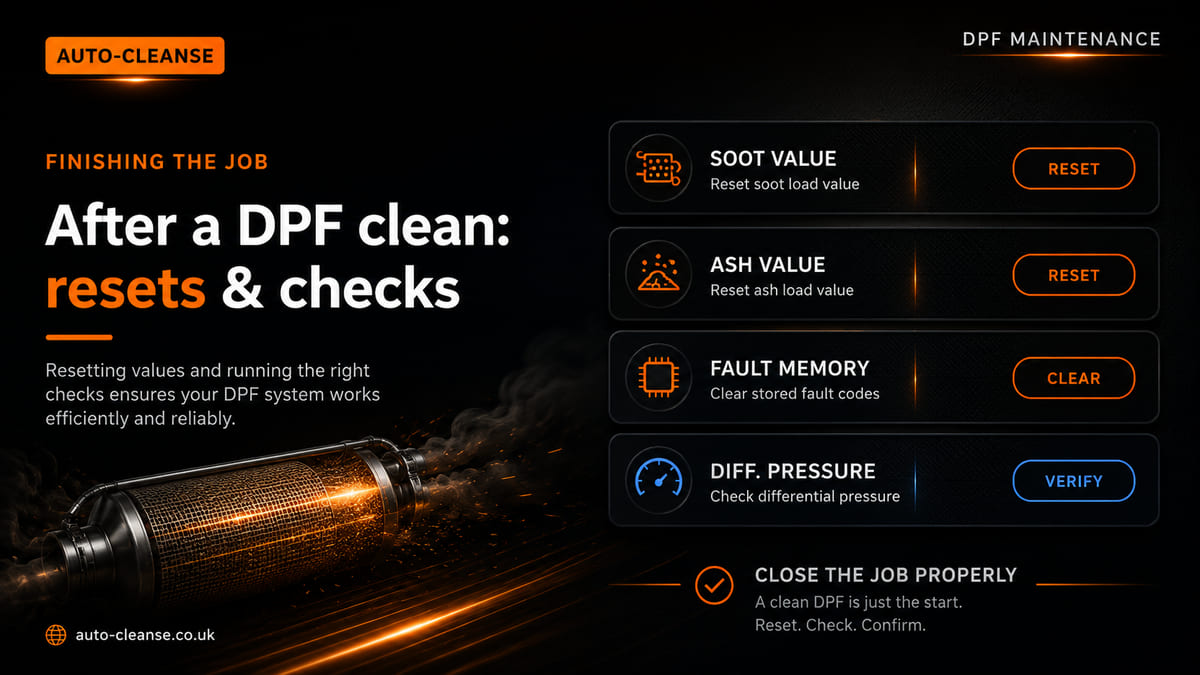
Finally, the vehicle side is addressed: any adaptation, learned soot or ash value, or service reset called for by the manufacturer's procedure is carried out, fault memory is dealt with properly, and the system is checked for plausible live data.
Why the measurement is the proof
Appearance is not performance. Deposits build up along the channels and inside the porous walls, out of sight of the two faces anyone can look at, so a filter can look dramatically better at the face while its restriction has barely moved.
A before-and-after flow figure on the same equipment removes the guesswork. It shows whether the off-vehicle clean achieved anything, and gives an honest answer where it did not.
Common misdiagnosis: "It came back clean, so the problem is solved." A restored flow figure confirms the filter. It does not confirm why the filter loaded up. If an engine, sensor or usage fault caused the blockage, that fault is still there after refitting.
Filters that cannot be cleaned
Cracking, melting, erosion and internal collapse are structural failures of the ceramic. Cleaning cannot restore a substrate that has lost its wall structure, and such a filter may pass air freely while filtering little or nothing.
Severe oil or coolant contamination often sits in the same category, because the material has penetrated the substrate rather than resting in the channels. Where a unit is sent in through our postal DPF service, the same inspection applies before cleaning begins - if it is not a viable candidate, the honest answer is to say so.
The takeaway
A proper off-vehicle clean is defined by what is measured, not by what is sprayed. Inspection decides whether the filter is worth cleaning, and matched before-and-after flow testing decides whether the cleaning worked.
Sources
- Cummins Emission Solutions - aftertreatment maintenance and diesel particulate filter cleaning
- HELLA TechWorld - diesel particulate filter system operation and diagnosis
- Motorservice - particle filter technical information
- Delphi Technologies - diesel aftertreatment service guidance
General technical guidance only. Removal procedures, permitted cleaning methods, flow-test criteria and reuse limits vary by manufacturer, engine and filter construction. Manufacturer workshop information always takes precedence.
Need help with this on your vehicle?
Auto-Cleanse can sort it. See our DPF Cleaning in Devon service, or get in touch.
Related: Nationwide Postal DPF · Blocked DPF Cleaning