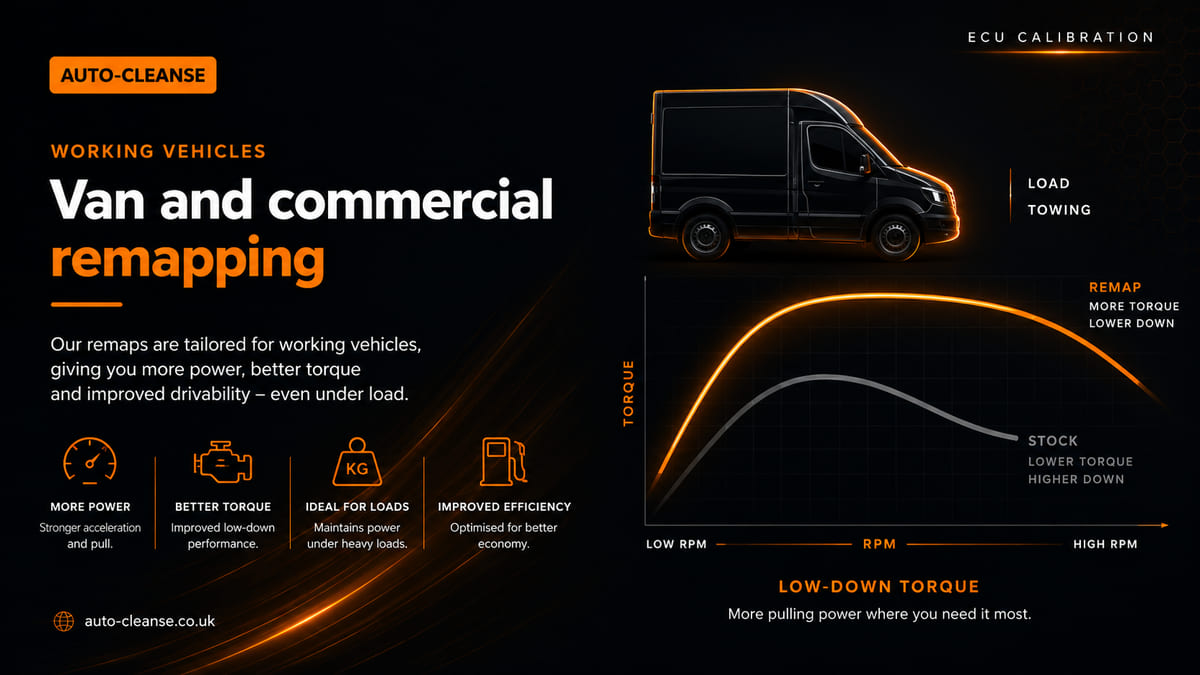
Diesel vs Petrol Remapping: Different Routes to More Power
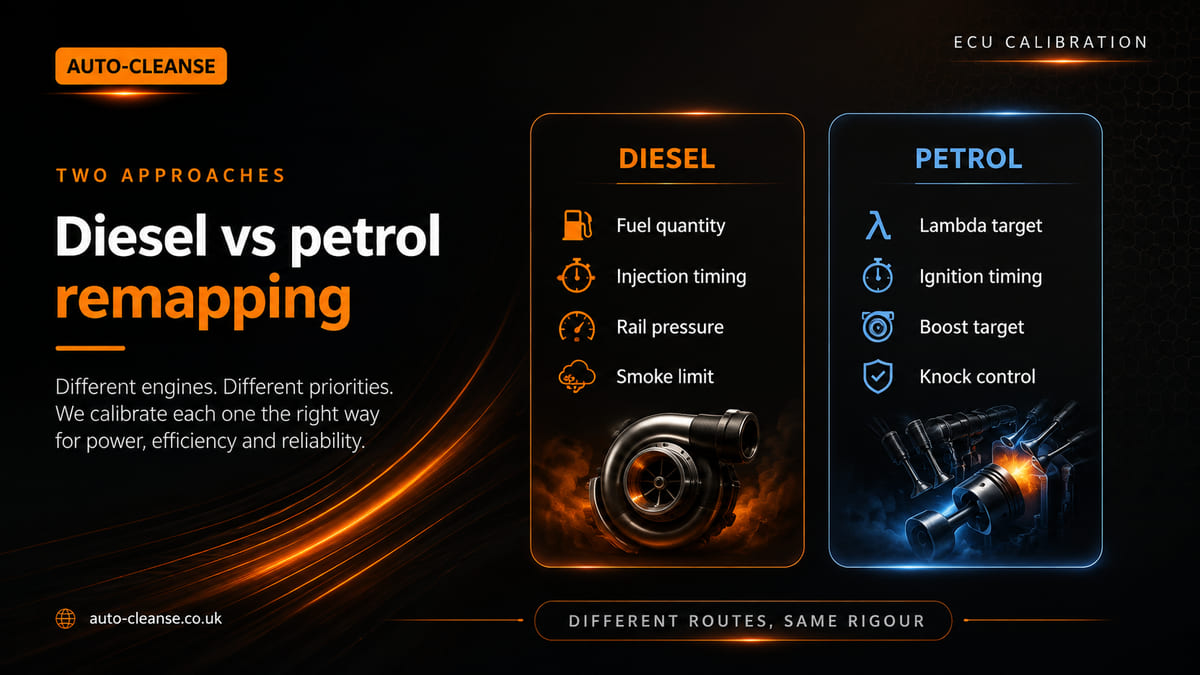
Ask about more power and the answer sounds universal: more air, more fuel, more output. In practice a diesel and a petrol engine get there by quite different routes, because they control combustion in fundamentally different ways - and what physically stops each making more is different too.
Diesel and petrol engines are limited by different things, so the calibration has to solve a different problem on each.
Diesel: quantity-governed and lean-burn
A compression-ignition engine runs essentially unthrottled and lean, with any intake flap there mainly for exhaust gas recirculation rather than load. Load is set largely by how much fuel is injected into the available air charge, and combustion begins when that fuel meets hot compressed air.
Injected quantity, timing and rail pressure
Fuel quantity is the primary load control, and injection timing shapes how that fuel burns. Common-rail systems split delivery into several events per cycle, shaping combustion noise, emissions and pressure rise as well as output. Rail pressure influences atomisation and mixing in the very short time available. They form one fuelling picture, not separate dials, and all must stay within the pump, injector and protection limits.
Smoke and air-mass limitation
Lean burn is also the diesel's main constraint. Inject more fuel than the available air can burn cleanly and the extra becomes particulate - visible smoke on an older vehicle, faster soot loading and more frequent regeneration on a filter-equipped one. Factory calibrations cap fuel against measured or modelled air mass for exactly this reason, and raising that cap does not create the air needed to burn the extra fuel.
Why gains tend to show as mid-range torque
Diesels work over a narrower rev range than petrol equivalents and are often near their airflow ceiling at the top of it. The usable headroom sits in the mid-range, where the turbocharger is already producing meaningful boost, which is why a good diesel result is felt as stronger in-gear pull, not a higher rev limit.
Petrol: throttled and close to stoichiometric
A spark-ignition engine controls load mainly by restricting airflow, and meters fuel to a target air-fuel ratio rather than simply adding more. Across much of the range that target sits at or near stoichiometric, because the three-way catalyst and closed-loop lambda control depend on it.
Lambda targets
This is the point most often misunderstood. The best-torque mixture sits only slightly rich of stoichiometric, so beyond that, adding fuel without adding air gains nothing and just moves the mixture off target. Enrichment under sustained high load is mainly there to manage temperatures and knock margin, not to make power.
Ignition timing and knock control
Spark timing is the petrol calibrator's main lever, limited by knock: uncontrolled auto-ignition of the unburnt end gas. Production ECUs monitor for knock and retard ignition when they detect it, so asking for more advance than conditions allow is usually pulled straight back - or damages hardware where detection cannot react in time.
Fuel quality and ambient conditions
Because the limit is knock, petrol results are more sensitive than diesel to fuel grade, intake air temperature and charge cooling. A calibration is specified against a particular fuel quality; run below it and the knock strategy will normally pull timing, costing performance. That protection assumes the detection is working, so fuel grade is a requirement, not a suggestion.
Common misconception: "It is the same job, just different software." The goal is similar, the constraint is not. A diesel is generally air- and smoke-limited; a petrol knock- and throttle-limited. Different problems, different solutions.
Why turbocharged engines respond more than naturally aspirated
On either fuel, meaningful extra output needs extra air. The difference is whether the ECU has any authority over how much arrives.
- A turbocharged engine has a controllable air supply. Boost is a commanded variable, set by wastegate or variable-vane position, so the calibration can ask for more air within the hardware's capability.
- A naturally aspirated engine's air supply is largely fixed. Airflow follows displacement, engine speed and volumetric efficiency. Variable valve timing gives software a little influence there, but no map conjures air the engine cannot draw in.
- Factory boost targets usually carry margin. Production calibrations allow for varied fuel quality, climates, altitudes and duty cycles worldwide, so a vehicle-specific recalibration usually has room to work.
- The supporting systems still have to cope. Charge cooling, the exhaust, the transmission and the fuel system all have to accept the extra request, which is why a considered Stage 1 calibration looks at the whole vehicle, not one map.
On a naturally aspirated engine the remaining software work is genuine but modest. That is not pessimism; it is why naturally aspirated tuning tends to move towards hardware.
Establishing what you are actually working on
Two vehicles wearing the same badge can carry different engines, ECU hardware and factory software, so confirming the exact application is basic groundwork - a vehicle performance lookup is a sensible starting point. Condition matters as much: a diesel with a restricted filter or boost leak, or a petrol already retarding ignition, will not deliver the intended result from ECU remapping until the fault is fixed.
A calibration change is a vehicle modification and should be declared to your insurer. On a road vehicle the manufacturer's emissions control equipment and its monitoring must also remain in place and working, whichever fuel it burns.
The takeaway
Diesel and petrol calibrations chase the same outcome through different physics: one is bounded by air and smoke, the other by knock and fuel quality. Knowing which limit applies is what separates a considered recalibration from a guess.
Sources
- Bosch Mobility - diesel engine management and common-rail injection technical information
- Bosch Mobility - gasoline engine management and lambda control technical information
- HELLA TechWorld - knock sensor function and ignition system diagnosis
- Motorservice - turbocharger and charge-air system technical information
General technical guidance only. Control strategies and limits vary by engine, ECU and software version, and manufacturer information always takes precedence.
Need help with this on your vehicle?
Auto-Cleanse can sort it. See our ECU Remapping service, or get in touch.
Related: Vehicle Performance Lookup · Stage 1 Remaps in Devon