Why the Original ECU File Must Always Be Backed Up
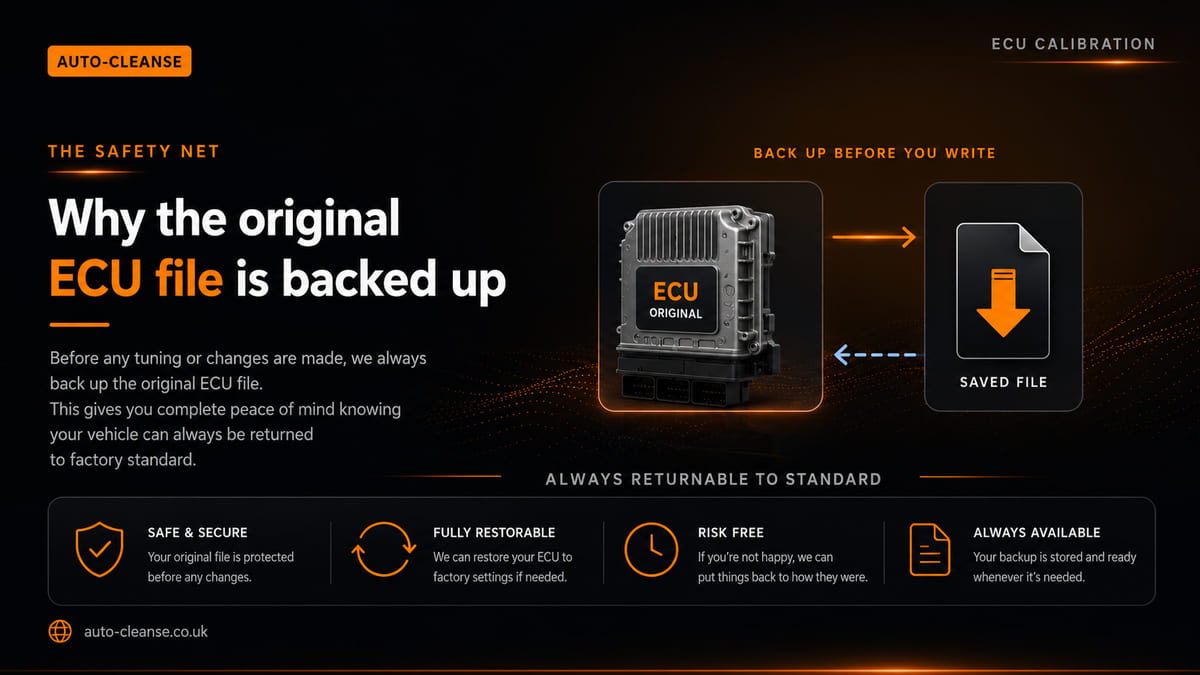
Almost every conversation about remapping is about the modified file - what it changes, what it gains, how it drives. The file that matters more on a bad day is the one nobody discusses: the original calibration read out of that specific ECU before anything was altered. It is the reference point, the recovery route and the record of how the vehicle arrived. Taking that backup is not administration - it is the difference between a reversible job and a permanent one.
A tuner who cannot return your vehicle to exactly the software it arrived with has not left themselves, or you, a way out.
What "the original file" actually means
The original file is the calibration data as it exists in your ECU at the moment it is read - not a generic stock file pulled from a database for the same engine and power output.
Those are not interchangeable. The same model can run different hardware and software revisions across its production life, carry dealer updates, or have had previous work done by someone else. A file that is nearly right is still the wrong file. Only a read taken from the vehicle in front of you is genuinely that vehicle's original.
What the backup is actually for
Returning the vehicle to standard
Owners need standard software back more often than people expect: a main-dealer visit, a warranty discussion, a diagnostic investigation that needs a known baseline, or simply selling the car to somebody who wants it unmodified. With the original stored, that is usually a straightforward write-back. Without it, it becomes guesswork, or buying a file and hoping.
One caveat worth stating plainly. A write-back restores the software that was in the module when it was read, but many systems hold a flash counter or log write events that a calibration change does not reset. Returning a vehicle to standard is not the same as making the work invisible.
Recovering from a failed or interrupted write
Programming an ECU means erasing and rewriting its memory. If that is interrupted - a voltage drop, a disturbed connection, a laptop that decides to sleep - the module can be left in an incomplete state. Recovery means rewriting a known-good file. If none was ever saved for that ECU, recovery becomes considerably harder and sometimes hardware-level.
Isolating a fault after the work
If a driveability complaint appears after a remap, the fastest honest test is to put the standard file back and see whether the symptom follows the software. It is also why vehicle condition is assessed before any remap - so a pre-existing mechanical or sensor fault is not quietly inherited by the calibration.
Replacing or cloning a module
When a control unit has to be replaced, the original holds the data that allows a like-for-like transfer to be attempted, where the application and manufacturer procedure permit it. That is the foundation of any ECU cloning work, and it only exists if somebody took a complete, verified read first.
Checksums: why a file cannot simply be edited and sent back
ECU software contains checksum values that the module uses to confirm its own data is intact. Change map data without correcting the associated checksums and the file no longer agrees with itself.
Depending on the system, the result ranges from a stored fault and a warning lamp to the ECU refusing the data or running in a limited mode. Correct checksum handling is part of producing the file properly, not an optional finishing step. It is one of the standard checks built into a professional trade file service.
Reading and writing: OBD and bench, in general terms
OBD reads and writes through the vehicle's diagnostic connector with the module still fitted. It is quicker and less invasive, but it depends on the vehicle's own communication and security handling, and stays exposed to anything affecting vehicle voltage or the connection.
Bench work involves accessing the module directly on a controlled supply, outside the vehicle's normal running environment. It usually means removing the module, but it gives a stable, isolated setup and access to some ECUs that will not co-operate over OBD.
Neither is universally better. What matters is that the method suits the specific ECU, with a stable supply and an uninterrupted connection throughout.
Common misdiagnosis: "The remap has damaged the ECU." Far more often it was an interrupted or unverified write, a partial read used as the basis for the file, or a generic stock file used in place of the vehicle's own. Calibration content and the programming process are separate failure points and should be investigated separately.
Verifying the read before anything is written
- Confirm vehicle and battery condition. Support the electrical system with a stable supply and check the connection is secure before starting.
- Take a full read, not a partial one. Confirm the read completed and the file is the expected size and structure for that ECU.
- Check the file is coherent. A read that is truncated, mismatched or shows signs of a corrupt transfer is discarded and repeated, not worked on.
- Identify what is already in there. Establish whether the software is genuinely standard or has been modified previously - that changes what "original" means for this vehicle.
- Store the untouched original separately. Keep the raw read archived against the vehicle, alongside any working copies.
- Only then write. Nothing goes back into the module until the backup exists and has been checked.
The takeaway
The original file is the safety net for every ECU job, and it can only be taken once - before the first write. If a backup was not verified and stored, the work was never reversible, whatever the result felt like on the road.
Sources
- Bosch Mobility - engine management and control unit technical information
- HELLA TechWorld - control unit diagnostics and vehicle electrical system guidance
- Delphi Technologies - diesel and petrol engine management diagnostics
- Vehicle manufacturer workshop information - ECU programming and software update procedures
General technical guidance only. Manufacturer-specific workshop information, programming procedures and specifications always take precedence.
Need help with this on your vehicle?
Auto-Cleanse can sort it. See our ECU Remapping service, or get in touch.
Related: Trade File Service · ECU Cloning