Why Does a DPF Block Again After Regeneration?
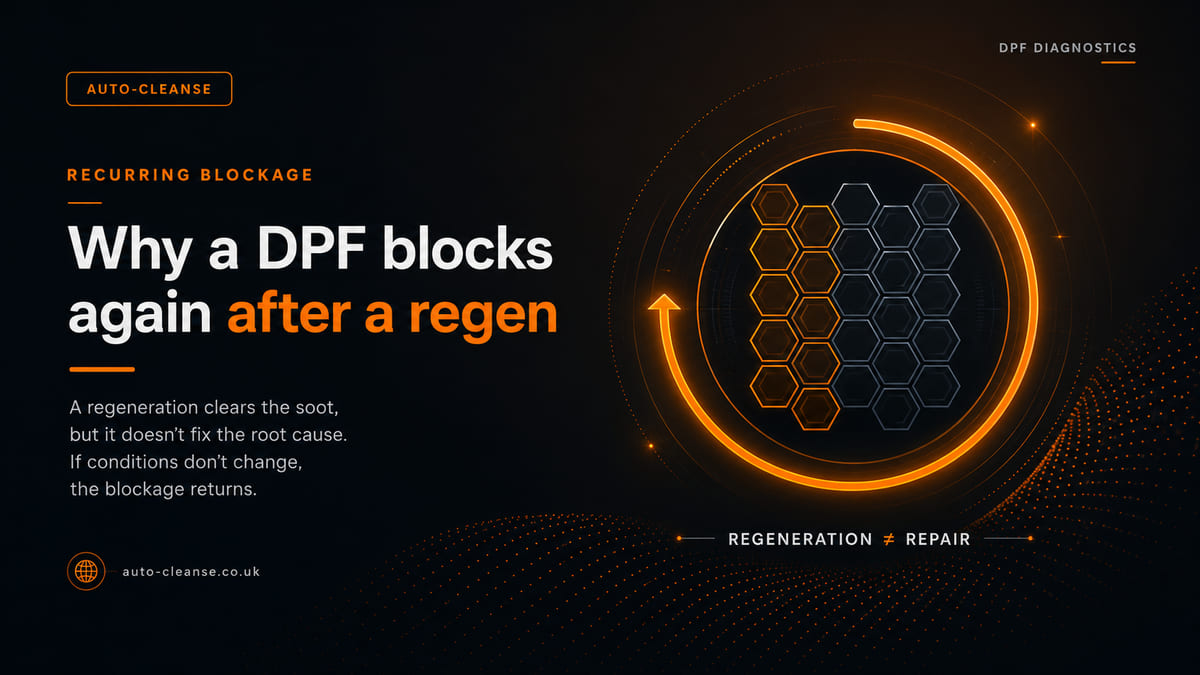
If a diesel particulate filter (DPF) has just completed a regeneration but the warning light returns a few hundred miles later, it is tempting to assume the regen failed. Usually it did exactly what it was designed to do. The catch is that regeneration only manages one part of the picture: soot. It does not remove ash, repair a faulty sensor, change how the vehicle is driven, or correct an engine fault that is producing soot faster than the filter can clear it.
"Regeneration completed" and "DPF system repaired" are not the same conclusion.
What a regeneration actually does
A wall-flow DPF traps particulate matter in its porous structure. During regeneration the filter is brought up to a high enough temperature to oxidise the combustible carbon soot that has collected inside it.
The non-combustible ash left behind by normal engine and lubricant operation is not burned away by that process. It stays in the filter and eventually has to be removed by an appropriate off-vehicle cleaning service, or the filter replaced, in line with the manufacturer's procedure. So a regeneration lowers soot, but it does nothing about ash, and nothing about the reason the soot built up in the first place.
Four reasons a DPF blocks again after a regen
1. Ash or contamination is still present
The soot model can fall after a completed regeneration while a physical restriction remains. Differential pressure and the filter's actual condition still need to be reassessed - a lower soot percentage is not the same as unrestricted flow.
2. The duty cycle has not changed
Repeated short, low-speed or stop-start journeys can stop some systems completing an effective regeneration often enough. If the way the vehicle is used has not changed, the loading simply returns. The exact conditions are vehicle-specific.
3. A control input is implausible
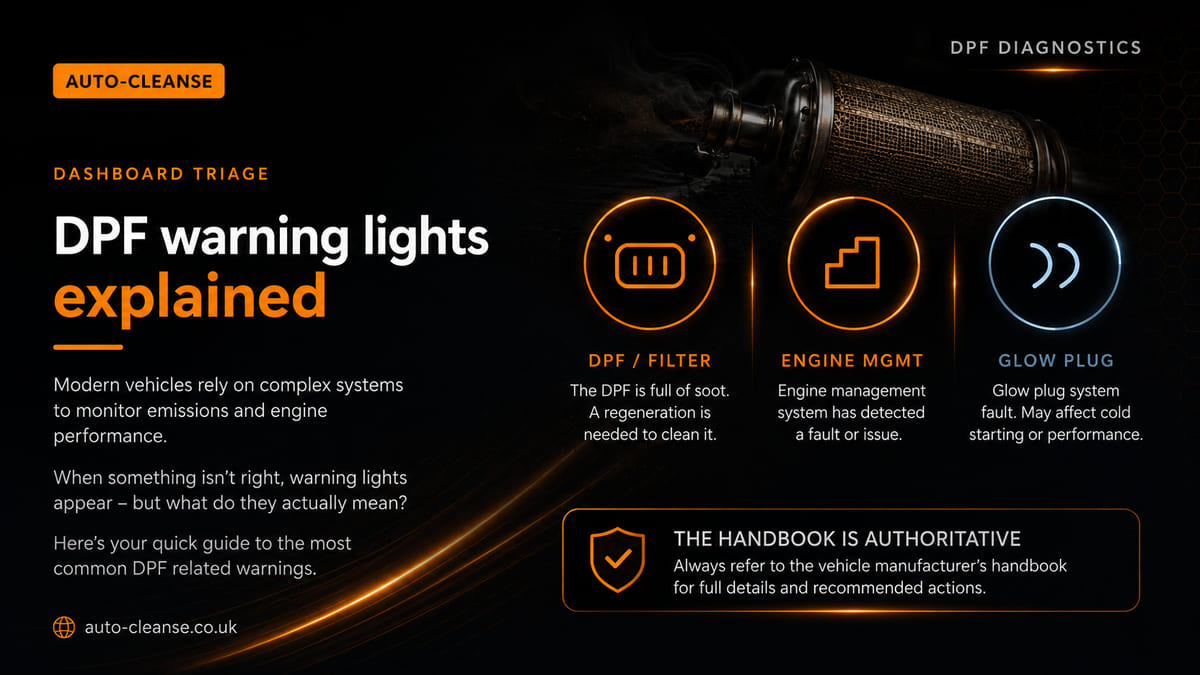
Differential-pressure and exhaust-temperature data are used to monitor loading and regeneration. A sensor, hose, wiring or plausibility fault can disrupt that process and skew the readings the ECU is working from.
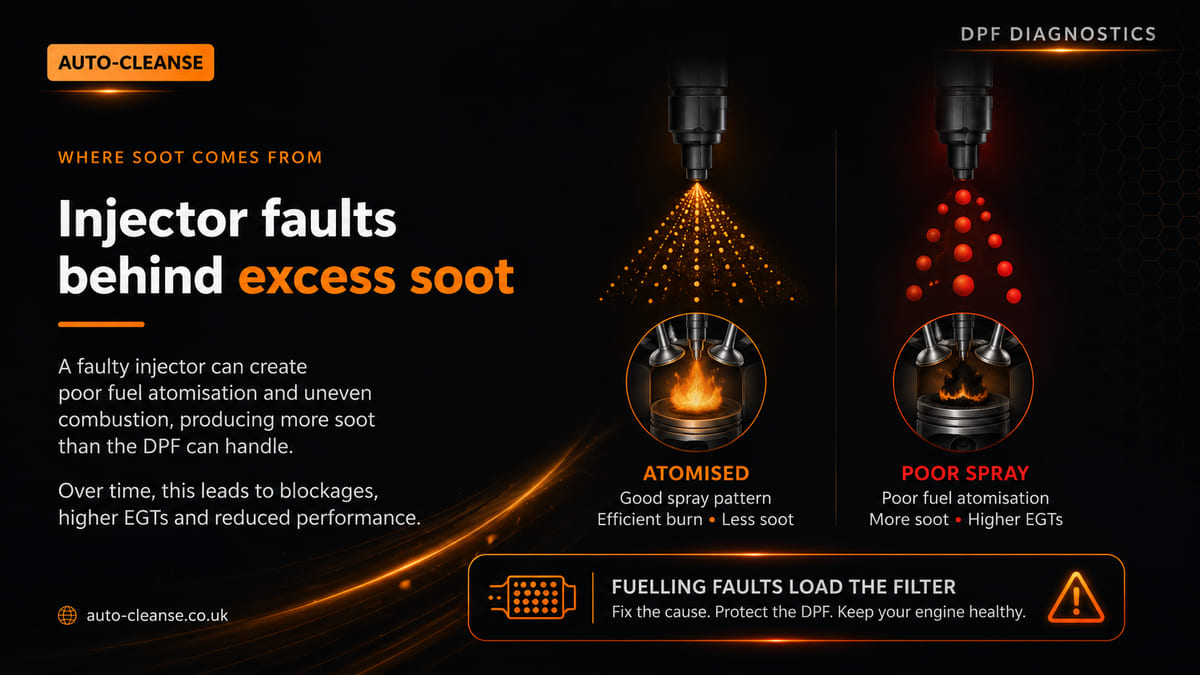
4. The engine is producing soot too quickly
Depending on the application, combustion, injection, air-management, EGR, glow-system or temperature-control faults can raise soot production or inhibit regeneration. The filter is then fighting a losing battle against a fault further upstream.
What to check before calling it fixed
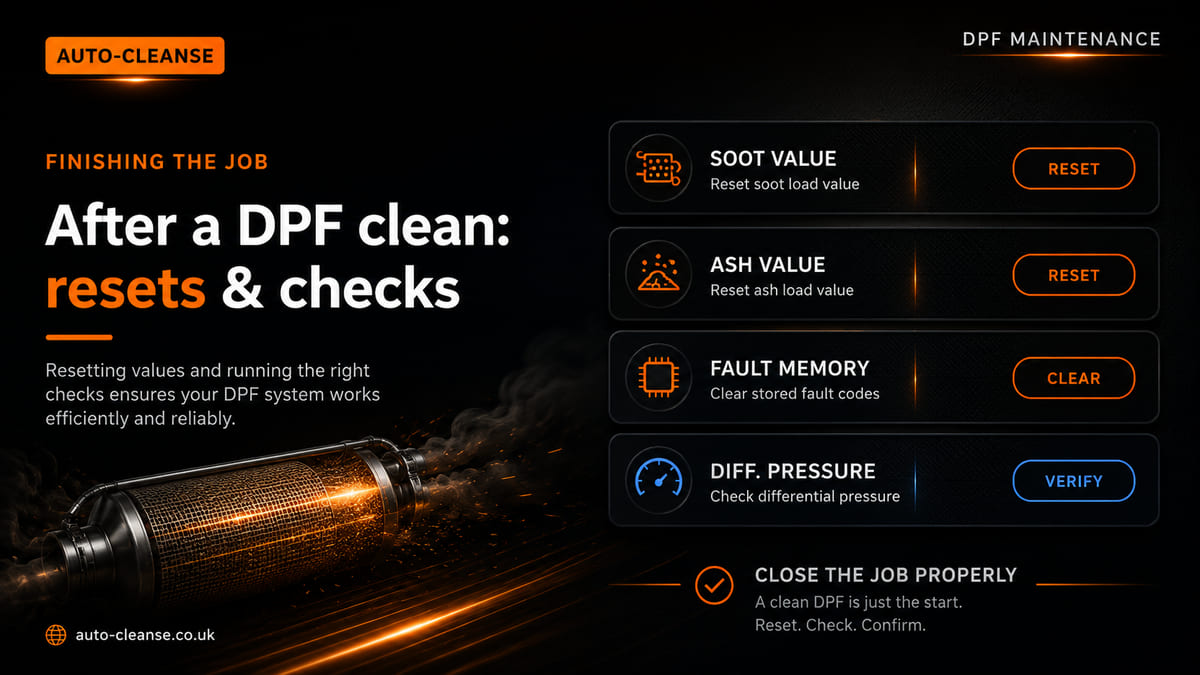
- Read the full fault picture first. Record current and stored DTCs, freeze-frame information and relevant live data before clearing anything.
- Verify the system's enabling conditions. Check the manufacturer procedure, operating temperature, regeneration history and whether any fault is preventing regeneration.
- Check data for plausibility, not just presence. Assess differential pressure, the pressure-sensor hoses, exhaust temperatures and any calculated soot or ash values available on that application.
- Re-test after regeneration. Compare the post-regeneration pressure and operating data against the correct manufacturer specification. A reduced soot percentage on its own is not proof of unrestricted flow.
- Find why the loading occurred. Resolve the underlying vehicle fault or usage issue before returning the vehicle, or the same symptom tends to come back.
Common misdiagnosis: "The forced regeneration completed, so the filter must be fine." A completed routine only shows the commanded event ran to completion. Filter flow, ash loading, sensor plausibility and the original cause all still need to be evaluated.
When off-vehicle cleaning is the right answer
Where a serviceable filter is restricted by ash or non-combustible contamination, removing it for inspection, controlled cleaning, drying and flow testing is the appropriate route - this is exactly what a proper off-vehicle DPF clean is for. A damaged substrate, on the other hand, is a different diagnosis and should not be treated as a routine cleaning job.
The important point is that cleaning follows diagnosis - it does not replace it. If a filter keeps blocking after a regen, the reason for the loading has to be found and fixed alongside the clean.
The takeaway
Treat a DPF warning as a symptom until the evidence shows otherwise. A correct repair confirms both the condition of the filter and the reason the loading happened - resolve only one of those and the warning has a habit of returning.
Sources
- Cummins - Aftertreatment System Fundamentals
- HELLA TechWorld - Diesel Particulate Filter System
- Delphi Technologies - How to Perform a DPF Regeneration
- Motorservice - Particle Filter Technical Information
General technical guidance only. Manufacturer-specific workshop information, test conditions and specifications always take precedence.
Need help with this on your vehicle?
Auto-Cleanse can sort it. See our Blocked DPF Cleaning service, or get in touch.
Related: DPF Diagnostics · DPF Cleaning in Devon