Temperature Data and Failed DPF Regeneration
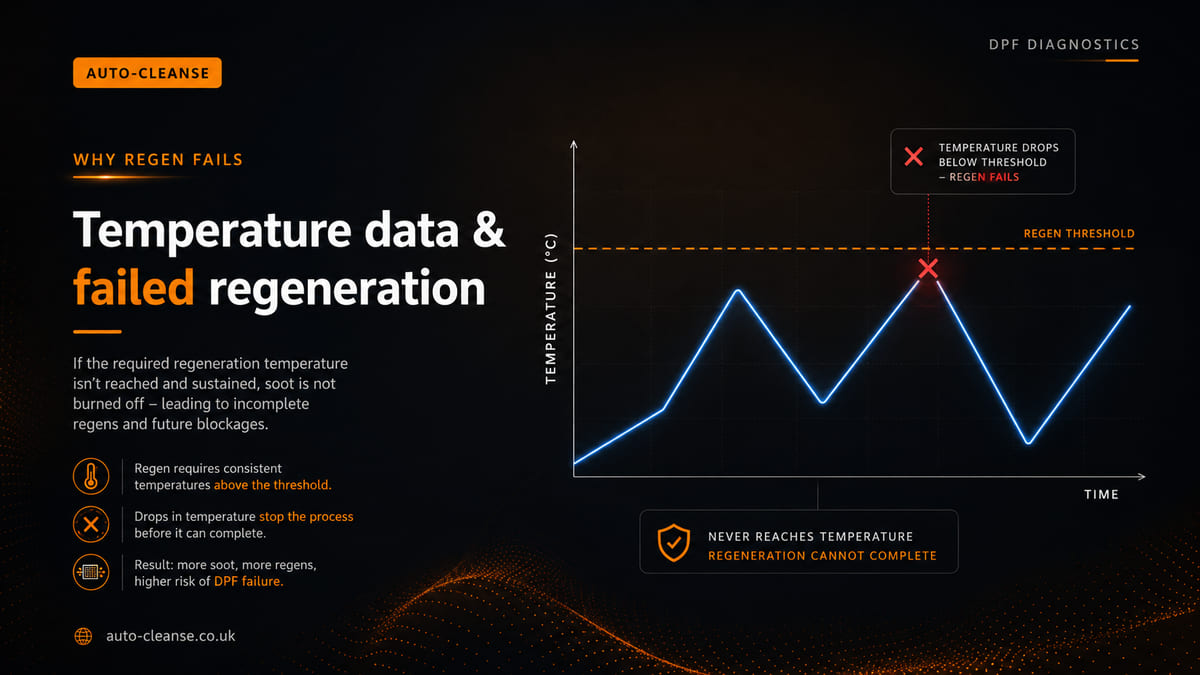
When a DPF regeneration aborts or fails to complete, it is tempting to look straight at the filter. Often the more useful place to look first is the temperature data the ECU was working from. A regeneration is a controlled heat event, and it depends on the engine and exhaust temperature signals being credible before and during the process.
If the ECU cannot trust those inputs, it may not proceed as normal.
A regeneration strategy depends on credible temperature data - one implausible signal can alter, inhibit or abort the process.
Why temperature matters
The ECU needs to know both the engine's operating state and the exhaust heat before it will command or continue a regeneration.
Engine temperature
Coolant temperature is a key engine-management input, and some manufacturer procedures require the engine to be at normal operating temperature before a manual regeneration can even begin.
Exhaust temperature
Exhaust gas temperature sensors feed back the information used to control the regeneration itself, and to protect hot exhaust components from critical overheating.
A temperature shown on a scan tool is the ECU's interpreted sensor value, not a direct physical measurement. A believable reading at one moment does not prove the sensor, its wiring or its response rate is correct under all conditions.
Sensor layout
The number of temperature signals available to compare varies by application. Possible inputs include:
- Engine coolant temperature, used to identify the engine's operating state.
- Exhaust temperature before the turbocharger or catalyst, where fitted.
- Exhaust temperature upstream of the DPF, commonly important for regeneration control and thermal protection.
- Exhaust temperature downstream of the DPF, where the system uses it for monitoring or control.
The number, position and purpose of these sensors vary by engine, emissions system and model year, so the correct wiring diagram and manufacturer test plan for that vehicle should be used rather than assumed.
Cold-start plausibility
Comparing the readings before adding heat is a useful starting point, provided the vehicle has had a genuine cold soak.
- After a genuine cold soak. Compare coolant, intake or ambient data against the available exhaust temperatures and look for obvious disagreement, not perfect equality - different sensor locations and thermal masses mean the values do not have to match exactly.
- During warm-up. Watch the direction, rate of change and stability of each signal. A sensor can be biased, intermittent or slow to respond, and graphing the values through warm-up and a controlled test can reveal dropouts, unrealistic jumps or a signal that fails to follow the engine's operating changes.
Common misdiagnosis: Treating one plausible temperature reading as proof that the vehicle is ready to regenerate. Required temperatures, prerequisites, sensor locations and abort conditions differ between systems, so the correct manufacturer procedure has to be followed for the exact vehicle.
When data is not credible
Where the ECU cannot trust a temperature input, several manufacturers document that it will protect the system rather than continue as normal.
Substitute value or restricted operation
HELLA notes that implausible exhaust-temperature signals can cause emergency operation, or the use of a substitute value, to protect components from overheating.
Regeneration altered or unavailable
Depending on the application and the fault, regeneration may be inhibited, interrupted or ineffective until the temperature fault or an unmet prerequisite is resolved. A vehicle in this state can present in much the same way as a blocked DPF, even though the filter itself may be undamaged.
A documented example
HELLA documents a case on the Vauxhall Astra K 1.6 CDTI where DPF regeneration was not possible with P2080 and P2084 invalid exhaust-temperature signal faults stored. The same case notes that if the sensors and their peripheral circuits test correctly, an ECU software issue may need to be considered - a code naming a temperature sensor does not automatically mean the sensor itself has failed.
Diagnostic sequence
Six checks worth working through before the filter is blamed, as part of a full DPF diagnostic check:
- Read the full fault memory and save freeze-frame or event data before clearing anything.
- Confirm the exact sensor names, locations and reference data for that vehicle.
- Compare temperature plausibility from cold, then graph the signals through warm-up.
- Inspect connectors, wiring, heat damage, sensor mounting and relevant exhaust-system integrity.
- Check every manufacturer prerequisite and reason for regeneration inhibition or abortion.
- Repair the cause, repeat the correct test, and verify that temperature response and regeneration behaviour are credible.
Repeated forced regeneration is not a substitute for understanding why the required conditions or temperatures were not achieved. Where the ECU is reporting an active fault, invalid data, excessive loading or another abort condition, the manufacturer procedure should be followed rather than commanding the same process again. Fitting a filter or booking an off-vehicle clean will not resolve a fault sitting in the temperature-sensing circuit.
The takeaway
A regeneration cannot be assessed from soot and pressure data alone. Engine temperature, exhaust-temperature plausibility, sensor integrity and the exact manufacturer prerequisites all need to be confirmed, since the filter may only be the symptom while a temperature fault is preventing the system from managing it correctly.
Sources
- HELLA Tech World, Checking the exhaust gas temperature sensor
- HELLA Tech World, Exhaust gas aftertreatment design and diagnostics
- HELLA Tech World, Vauxhall Astra K particulate filter regeneration not possible
- Ford Motor Company, Diesel Particulate Filter Manual Regeneration
- Bosch Mobility, Temperature sensor for a wide temperature range
- DENSO, Exhaust Gas Temperature Sensors
General technical guidance only. Exact sensor locations, target values, prerequisites and regeneration procedures should always be taken from the correct manufacturer information for the vehicle.
Need help with this on your vehicle?
Auto-Cleanse can sort it. See our DPF Diagnostics service, or get in touch.
Related: Blocked DPF Cleaning · DPF Cleaning in Devon