After a DPF Clean: Resets, Relearns and What to Verify
A properly cleaned diesel particulate filter goes back on the vehicle in far better condition than it came off. That does not, on its own, finish the repair. The engine control unit has been building its own picture of a loaded filter, and unless that picture is corrected where the manufacturer procedure calls for it, the ECU can carry on managing a restriction that is no longer there.
Refitting is a mechanical task. Returning the aftertreatment system to a known-good state is a diagnostic one, and the two need to be treated separately.
A clean filter and a corrected ECU picture are two halves of the same repair.
Refitting: seal it properly before anything else
Every check that follows depends on the exhaust being gas-tight. A leak either side of the filter distorts the readings you are about to rely on, so this comes first.
Gaskets, clamps and fastenings
Use new gaskets and, where specified, new clamps, nuts, studs or V-band hardware rather than reusing distorted parts, and tighten to the manufacturer's torque figures and sequence. Heat-cycled fasteners often need replacing outright, and a clamp that feels tight is not the same as a joint that is correctly loaded.
Sensor take-offs and hoses
Differential-pressure hoses, unions and any restrictors must go back on the correct ports, routed as originally fitted and clear of heat sources. Check them for softening, splits, kinks and soot blockage while they are accessible. A swapped, split or blocked hose can produce a pressure signal that looks plausible on a scan tool but is wrong.
Temperature sensors, wiring and shields
Refit exhaust temperature sensors to the correct positions and reconnect the looms without strain. Heat shields protect wiring and hoses, so put them back. Run the engine and check the joints for leaks before the vehicle goes anywhere.
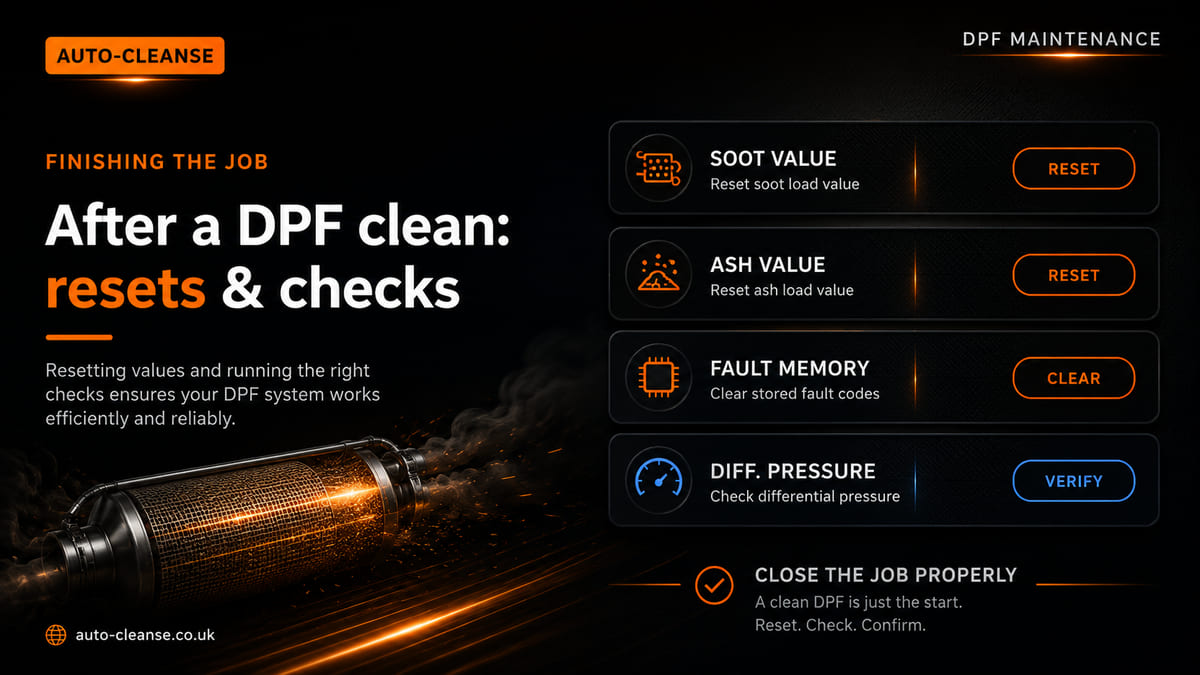
Resetting or relearning the soot and ash values
This is the step most often skipped, and the one that most often undermines an otherwise good repair.
On many applications the ECU does not measure soot and ash directly. It maintains calculated loading values built from fuelling, running conditions and regeneration history, cross-checked against differential pressure. Once a filter has been cleaned and refitted, those stored values no longer describe the part on the vehicle.
Leaving them in place has predictable consequences:
- The ECU still thinks the filter is loaded. It may command regeneration sooner than necessary, adding heat, fuel dilution and unnecessary cycles.
- Ash counters keep climbing from the wrong starting point. On systems that use an ash figure to schedule service or replacement, the vehicle can reach a warning or limp condition despite a serviceable filter.
- Later diagnosis becomes unreliable. Anyone comparing calculated loading against measured pressure is then working from a value that was never corrected.
The correct procedure varies by manufacturer. Some require a specific reset or replacement routine, some an adaptation or relearn, and some a service function that will only run when particular conditions are met. Follow the workshop information for that vehicle rather than clearing whatever a generic tool offers, and record what was reset. If the tooling cannot perform the required routine, that is a reason to arrange the correct equipment, not to skip the step. This is where proper DPF diagnostics earns its keep.
Common misdiagnosis: "The light came back, so the clean must have failed." Very often the clean was fine and the stored loading values were never reset, so the ECU carried on managing a filter that no longer exists in that condition.
Verifying differential pressure at the specified test points
With the system sealed and the values corrected, check the pressure signal at the manufacturer's test points and operating conditions rather than a single idle figure, and against the specification for that engine and filter combination.
The useful questions are whether the signal sits sensibly with the engine off, whether it responds smoothly as flow increases, and whether it agrees with the condition of the filter you have just handled. A reading that disagrees with everything else points at a sensor, hose or leak rather than the substrate. Where flow data is available from an off-vehicle DPF clean, it is worth having alongside as a record of what the filter was capable of before refitting.
Confirming a clean fault memory
Re-scan every relevant module, not just the engine ECU. Record what is present, resolve the causes rather than simply clearing codes, then clear and re-check after running the engine. Pending and intermittent entries matter: a fault that reappears after a short run is telling you something the first scan did not.
Road testing to confirm normal behaviour
The final proof is the vehicle behaving normally in use. A structured road test should bring the system up to normal operating temperature, cover the conditions the manufacturer associates with regeneration, and let you watch pressure, temperature and loading data develop together.
What you are looking for is consistency: loading that rises at a sensible rate and, where a regeneration occurs during the test, one that runs and completes with pressure returning to a plausible figure afterwards. A road test will not always produce a regeneration, so treat the result as evidence rather than proof. Where a filter has been sent away and returned, as with a postal DPF clean, this on-vehicle verification cannot be posted anywhere.
The takeaway
A cleaned filter only delivers what it should if the exhaust is sealed, the stored soot and ash values are corrected to the manufacturer procedure, and the result is verified by data and a road test rather than assumed.
Sources
- Bosch Mobility - diesel engine management and exhaust aftertreatment
- HELLA TechWorld - particulate filter systems and pressure sensor diagnosis
- Motorservice - particulate filter technical information
- Delphi Technologies - diesel aftertreatment service and regeneration
- Manufacturer workshop information - vehicle-specific reset, adaptation and test procedures
General technical guidance only. Manufacturer-specific workshop information, test conditions and specifications always take precedence.
Need help with this on your vehicle?
Auto-Cleanse can sort it. See our DPF Cleaning in Devon service, or get in touch.
Related: DPF Diagnostics · Nationwide Postal DPF